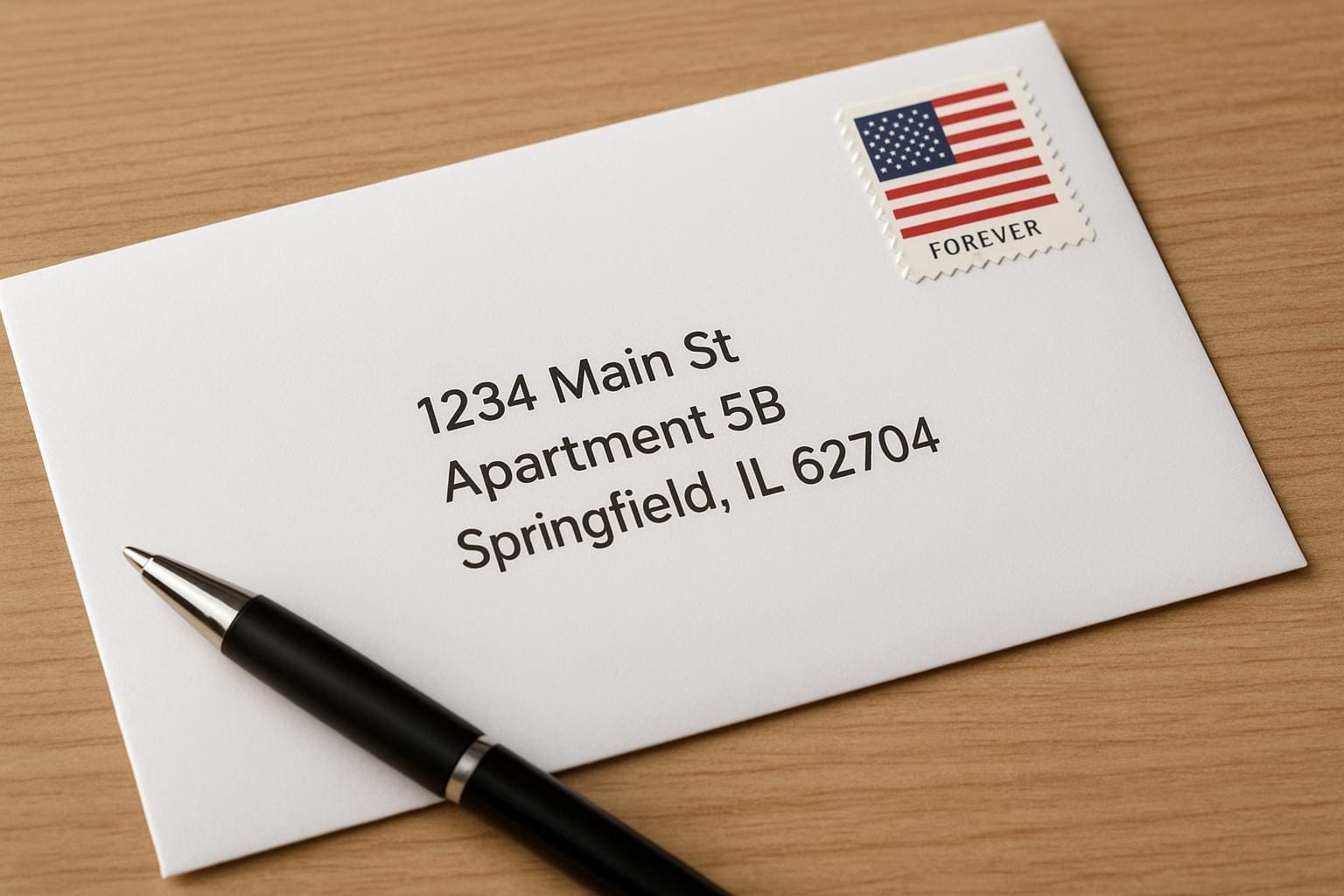
## Apartment Address Format USPS: How To Write It Right
If a package or letter never shows up, the first place to look is the line that tells the carrier where to leave it. The postal system is strict about where each piece of information goes. Use the apartment address format usps and you’ll cut down on misdelivered or returned mail.
USPS has rules for a reason: machines read addresses first, humans handle exceptions later. Put the unit designator in the wrong spot or misspell the street number and automation will route it wrong or spit it back. Below I’ll walk through the practical rules, give real examples, and show how to handle weird cases like multi-building complexes, PO Boxes, and online forms.
### Why Format Matters
Machines and scanners are part of every step in sorting. They look for patterns: number, street name, unit designator, city, state, ZIP. If your apartment number is buried or has unusual punctuation, it may not register. That’s when mail ends up delayed or returned. Using the correct apartment address format usps makes the address easy for automation and for the carrier when they’re on the route.
## Basic Rules For Apartment Lines
### Put The Apartment On The Same Line When Possible
USPS prefers the secondary unit designator on the same line as the street address. That means this is good:
123 Main St Apt 4B
and this is even better for automation:
123 MAIN ST APT 4B
Avoid putting the apartment in parentheses, after a comma, or on the line with the city. Keep it with the street number and name.
### Use Standard Unit Designators
Use APT, UNIT, STE, BLDG, FL, or # where appropriate. A few examples:
– APT 4B
– UNIT 12
– STE 200
– BLDG 3
– FL 2
Don’t invent words like “Room” or “ApartmentNo.” Stick to the standard USPS abbreviations so sorting systems and carriers instantly recognize the meaning.
### No Punctuation, All Caps Works Best
USPS addressing guidelines recommend no punctuation. Commas and periods can confuse optical character recognition. Capital letters are recommended for machine readability, though your envelope won’t be rejected for lower case. An ideal formatted line looks like:
JOHN DOE
123 MAIN ST APT 4B
SPRINGFIELD IL 62704-1234
Use the ZIP+4 when you can; it reduces ambiguity.
## Examples: Correct Vs Incorrect
### Correct
JOHN DOE
123 MAIN ST APT 4B
SPRINGFIELD IL 62704-1234
### Incorrect
John Doe, 123 Main Street, Apt. #4B, Springfield, IL 62704
The second version has punctuation and long forms that machines might not parse cleanly.
## Filling Online Forms: When There’s A Separate Apartment Field
Most web forms give you a first address line and a separate apartment or unit line. Put the street address on the first line and the apartment number on the second line using the designator:
Address Line 1: 123 Main St
Address Line 2: Apt 4B
If the form only has one line for address, add the apartment after the street: 123 Main St Apt 4B. If there’s a character limit and you must shorten, discard commas and unnecessary parts first.
### When The Form Forces A Single Line
Some legacy forms collapse everything. In that case, make sure the unit designator is immediately after the street information. This is cleaner and more likely to be read by software:
123 Main St Apt 4B Springfield IL 62704
But don’t put the city on the same line if the form has a separate fields for city and state.
## Apartment Versus Suite: Why It Matters
An apartment address is residential; suite numbers typically imply business. For carriers and sorting, that can change routing inside a building. If you live in a building with both businesses and residents, using APT versus STE helps the carrier know where to deliver.
– Use APT for residential spaces.
– Use STE for business offices or commercial suites.
If your building uses “Unit” or “Bldg” in internal signage, reflect that in your address if it’s official. For example, in a campus with multiple buildings:
CAMPUS HOUSING
456 College Ave Bldg 5 Apt 210
COLLEGE TOWN NY 10001
## USPS Apartment Address Specifics To Keep In Mind
### ZIP+4 Can Help But Isn’t Always Apartment-Specific
A ZIP+4 improves accuracy. It narrows delivery to a block, a side of the street, or even a single building. It won’t necessarily be unique for every apartment, but entering the ZIP+4 tied to your building is helpful. Use the USPS ZIP Code Lookup to find the right code.
### Don’t Use PO Box If You Have An Apartment Number
If you live in an apartment, don’t combine PO Box and apartment info. If you rent a PO Box instead of receiving mail at your apartment, use the PO Box format:
JOHN DOE
PO BOX 1234
CITY ST 12345-6789
If you want mail delivered to your apartment, never put a PO Box and apartment number on the same address. Pick the correct method.
### What If Your Building Uses A Separate Mailroom Address?
A building may want mail addressed to a mailroom or to “C/O Front Desk.” Follow building instructions. If the mailroom accepts packages and your landlord requires a specific format, write what they require, then add your apartment number. For example:
JOHN DOE
C/O FRONT DESK 123 MAIN ST APT 4B
CITY ST 12345
Make sure your building’s internal policy matches USPS rules so carriers aren’t confused.
## How Carriers Handle Apartment Complexes
### Key Information For Carriers
A carrier needs three things to deliver reliably: building number, street name, and unit number. If any is missing, delivery may stall. For large complexes, carriers rely on internal unit maps. If your apartment number changed because of a renovation, notify the post office and building management immediately.
### When Packages Are Held Or Returned
If a delivery fails, carriers will often leave a notice. Common causes:
– Missing or wrong apartment number
– Illegible handwriting on the label
– Incompatible size for mailbox
– Restricted access to building
If you see frequent misses, check the address formatting and confirm that the ZIP+4 matches the building.
## Common Mistakes That Cause Returns
### Leaving Off The Unit Number Entirely
This is the number one mistake. If the street has multiple units, the carrier has no way to tell which one. Always include APT 4B or equivalent.
### Using Nonstandard Abbreviations
Stuff like “#4B” is okay in casual contexts, but some systems prefer APT 4B. If you use “#”, make sure the form or label can accept it. Best practice: use standard abbreviations.
### Typing The Apartment In The City Field
On some forms people stuff the apartment into the city field because the address line fills up. Don’t do that. Put apt info on the address line or second address line, never with city/state.
### Wrong ZIP Code
ZIP codes change occasionally. Use the USPS lookup tool. A single-digit error can send mail to a different town.
## How To Verify An Address With USPS Tools
USPS provides tools to validate addresses and find ZIP+4 codes. Use them before sending irreplaceable documents. The tools will standardize the format in USPS preferred style, which helps avoid returned mail.
– USPS ZIP Code Lookup
– Address Validation APIs (for businesses)
– Local post office for tricky cases
Use these if you manage mass mailings or if your address gives delivery problems.
## Special Cases And Edge Conditions
### Multi-Building Complexes
If the complex uses building numbers, include them. The format may look like:
123 Campus Way BLDG 7 Apt 12
Sometimes the official address lists the apartment under a different street name. If in doubt, check the building management or USPS.
### Rural Routes
If you’re on a rural route rather than a numbered street, the format changes. Use RR or HC format as instructed by USPS. Rural addressing has its own set of rules and often a required box number.
### Military Addresses
APO/FPO addresses have their own structure. Include the rank and name, unit number, and proper APO/FPO label. The unit is critical—military mail uses it to route through the base.
For international shipments to US apartments, format the US destination line as USPS prefers and then add any foreign requirements on the customs form. Keep the apartment info clear on the US address lines.
## Business Mail And Amazon-Style Deliveries
Companies that ship a lot of packages should validate addresses programmatically. If you’re a seller or run a small business, use the USPS standardized format in your shipping labels. For example, Amazon and other carriers often accept “#” but if you use printed labels, follow the USPS style to minimize scanning errors.
## When In Doubt, Ask Local Post Office
If your building has unusual addressing—units labeled differently, internal unit numbers, or historical quirks—ask the local post office. They’re the ones routing your mail. Provide proof like your lease or building map and request guidance on the exact line format.
## Practical Tips For Sending Important Mail
– Print labels instead of handwriting when possible. Human handwriting adds variability.
– Use the ZIP+4. It matters.
– Verify the street suffix abbreviations (St, Ave, Rd). Wrong suffixes can point mail to the wrong block.
– If you’re sending legal or time-sensitive documents, double-check the recipient used the correct apartment address format usps and confirm the apartment number directly.
### A Couple Of Real Examples
Example 1 — Apartment resident using a common web form:
Name: SARAH MILLER
Address 1: 789 Oak St
Address 2: Apt 2A
City: OAKLAND
State: CA
ZIP: 94607-1234
Example 2 — Single-line label:
MARK JONES
1024 Elm Rd Apt 5C
FAIRVIEW NJ 07022
Example 3 — Mailroom delivery instruction:
JANE DOE
C/O MANAGEMENT 234 Pine Ave Apt 304
RIVERTON TX 76010
These all follow USPS style and make life easier for automated sorting and carriers on the street.
## Handling Returns And Misdelivered Mail
If you get mail that’s not yours or mail is missing, record tracking numbers and contact the sender. For persistent misdelivery, report it to your post office. They might update routing for your building or correct the master address file.
If you receive someone else’s mail, write “Not At This Address” on the envelope and drop it back in the mailbox. Don’t cross out the address—doing so can make it illegible to machines.
## Final Practical Notes On The Format
– Keep the recipient line clear and complete.
– Put apartment/unit designator directly after the street address.
– Use standard USPS abbreviations and ZIP+4.
– When a website separates address lines, use the second line for the apartment number.
– Confirm with local post office for unique building conventions.
Using the right apartment address format usps is not about following rules to be tedious. It’s about getting mail where it belongs without delay. If you’ve ever waited for an important package that didn’t arrive, there’s a good chance a small formatting error was the culprit. Fix that, and you’ll cut down on trips to the post office and the time spent on hold. Plus, carriers will thank you for clear, readable lines.
### Where To Learn More And Tools To Use
USPS has online resources for standardizing addresses and getting ZIP+4 codes. For businesses, address validation APIs automate this work. For individuals, a quick ZIP Code lookup before sending something important is often enough. If the building uses internal identifiers, get the official wording from management so your address matches what the carrier expects.
Keep your address simple and precise and you’ll avoid the common pitfalls that send mail awry. And remember to double-check the apartment number—most delivery problems start and end there. If you still have issues, go talk to your carrier or local office; they can often tell you what to change so your mail, packages, and ballots arrive on time.
(By the way, if you need a quick check, run the address through the USPS lookup and you’ll see the standardized version ready to copy. It’s a tiny step that prevents a lot of headaches. Also, don’t forget to recieve notifications if a carrier attempts delivery and can’t access your building.)