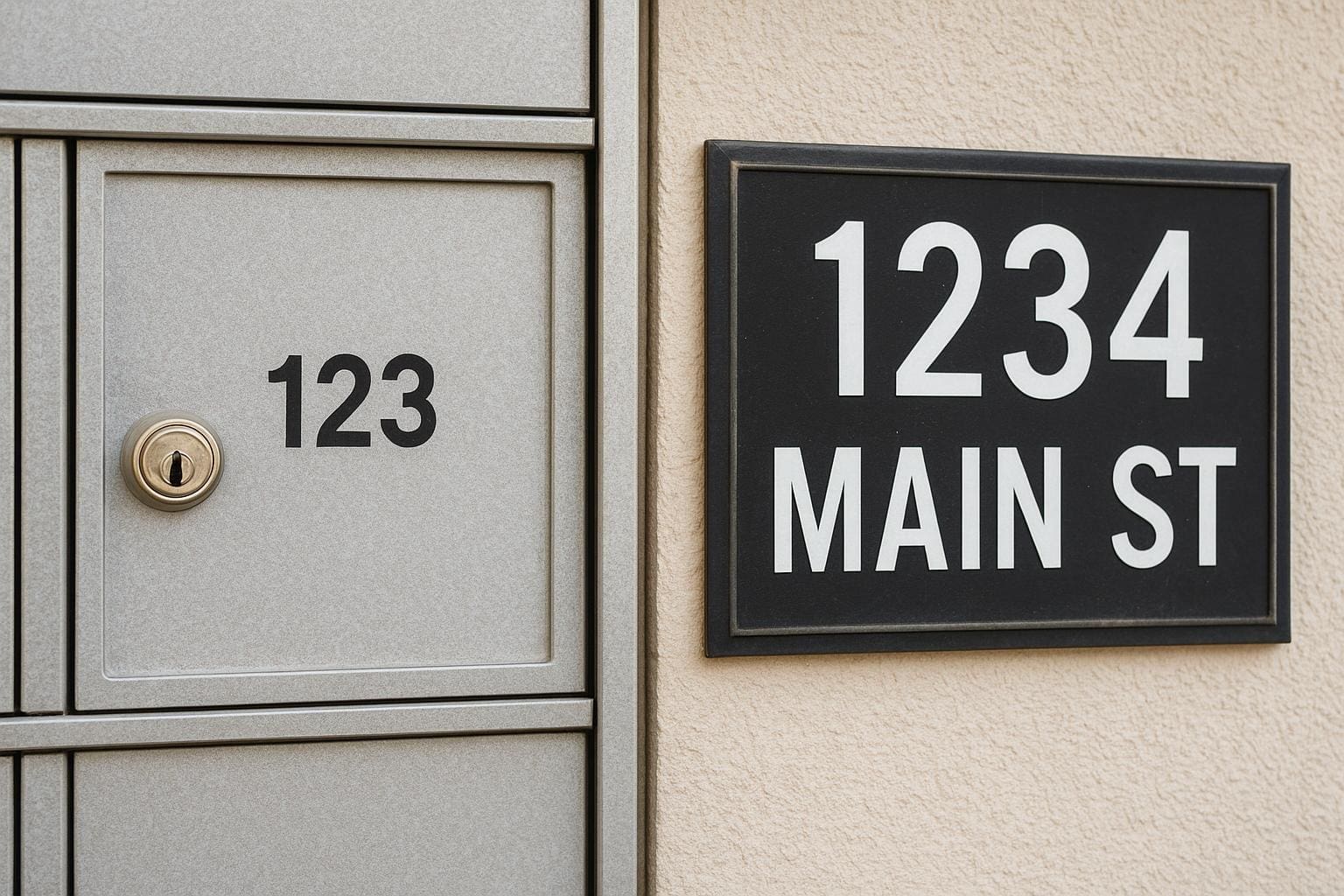
## Po Box Vs Street Address For Business: Weighing The Trade-Offs
Choosing between a PO Box and a street address is dull on paper, but it shapes everything from customer trust to whether your packages ever arrive. The decision isn’t about “which is better” in the abstract. It’s about which solves the real problems your business faces right now and which lets you scale without surprise headaches. Here’s how to think about it.
### How The Two Options Work In Practice
A PO Box sits at the post office. You rent a numbered box and pick up mail during business hours. Simple. It’s private and cheap. It’s also limited: packages from couriers like UPS or FedEx sometimes won’t be delivered, and many banks and government agencies won’t accept a PO Box for registration or verification.
A street address is any physical location that can receive deliveries—an office, storefront, warehouse, or mailbox at a commercial mail receiving agency (CMRA). It’s what customers expect for deliveries and legal filings. It also serves as proof of presence in a locality for permits, licensing, and bank verification.
### Who Should Pick A PO Box
A PO Box shines for tiny operations where cost and security beat accessibility. Consider these cases:
– A sole proprietor who runs an online craft shop from home and wants to avoid publishing a home adress on the website.
– A seasonal vendor who needs a cheap, reliable place to receive invoices and letters.
– A hobbyist selling low-volume items where couriers aren’t a major factor.
PO Boxes are low-profile and fairly inexpensive. They remove the risk of customers or suppliers showing up unannounced at your home. If you mainly receive letters and small envelopes, a PO Box does the job.
### When A Street Address Is Necessary
If customers expect deliveries, if you need to accept courier packages, or if you must register with banks and regulators, get a street address. Situations that push you toward a street address:
– You sell physical goods that require FedEx, UPS, DHL, or same-day delivery.
– You rent a co-working space or storefront and need a public-facing location.
– You’re applying for an employer identification number (EIN), certain licenses, or opening a business bank account that requires a physical address.
A street address signals legitimacy. Clients, suppliers, and partners often treat a business at a physical address more seriously than one that lists only a PO Box.
### The Reality Of Compliance And Banking
Banks and state authorities tend to prefer street addresses. When you’re setting up an LLC, registering for state taxes, or opening a merchant account, a physical address can be mandatory. Banks use street addresses for identity verification and fraud prevention. If you try to open an account with a PO Box as your primary address, expect extra hoops or outright rejection.
This isn’t bureaucracy for its own sake. Financial institutions need ways to tie a business to a geolocation for risk assessment. A street address provides that. If you can’t list your home, consider virtual office services that provide a real street address you can use for banking and registrations.
### Customer Perception And Brand Signals
Look at websites. Which one are you more likely to trust: a company that lists a PO Box as its only contact or one that lists a street address and hours? People read addresses as data about legitimacy.
That said, some businesses intentionally hide a home address behind a PO Box because privacy is more important than appearing brick-and-mortar. The trade-off is clear: privacy versus perceived credibility.
### Shipping And Package Delivery Nuances
PO Boxes are fine for letters and small USPS parcels. But couriers often require a street address. Many e-commerce platforms default to showing shipping options that depend on the delivery address; if your business address is a PO Box, customers may be prevented from selecting ground shipping with certain carriers. That creates friction at checkout.
If your business depends on returns, replacements, or receiving supplier shipments, a street address usually wins.
#### Handling Large Volumes And Mixed Mail
If you foresee a mix of letters, catalogs, and frequent courier deliveries, using a street address—or a commercial mail receiving agency that accepts courier parcels for you—is less of a headache. You pay more, but your operations run smoother.
### PO Box Alternatives That Fit Between Cheap And Professional
Not everyone needs a full office, but many need more capability than a PO Box. Here are practical po box alternatives to consider: virtual mailboxes, UPS mailbox services, rented office mail services, and coworking addresses.
A virtual mailbox scans incoming mail and shows it to you online. You can request opening, scanning, shredding, or forwarding. This is great for remote founders who travel. UPS and other CMRAs give you a real street address and accept courier deliveries. Coworking spaces often let you list their address for mail and provide meeting rooms by the hour.
Each of these po box alternatives costs more than a basic PO Box, but they solve specific problems—package acceptance, professional presentation, and remote access to mail contents.
### Cost Comparison: Dollars And Time
A PO Box is cheap. You can rent one for under $100 per year in many locations. A virtual mailbox or CMRA is more expensive—typically several hundred dollars a year for reliable services. Renting a physical office or storefront is far costlier.
Don’t forget hidden costs. Time matters. If you’re spending hours driving to the post office to pick up mail, that’s an expense. If missed courier deliveries force you to reschedule or lose inventory, that’s an expense too. Sometimes paying extra for a service that accepts all delivery types is cheaper in practice.
### Legal Address Versus Mailing Address: A Distinction That Matters
Your mailing address is where you receive correspondence. Your legal or registered address is what government entities use for official contact and where legal notices can be served. In many jurisdictions, a PO Box cannot serve as the registered address for a corporation. You might need to list a physical location even if you use a PO Box for day-to-day mail.
The term business mailing address often shows up in forms. That’s the address you expect to receive mail at. It can be a PO Box, but if the form specifically asks for a “principal place of business” or “registered office,” they typically want a street address.
### Privacy And Safety Considerations
Publishing a street address exposes you to more direct contact. If you work from home, that might be undesirable. For service providers who meet clients at neutral locations, a PO Box or one of the po box alternatives keeps their home private.
But also consider records and subpoenas. A PO Box doesn’t shield you from legal process; it just changes the way documents are served. Law enforcement, process servers, and official notices will still find their way to you through other channels.
### Case Studies: Which Choice Fits Which Business
– Local Coffee Shop: Needs deliveries of coffee beans and equipment. Must pass health inspections. A street address is necessary.
– Freelance Graphic Designer Working From Home: Wants privacy and minimal mail volume. A PO Box or virtual mailbox makes sense.
– E-Commerce Retailer Shipping Boxes Nationwide: Needs couriers and returns handling. A street address or CMRA that accepts courier parcels is essential.
– Startup With Remote Team And Investor Visibility: Wants a professional address for pitch decks and incorporation documents. A virtual office providing a street address or coworking mail service can bridge the gap.
### Practical Steps To Decide Today
Figure out what you actually receive now and what you expect to receive in six months. If shipments are rare and mostly letters, a PO Box is fine. If you’re scaling inventory or expect to sign contracts and need bank accounts, prioritize a street address.
Call your bank and the state office. Ask whether a PO Box will be accepted for your specific filings. Check popular carriers you’ll use and confirm whether they deliver to PO Boxes in your region.
### How To Combine Both: Hybrid Approaches That Work
You don’t have to be all-in on one choice. Many small businesses use a hybrid approach: list a street address for registrations and customer-facing pages, and use a PO Box for certain invoices and personal mail. Virtual mailbox services can reroute or scan selected items so you control what arrives physically.
Using a CMRA to get a street address while keeping a PO Box for sensitive correspondence merges security with functionality. That’s often the pragmatic middle ground.
#### Practical Example Of A Hybrid Setup
A photographer lists a virtual office street address for client bookings and bank account registration. They also maintain a PO Box for personal correspondence and vendor invoices. Large deliveries from suppliers go to a rented studio when needed.
### Common Misconceptions That Trip People Up
People often assume PO Boxes protect them from all solicitation. They don’t. Junk mail, marketing flyers, and inquiries can still be associated with a business through other public listings. Conversely, having a street address doesn’t automatically mean better search rankings or instant credibility. Reputation is built by reviews, responsiveness, and consistent branding.
Another myth: PO Boxes are inherently anonymous. They’re not; the post office keeps records, and in many legal contexts you must disclose your real identity.
### Implementing A Change Without Disruption
If you switch from a PO Box to a street address, notify vendors, banks, and customers. Update your website, invoices, and registrations. If you’re changing registered addresses, follow your state’s procedures to amend filings. Use mail forwarding for a transition period so nothing gets lost.
If you adopt one of the po box alternatives, test the service with a few trial shipments before committing. Send a high-value package and a regular invoice to make sure they treat both reliably.
### The Role Of E-Commerce Platforms And Marketplaces
Marketplaces like Amazon and Etsy sometimes treat addresses differently. Amazon sellers, for example, often need to verify locations for tax and performance reasons. Some platforms block checkout options if a PO Box is entered. When you set up shipping profiles, test the checkout flow as a customer to see if your listed address causes unexpected results.
Keep in mind that returns are frequently the pain point. If you sell on multiple channels, ensure your returns process works with the address you provide.
### Final Practical Advice For Most Small Businesses
For a one-person operation with low mail volume, start with a PO Box or a virtual mailbox. It’s inexpensive and keeps your home private. If you sell physical goods, accept regular courier deliveries, or need to register with banks or state agencies, invest in a street address—either by renting space, using a CMRA, or subscribing to a virtual office.
Remember to think beyond price. Time, customer experience, compliance, and risk of missed deliveries are often more expensive than the rental fee. And if you need a middle path, explore po box alternatives until you find a setup that fits your workflow and budget.
### How To Choose A Provider Without Getting Burned
When evaluating virtual mailboxes or CMRA providers, look for: clear pricing, sample scans, secure storage, and a local street address rather than a PO Box. Read reviews about package handling. Ask about insurance for lost packages. Check if they allow you to add authorized users so employees can pick up mail without complications.
If you need bank or legal acceptance, confirm the provider’s reputation with those institutions. Some virtual address services are specifically designed to meet verification requirements; others aren’t.
### Changing Addresses Later: What To Watch Out For
Changing your adress, whether it’s to a street address or a virtual office, means updating tax registrations, bank accounts, vendor records, and web listings. Missing one of these can cause billing errors, lost mail, or compliance flags. Use a checklist and allow overlap with mail forwarding for at least 60 days.
Keep a log of who you notified, including dates. That small habit saves hours during audits, renewals, and vendor disputes.
### Quick Workflow Checklist To Decide
– List current mail volume and types (letters, small parcels, large couriers).
– Identify required registrations and whether they accept a PO Box.
– Tally direct costs and estimate time cost for pickups and missed deliveries.
– Trial a po box alternative if you need package handling but don’t want a full office.
– Confirm bank and marketplace requirements before deciding.
Pick the option that maps to your operational realities, not just your budget. The right choice shifts paperwork, customer experience, and cash flow in tangible ways. If you’re unsure, start with a lean solution that can scale: a virtual mailbox or CMRA often buys time without locking you into a full office lease. And remember, a tiny investment now can prevent a big problem later.