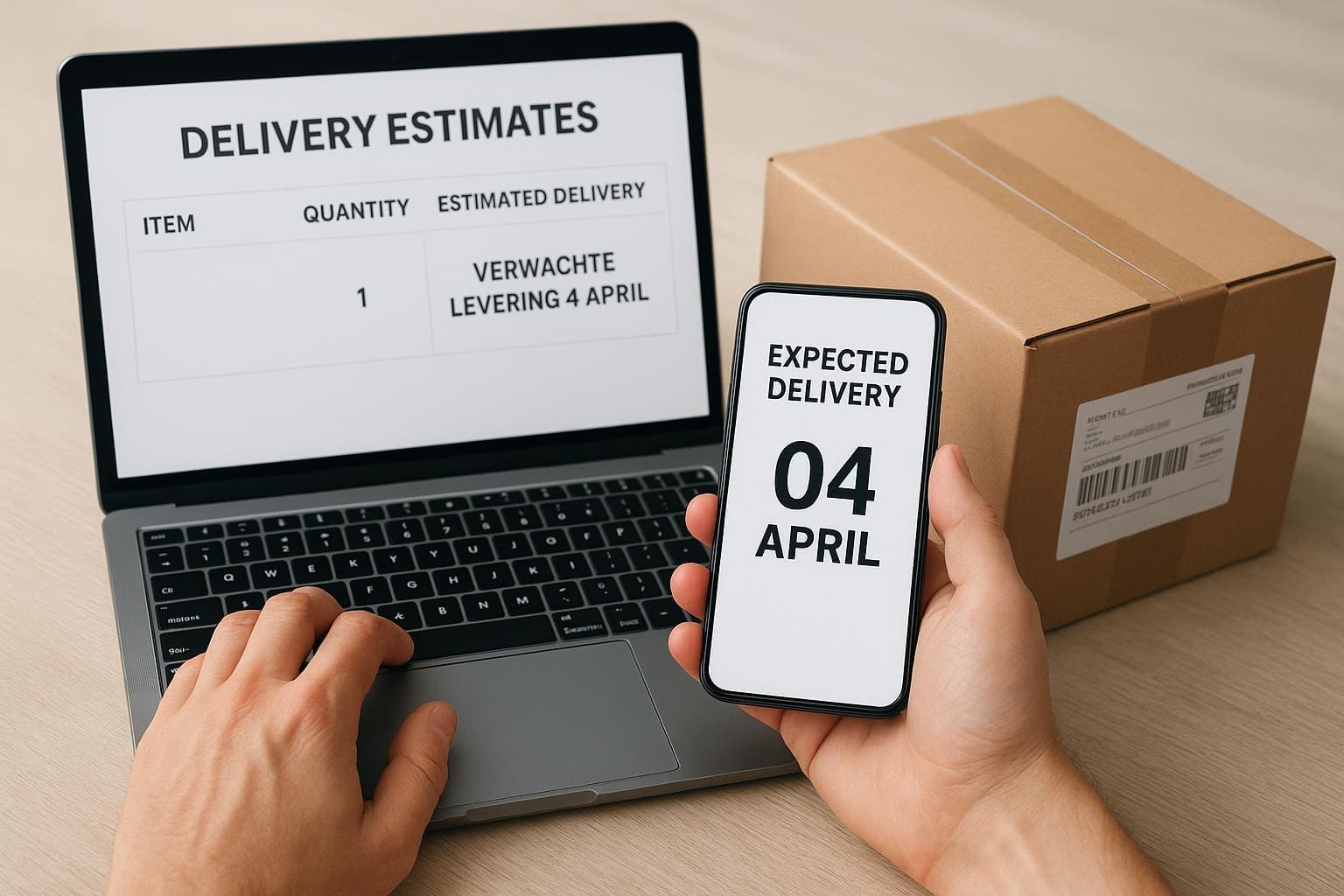
## How Delivery Estimates For Ecommerce Orders Work
Delivery estimates for ecommerce orders are not a single math problem you solve once and forget. They’re a moving target built from several pieces: the time your warehouse needs to process the order, the carrier’s pickup and transit time, any customs clearance for international shipments, and last-mile variables like weather or local delivery capacity. Put those pieces together and you get a range or a date a retailer can reasonably promise.
At the simplest level, delivery estimates for ecommerce orders fall into a few common formats: a single promised date, a delivery window (for example, 3–5 business days), or a dynamic ETA that updates after the parcel ships. Each format tells the customer slightly different things. A single date looks confident but is only accurate if everything goes right. A range admits uncertainty but can feel vague. A dynamic ETA is the most accurate in practice, but it requires integration with carriers and real-time tracking data.
## The Components That Make Up An Estimate
### Processing Time And Cutoff Policies
Processing time is the minutes-to-days your team needs to pick, pack, and hand the parcel off to a carrier. That time changes with inventory, staffing, and order complexity. If you show a ship date in your cart, be explicit whether that means the order leaves the warehouse that day or the next business day. Cutoff times matter too. Orders placed before a cutoff may ship the same day; those after wait until the next. Be concrete about timezones.
### Carrier Transit Times And Service Levels
Carriers publish transit tables, but those tables assume ideal routing. Two-day service might be two business days from pickup to delivery, but not from when the customer clicks buy. If your carrier has limited departure flights or weekend pickups, transit stretches. Also, international carriers often hand off to local couriers, which adds unpredictability.
### Inventory Location And Multi-Warehouse Logistics
If inventory is spread across fulfillment centers, the chosen fulfillment site affects the estimate. A product in a nearby micro-fulfillment center can deliver in a day. The same SKU held only in a factory-adjacent warehouse might take longer. Smart routing that picks the closest fulfillment source is basic but often mishandled.
### External Factors: Weather, Holidays, And Customs
Storms and peak-season surges are the silent killers of promises. Customs checks for cross-border shipments can add several days unpredictably. Build buffers for major holidays and known weather patterns. Don’t assume carriers will absorb the delay without passing it downstream.
### Returns, Exchanges, And Reverse Logistics
Delivery estimates for ecommerce orders should also consider the reverse trip when you promise “fast exchanges.” If your policy requires items to be returned before a replacement ships, the customer timeline includes that outbound leg. If you pre-ship replacements and accept returns later, the estimate looks shorter but increases your inventory risk.
## How To Calculate Delivery Estimates For Ecommerce Orders
### Start With Clear Data Inputs
A usable estimate needs these data points: current fulfillment center stock levels, average pick-and-pack time per SKU, carrier pickup schedule, published transit times by ZIP or zone, and the customer’s address type (residential vs. commercial). Put that data into a basic model first, then refine.
### Use A Layered Buffer System
Don’t rely on single-point buffers. Use three layers: operational buffer (warehouse variability), carrier buffer (transit variability), and external buffer (holidays, weather). For instance, if your best-case calculation gives two business days, you might communicate a 3–5 business day window after adding layered buffers.
### Account For Peak Variability
Run scenario simulations for peak conditions. Peak season doubles processing times in many operations. Model what happens if your processing time increases by 50 percent, or if a carrier delays pickups by one day. Those scenarios reveal when a promised date becomes risky.
### Combine Static And Dynamic Elements
Static elements are things you know before shipment, like warehouse processing. Dynamic elements arrive after pickup, such as carrier scans and route optimization. The best approach is a hybrid: show an initial, honest estimate at purchase, then update the customer with a dynamic ETA after the first carrier scan.
### Use Historical Performance, Not Just Published Times
Published transit times are a starting point. Your store’s actual performance against those times is more valuable. Track historical on-time rates by carrier and region and weight your estimate toward reality. If Carrier A hits two-day service 70 percent of the time to a given zone and Carrier B hits it 90 percent of the time, let that inform which service you offer.
## Ecommerce Delivery Estimates: Presentation That Builds Trust
### Be Specific With Language
Customers respond to specifics. “Arrives by Friday, April 9” is stronger than “arrives in 3–5 days.” If you must use a window, explain what determines the lower and upper bounds. For example, “3–5 business days (orders placed before 2pm ET ship same day).” That last clause anchors the range.
### Offer A Choice Between Speed And Cost
Don’t pretend a single option fits all. Show the fastest option up front and a lower-cost slower option. When shoppers can choose, even if they pick the slower option, they feel informed and are less likely to be upset when the package arrives later than the fastest date would have promised.
### Use Real-Time Tracking Where Possible
A dynamic ETA that updates from carrier scans reduces uncertainty. After the parcel ships, show a countdown or an estimated delivery day that adjusts when delays occur. This transparency lowers inbound support requests and calms customers when things change.
### Display Service Limitations Upfront
If certain ZIP codes or remote regions routinely take longer, flag those during checkout. It’s better to warn than to surprise. If an item ships from overseas and requires customs clearance, add a note explaining typical customs times and the possibility of extra days.
### Be Cautious With Guarantees
Guarantees reduce complaint costs but increase financial exposure. If you guarantee delivery by a date, back it with compensation rules that are fair and sustainable. Alternatively, offer a “delivery on time or we’ll cover the shipping” style promise but define the limits clearly.
## Writing Copy That Doesn’t Overpromise
### Use Plain Sentences
Avoid marketing fluff. Say: “Standard delivery: 4–6 business days” and then add a clarifying sentence: “This estimate assumes the item is in stock and orders ship from our U.S. warehouses.” Short, factual lines work better than flowery promises.
### Explain Trade-Offs Briefly
When customers choose express shipping, confirm what that actually changes: “Express shaves one day in transit and ships the same day if ordered before 1pm local time.” The customer then understands the trade-off between cost and time.
### Keep Refund/Return Statements Short And Visible
If delays trigger refunds or expedited reshipment, state that plainly. Place the policy near checkout and again in the order confirmation email.
## Handling Delays And Exceptions Without Losing Customers
### Communicate Early And Often
When a delay happens, notify customers immediately with a concise explanation and next steps. For example: “Your shipment hit a weather delay. We now expect delivery on Tuesday. We’ll refund expedited shipping if you paid for it.” Early transparency reduces frustration.
### Provide Clear Remedies
Have a simple compensation ladder: partial refund, full refund, discount code, or reshipment. Make the remedy visible in communications so customers know you’re fixing things. Where possible, automate eligibility checks to speed resolutions.
### Train Customer Service On Timing Language
Equip reps with precise language that matches what customers saw at checkout. If you said “3–5 business days,” reps should not tell customers “it should be there tomorrow” unless they can confirm it via tracking. Consistency across touchpoints matters.
### Learn From Exceptions
Log every significant delay and its root cause. Over time you’ll see patterns: a carrier struggling in a certain region, a fulfillment center with intermittent staffing issues, or a specific SKU that always slows orders. Use that data to change routing, carriers, or stocking strategies.
## Metrics To Watch And Tools That Help
### Essential Metrics
– On-Time Delivery Rate: Percentage of orders delivered by the promised date.
– Promise Accuracy: How often your initial estimate matched the actual delivery window.
– Customer Contact Volume: Number of inquiries related to timing.
– Refunds And Credits Issued For Late Deliveries.
Track these by carrier, service level, fulfillment location, and geography. If a carrier shows a low on-time rate in a region, you either change carriers in that zone or adjust the promise.
### Tools That Improve Estimates
Carrier APIs provide real-time tracking and transit time matrices. Shipping platforms and TMS solutions can centralize carrier performance stats and compare cost versus speed. Predictive ETA services use machine learning on historical carrier scan data to give more accurate ETAs than static tables. Use these tools to push dynamic updates to customers after the package ships.
### Small Investments With Big Returns
A small investment in better routing logic or a predictive ETA integration often yields a big drop in customer inquiries. For example, implementing zip-to-zone routing so orders ship from the closest fulfillment point can shave days off many routes with minimal operational change.
## Common Mistakes Companies Make With Delivery Estimates
### Promising What You Don’t Control
Don’t promise same-day delivery if your warehouse lacks reliable same-day pickups. Promises that rely entirely on carriers’ best-case performance tend to break during stressed conditions.
### Hiding Complexity From Customers
Simplifying is good; hiding is not. When a shipping quote excludes customs, duties, or third-party delays, say so. Surprises are the main source of complaints.
### Using A Single Estimate For All SKUs
A blanket “2–4 business days” for everything is easy, but rarely accurate. Heavy items, bulky cartons, or items shipped from a factory will have different realities. Segment estimates by product type or fulfillment location.
### Ignoring Historical Data
If you have a habit of estimating based on carrier brochures rather than your own delivery history, you’re setting yourself up for disappointed customers. Historical performance tells the true story.
## How To Experiment With Your Estimates
### A/B Test Wording And Format
Try showing a specific date versus a window for a subset of traffic and measure conversion and returns. Some customers prefer a single date; others prefer a range. Let data guide the format.
### Test Buffer Sizes
Experiment with different buffer amounts and measure changes in complaints and conversions. Too-large buffers depress conversions; too-small buffers increase service costs and refunds.
### Trial Alternative Fulfillment Strategies
Run pilot programs with local pickup, parcel lockers, or micro-fulfillment centers in dense areas. These often allow tighter delivery promises for a segment of your customers without overhauling the whole operation.
## When To Escalate A Policy Change
Change your public promises when you see sustained slippage in on-time rates or when you add or remove a major carrier or fulfillment site. If average transit increases by a business day in a region for more than a month, update the estimate to reflect reality. Customers forgive companies that adjust transparently more than those that persist with the same broken promise.
## Example Messaging Scenarios
#### Order Confirmation With A Range
“Your order will arrive in 3–5 business days. We’ll ship from the nearest warehouse; orders placed after 2pm ET may ship the next business day.”
#### After Carrier Scan With Updated ETA
“Good news — your order is on its way. Current ETA: Friday, April 16. We’ll update you if anything changes.”
#### Delay Notification
“We hit an unexpected delay due to local weather in the carrier network. New expected delivery: Tuesday, April 20. If you paid for expedited delivery, we’ll refund that charge.”
## Final Practical Tips
Put a clock on your promises. If the customer sees a specific date, confirm that you have the processes and vendor performance to meet it. If you choose ranges, define what affects the endpoints. Automate what you can, but keep a human escalation path when exceptions require judgment. Customers notice honesty. If you consistently under-promise and over-deliver, you build trust faster than with polished but unrealistic promises. Remember: good delivery promises are as much about communication as about logistics. And when in doubt, check the scans before you answer an impatient inbox — the tracking will usually tell the truth even when the system that created the estimate did not. Recieve feedback from front-line reps regularly and adjust the models; they see the patterns first.