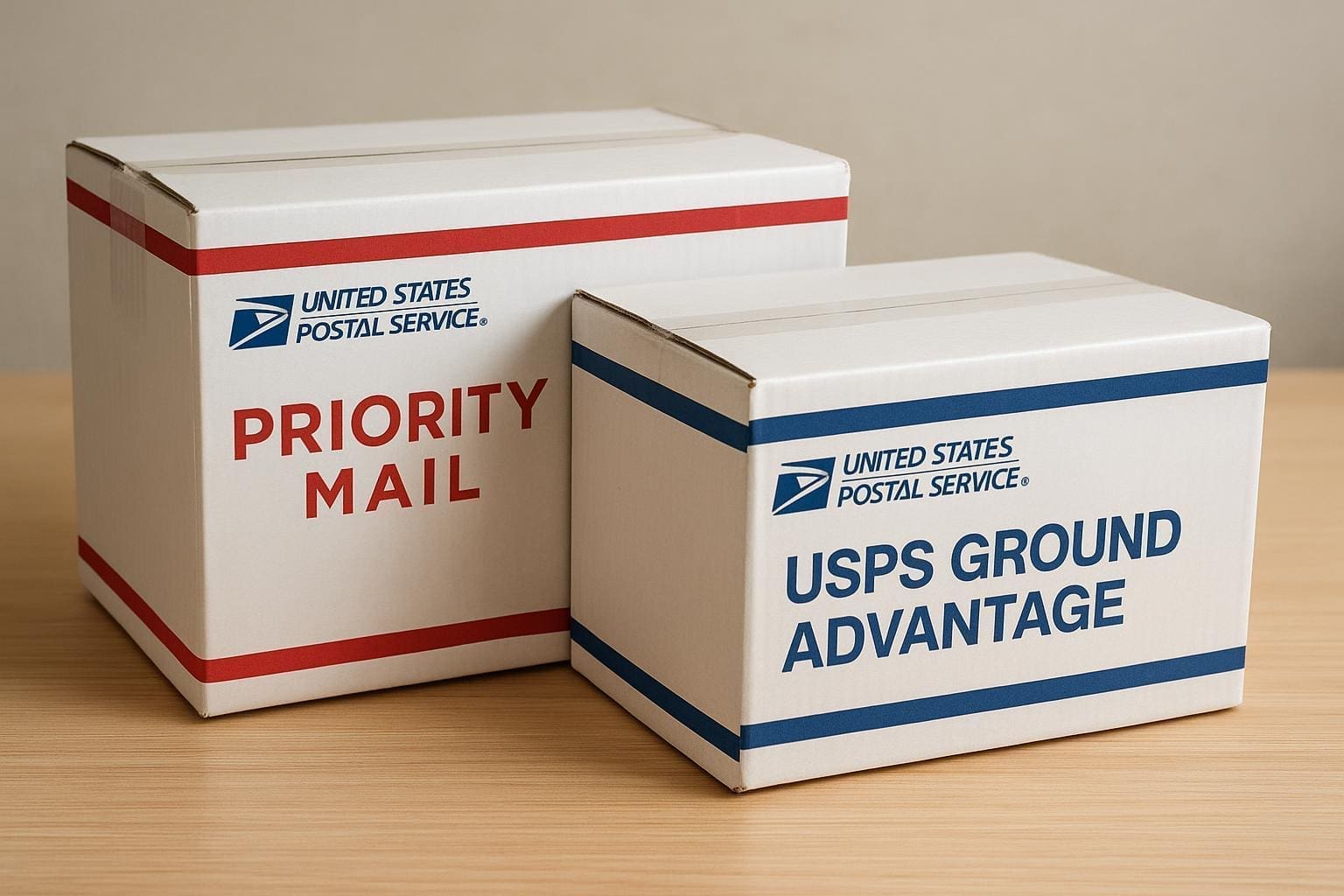
Start with this: if speed and cost both matter, you’re comparing two very different promises. One is built for urgency, the other for budget-conscious parcels. Saying “which is better” without context misses the point. The right choice depends on weight, dimensions, fragility, and how much time you can tolerate.
## USPS Ground Advantage Vs Priority Mail Explained: Quick Reality Check
usps ground advantage vs priority mail explained comes up a lot because the USPS reshuffled services and gave us new names. The short version: Priority Mail is generally faster and more consistent for small and medium packages. ground advantage is cheaper for heavier or larger items that can travel by ground. But the practical details matter.
### How Pricing Actually Works
Pricing looks simple on the surface: Priority Mail has flat-rate boxes and zone-based rates; ground advantage charges by weight and distance with different dimensional considerations. In practice, a 2-pound item shipped across state lines often costs less with Priority Mail if you use a flat-rate envelope. Move to a 15-pound box, and ground advantage usually wins.
Priority Mail includes some services by default — like limited insurance and faster scans — which can carry value even if the sticker price is higher. For many sellers and small businesses, those extras reduce headaches. Meanwhile, if you’re shipping heavy but not urgent items, the lower base rate on usps ground packages adds up over time.
### Delivery Speed And Reliability
Priority Mail aims for 1–3 business days in most cases. It moves by air more often and is prioritized in sorting hubs. That means fewer delays and better predictability. Tracking updates tend to be more frequent.
With ground advantage, expect 2–5 business days depending on origin and destination. Your package will move by truck for most routes. That increases transit time variability. If a holiday or weather event hits, ground routes get stretched more quickly than air lanes.
### When To Pick Ground Advantage
– You’re sending bulky or heavy items where Priority’s flat rates aren’t competitive.
– You’re not under a tight deadline.
– You’re trying to keep long-term shipping costs low for lower-margin products.
Think furniture parts, large craft supplies, or dense items sold in bulk. For these, the per-pound savings on ground advantage are often meaningful. If your customer expects delivery in a week and the price difference is substantial, choose ground.
### When Priority Mail Wins
Priority Mail is the better choice when speed and consistency matter. If you sell electronics, perishable goods, or anything that customers expect quickly, the extra few dollars can save you support tickets later. Also look at Priority when you can take advantage of flat-rate packaging: a heavy item in a flat-rate box can make Priority the cheaper option.
### Insurance, Claims, And Tracking Differences
Both services include tracking. Priority Mail often gets more scans because it moves through higher-visibility channels. Insurance terms are similar for declared value, but Priority Mail includes up to $100 of insurance in some retail contexts. That’s useful for small-value but fragile items.
Claims on usps ground shipments can take longer to resolve if the package moved on multiple trucks and hubs. The paperwork is the same, but the practical reality is that traceability and claim resolution tend to be quicker with Priority.
#### Package Size And Weight Rules
Priority Mail pricing depends on weight and destination unless you use flat-rate boxes. Ground advantage focuses more on pounds and distance, and can charge more for large dimensions even if weight is low. For awkwardly shaped items that fill a box but don’t weigh much, run the math for both services.
For example: a 12x12x12 box that weighs 8 pounds might cost more on Priority than on ground advantage when shipped a long distance. But if it’s only crossing a couple of zones, Priority flat-rate might be cheaper.
#### Hazmat, Restrictions, And Special Handling
Both services have similar restrictions for hazardous materials, but the routing differences mean you’ll sometimes see ground advantage refuse certain items that Priority will accept because of air transport rules. Check USPS hazmat guidelines before you label and ship.
### Labeling, Dropoff, And Pickups
You can print both labels online. Priority Mail flat-rate boxes are free at Post Offices; you can also schedule pickups for both services. In practice, Post Office lines move faster when your package is Priority Mail because it’s scanned and routed immediately. That’s a small time-saving but it adds up when you ship dozens of packages a day.
### Cost Examples To Run Yourself
Do quick tests. Weigh and measure your common package types and price them for both services using USPS rate calculators. For many sellers the rule of thumb becomes: under 5–6 pounds close-distance, compare Priority with flat-rate options; over that, lean to ground advantage. But volume discounts and commercial pricing can flip that in some accounts.
usps ground pricing can be surprisingly competitive when you have repeated shipments to similar zones. If you use a shipping platform that offers commercial rates, re-run those scenarios there — the advertised retail prices aren’t the whole story.
### Packaging Tips Based On Service
If you pick ground advantage, protect items against jostling. Ground routes mean more time on trucks and more handling. Wrap fragile items and fill voids. For Priority Mail, pad and protect but you can be a little more confident in timeliness reducing risk.
If you use flat-rate Priority boxes, pack tightly. An item that moves around inside a flat-rate box can still break. For the ground advantage, avoid oversized boxes that raise dimensional pricing.
### Real-World Tradeoffs For Sellers
Small sellers sometimes default to Priority because it’s simpler and predictable. That’s fine for low-volume operations where time is money. For higher-volume or low-margin products, switching to ground advantage on suitable SKUs can cut shipping spend notably.
If you sell on marketplaces, check their delivery promises. Some platforms favor faster delivery and penalize sellers whose choices lead to late shipments. Align your shipping selection with the promise you’ve made to customers.
### Common Gotchas To Watch For
– Don’t assume flat-rate always wins; weight and zone change that quickly.
– Watch dim weight on large packages for ground advantage — dimensions can raise the price.
– Verify pickup cutoffs. Ground pickup trucks might have different schedules than priority flights.
– Use the right service label. Mislabeling a Priority package as ground advantage or vice versa will complicate tracking and claims, and can hold up refunds for customers.
If you want, send me a couple of package specs — weight, dimensions, origin and destination zip codes — and I’ll run the numbers and recommend which service fits each case better. I’ve seen sellers save hundreds a month by moving the right SKUs to usps ground while keeping high-value items on Priority. Recieve one or two examples and we can test it.