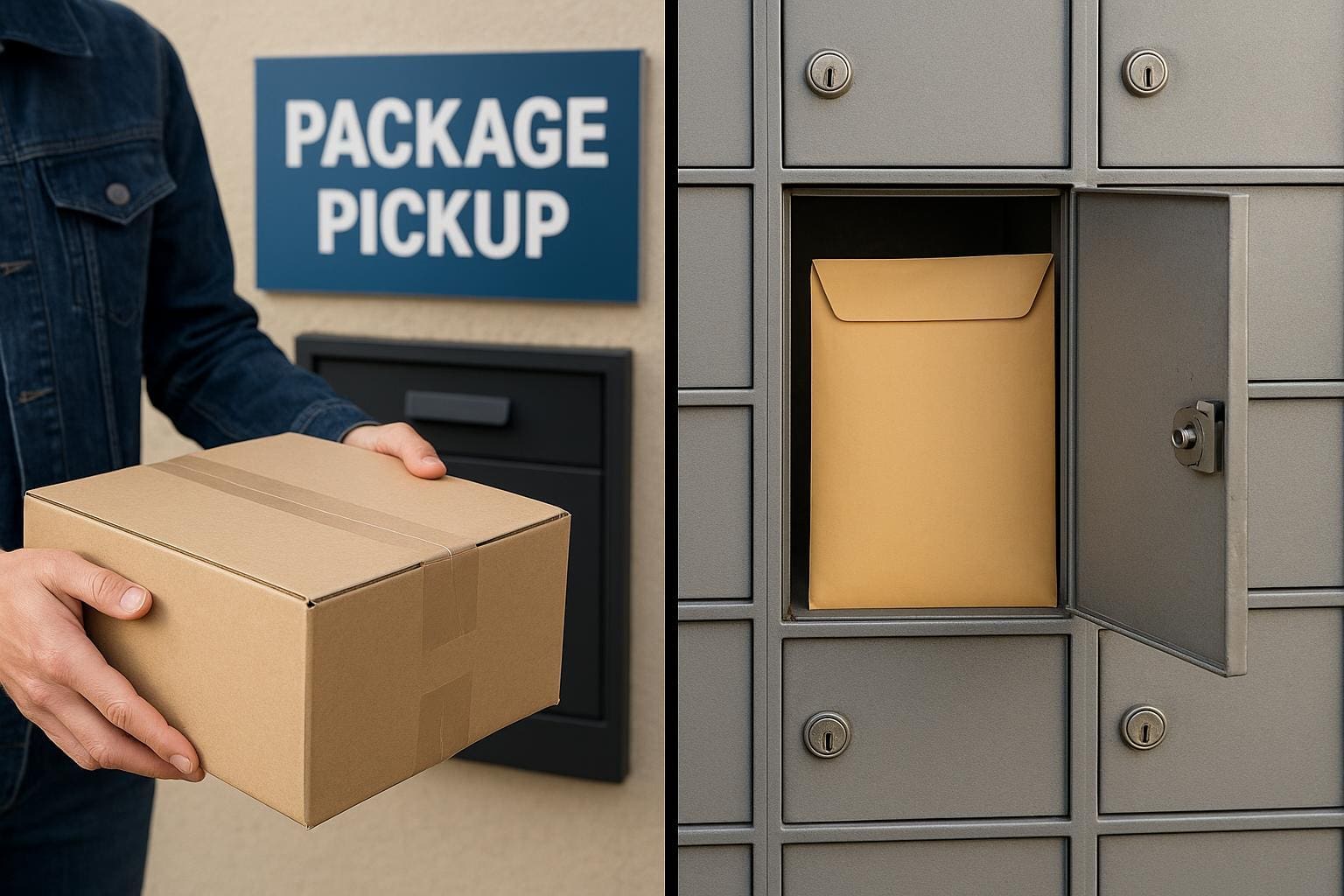
## Package Pickup Vs Po Box Delivery: Which Option To Choose
You need packages to arrive reliably. That’s the whole point. Deciding between package pickup vs po box delivery: which option to choose comes down to a few concrete things—where you live, what you buy, how often you need access, and what you’re willing to trade for convenience or security.
### What Each Option Actually Means
Use the right words and you avoid surprises. With package pickup, a carrier holds your parcel at a location—this could be the local post office counter, a parcel locker at a shipping store, or a retailer’s pickup point—until you collect it. With PO Box delivery, your mail and eligible packages go into a roadside, lobby, or post office box assigned to you. There’s no doorstep delivery; you go to the box for everything that fits.
### How I Decide For My Clients
I run postal setups for people who move a lot and for small businesses that sell online. If someone ships high-value items, I usually steer them to dedicated pickup because it reduces the time a package sits unattended. If someone needs a stable mailing address for legal forms and little envelopes, PO Box delivery works better. No one-size-fits-all answer here.
## How Security Compares
### Risk Of Theft And Weather Damage
Packages left on porches get stolen or soaked in rain. With package pickup, the parcel sits inside a controlled area until you collect it. That reduces theft risk and weather exposure. PO Boxes keep letter-sized mail locked away and safe. But many PO Boxes can’t accept large packages—those end up as a notice to pick up at a counter, which is effectively package pickup.
### Chain Of Custody And Liability
Carriers usually accept more liability for items they handle directly at a pickup counter. If a package is marked delivered to your curb, getting reimbursement can be slow. Both systems give you a clear point of contact; but package pickup often gives sharper proof-of-possession because a clerk signs you out or the locker logs your access.
## Cost, Fees, And Hidden Charges
### Upfront And Ongoing Costs
PO Boxes have rental fees. In many places, a small box for a year might be very cheap; in high-rent cities the same box is pricey. package pickup is more variable: some carriers offer free hold-for-pickup; others charge a small fee for locker or retail store handling. If cost matters, check local post office rates and any private locker fees.
### Business Accounts And Volume Discounts
If you ship frequently, business services like scheduled package pickup or corporate mailrooms reduce per-item costs. PO Boxes don’t scale the same way; they’re better for a single point of contact, not for high-volume daily package flow.
## Convenience And Accessibility
### Hours And Pickup Flexibility
PO Boxes usually give you 24/7 access when located in a lobby with key access. That’s a big deal for people who work odd hours. package pickup locations vary—some are open late, some close early, and some require you to pick up during business hours only.
### Travel And Temporary Absence
If you travel a lot, a PO Box gives continuous receipt of official mail. package pickup can be set for short holds while you’re away, but it’s not a substitute for mail forwarding. If you’re on the road, arrange forwarding or an extended hold.
## What Size Packages Fit Where
One of the most practical differences. PO Boxes are limited. If you order anything over the box size, the post office normally hands you a pickup notice and stores the parcel in a backroom. That then becomes package pickup. Some private locker networks accept larger shapes but have strict size limits and additional fees.
### Examples From Real Orders
– Books and small electronics usually fit a PO Box; you walk away with them.
– Bulky home appliances or furniture will always need door delivery or a scheduled package pickup with a freight service.
– Clothes from regular retailers: most fit boxes or lockers, but returns get messy if your pickup point has limited hours.
## Rules, Restrictions And Addressing
### What You Can Put As The Address
PO Box delivery requires the box number. You can’t use a physical street address in place of a PO Box for most carriers. Some services let you combine a PO Box with a street address via “PMB” or suite options for private mailbox services, but read the small print.
With package pickup, many carriers allow “Hold For Pickup” on the shipping label; that directs it to a specific branch or locker. That works for most parcels, but vendors sometimes refuse to hold packages for pickup due to return policies.
### ID And Verification
Picking up packages from a counter often requires ID and the tracking number. PO Box access requires your key or code. Locker systems may use PINs or apps. If someone else needs to collect for you, PO Boxes are restrictive unless you set up authorized pickups; package pickup locations often permit authorized agents with ID and paperwork.
## When Privacy And Legal Mail Matter
If you need a stable mailing address for government forms, bank accounts, or business registration, PO Box delivery is a clean legal address for many purposes. Some agencies won’t accept a PO Box for residency verification; others will. For business, a private mailbox (PMB) often has a street-style address that looks more professional than a PO Box and supports package pickup.
If privacy is the major concern—say you don’t want your home address public—a PO Box reduces exposure. But remember, someone can still subpoena mail at a post office if it’s relevant to legal proceedings. It’s not an ironclad shield.
## Speed And Reliability
### Delivery Times
Courier services that do package pickup often process faster for some shipments, because they don’t need to attempt curbside delivery. If you choose Hold For Pickup, your package may be delivered to the branch the same or next day and held, rather than being attempted at your door multiple times.
PO Box delivery can be faster for items that fit because postal sortation is optimized for mail going to PO Boxes. However, if a parcel doesn’t fit, you’ll get a notice and then have to go to the counter—an extra step that slows you down.
## Real-World Scenarios: Which To Pick
### Apartment In A Busy City
If you live in a third-floor walk-up with no secure entry, choose PO Box delivery for everyday mail and small packages, plus occasional package pickup for larger items. That gives consistent protection and predictable access.
### Single-Family Home With A Porch
If porch theft is rare in your neighborhood, doorstep delivery might be fine. If theft is a problem, use package pickup for high-value purchases. Alternatively, use carrier-authorized delivery instructions or scheduled pickups to minimize exposure.
### Small Online Business
You want consistent tracking, returns handling, and a professional address. Look at private mailbox services that combine PO Box features with package pickup options and courier acceptance. They handle mixed carrier deliveries better than a standard PO Box.
### Frequent Traveler
PO Box delivery wins when you need reliable receipt while you’re gone. For shipments that can’t fit, schedule package pickup for when you come back or use forwarding services.
## The Setup Steps You’ll Actually Take
### How To Set Up A PO Box
Visit the post office or set up online if your local office supports it. Choose a box size and pay the rental. Give the box number to senders. If you need a street-style address instead, consider a private mailbox provider.
### How To Request Package Pickup
When checking out online, look for “hold for pickup” or choose the carrier’s pickup location. For carriers like UPS, FedEx, or DHL, you can change delivery preferences on their websites and request a hold. Private lockers will provide a code when the parcel arrives.
#### Tips For Smooth Pickup
– Keep tracking numbers in one folder or app.
– Bring a photo ID and the pickup notice when collecting.
– If you authorize someone else, confirm the pickup policy in advance.
## Hidden Friction Points People Miss
### Pickup Windows And Lines
Some post offices have long lines. A package pickup that requires waiting an hour erodes the convenience. Check whether the pickup counter has express lanes or use lockers to avoid queues.
### Unexpected Fees
Retail locker services or third-party pickup points sometimes charge per-package handling fees. Those fees add up if you order frequently. Ask about caps or monthly plans.
### Returns And Bulk Shipments
Returning via a PO Box is awkward; many returns require a carrier label and sometimes a return to a storefront, which means package pickup. If you sell in bulk, arrange a business pickup or use a fulfillment service.
## Integrations With Modern Shopping
Retailers increasingly offer pickup points at local stores. That blurs the line between package pickup and PO Box delivery. Some apps show nearby pickup options and hold times. Use those tools to choose the fastest, cheapest, or most secure pickup point.
### Automation And Notifications
Opt into SMS or app notifications. They save time and prevent missed pickups. Locker systems and most carriers will send a code or barcode you show to pick up. If you won’t check notifications often, choose a system that gives physical notices too.
## Quick Decision Checklist
– Want guaranteed privacy and legal stability? Lean toward PO Box delivery.
– Need secure handling for high-value parcels? Favor package pickup locations or lockers.
– Travel frequently? Use a PO Box plus forwarding or scheduled pickups.
– Ship and receive in high volume? Consider business pickup or a private mailbox service.
– Worried about pickup hours? Choose a box with 24/7 lobby access or a locker.
#### A Real Example: Two Neighbors
One neighbor took a small PO Box because their building had no mail room; they get letters and small packages without worry. The other neighbor works nights and prefers package pickup at a locker that’s open 24/7; they get a code, grab the item, and leave. Both solutions solve different pain points. Neither is objectively better.
## Things To Ask Before You Commit
– What are the exact hours for the pickup location?
– Are there size limits and handling fees?
– Does the pickup site accept all carriers?
– What ID or proof is needed to collect?
– Is there a process for authorizing third-party pickups?
If you can get direct answers, you can avoid surprises like a parcel that won’t fit or a fee you didn’t budget for.
## Small Details That Make A Big Difference
Using a consistent return address reduces delays. Combine services: get a PO Box for legal mail and a pickup locker for oversized packages. Check delivery instructions in your shopping accounts—sometimes you can change delivery preferences per order. For businesses, a local fulfillment partner that accepts multiple carriers will simplify things more than juggling PO Boxes and pickups.
## Common Mistakes People Make
People sign up for the smallest PO Box without checking average package dimensions. Others assume a pickup point accepts all carriers; many only accept one. Also, forgetting to check expiration dates on PO Box rentals causes service interruptions. Keep an eye on renewal notices and reciept stubs.
## When To Reconsider Your Choice
If pickup queues get long, switch to lockers or a different branch. If you start shipping more frequently, move from a PO Box to a private mailbox that accepts couriers. Conversely, if porch theft rises, add a PO Box to stop deliveries to your home.
## How Technology Is Changing Both Options
Apps and locker networks are pushing package pickup into a faster, more automated model. PO Boxes are getting digital notifications and photo scans at some locations. Expect more hybrid products where a single provider offers a key-secured box plus scheduled courier acceptance.
## Practical Next Steps Right Now
If you’re unsure, test both for a month. Get a PO Box for regular mail and add a pickup point for larger orders. Check fees and hours, try a few deliveries, and see which routine fits your life. Changing later is possible but involves a bit of paperwork; trying both briefly saves time in the long run and helps you pick the one that actually reduces friction rather than shifting it elsewhere.
Pick what keeps you from making extra trips and from losing parcels. Pick what matches your buying habits and your neighborhood’s realities. Pick the system that you’ll actually use consistently.