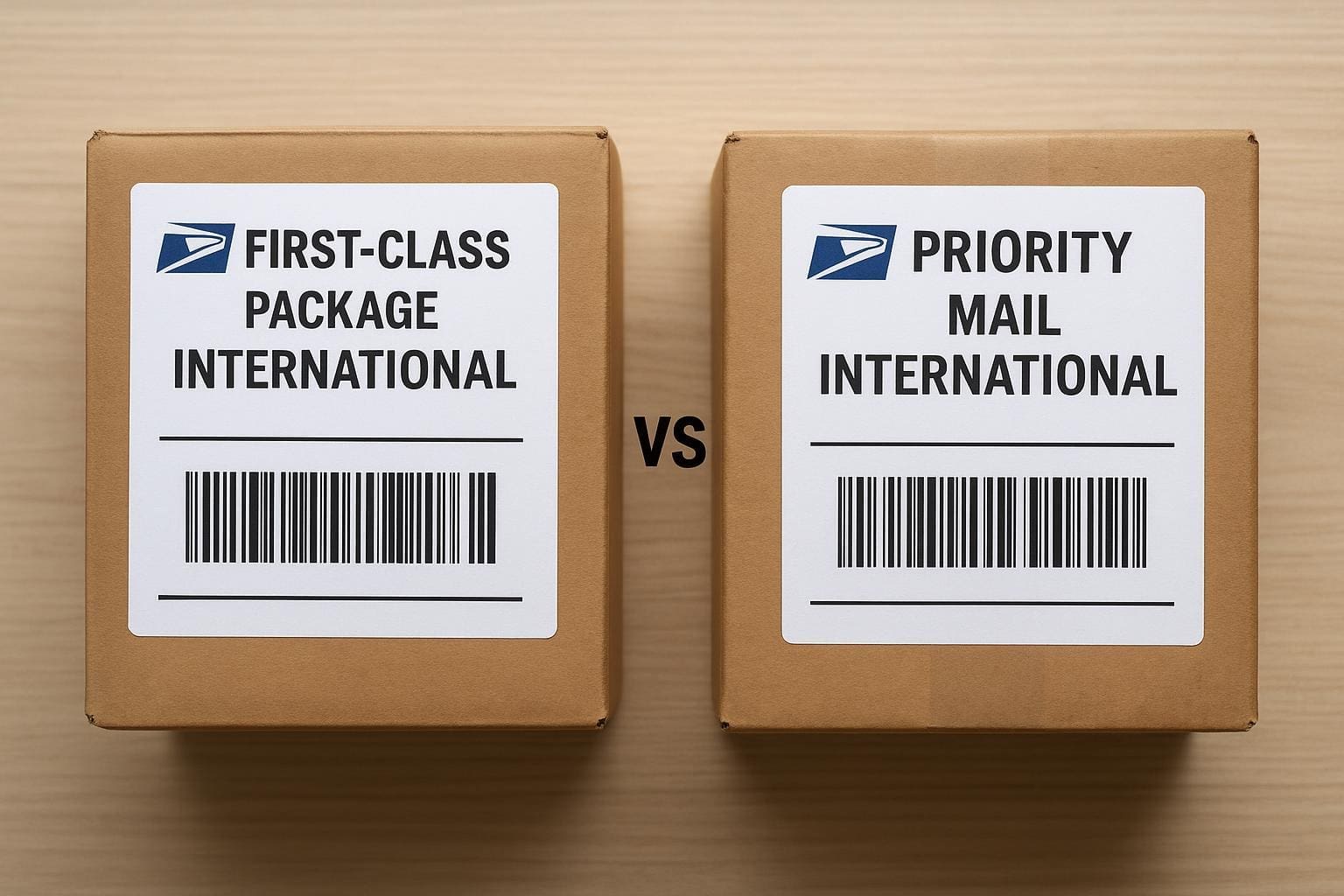
First Class Package International Vs Priority Mail International Price Comparison

first class package international vs priority mail international price comparison

## How These Two Services Differ

When you ship overseas with USPS, the decision usually comes down to cost versus certainty. First Class Package International Service and Priority Mail International are both common choices, but they behave very differently once your package leaves the U.S. First Class is designed for light, inexpensive parcels; Priority is meant for heavier goods and people who want faster transit, better tracking, and built-in protections.

First Class Package International is limited by weight (under 4 pounds) and size, and it’s priced to compete with economy options offered by other carriers. Priority Mail International accepts heavier packages, offers flat-rate boxes, and includes more comprehensive tracking and a baseline amount of indemnity for loss or damage. Those distinctions explain most of the gap you’ll see in any first class package international vs priority mail international price comparison.

### Weight, Size Limits And Eligibility

Weight is the first gatekeeper. First Class caps at 4 lbs; Priority has no strict low-end limit and is suitable for anything above that. Many small online sellers choose First Class for lightweight items such as jewelry, small clothing items, or parts, because the price per shipment can be notably lower. If your parcel weighs 2.5–3.5 lbs, you’ll be near the top of the First Class limit and might pay nearly as much as the cheapest Priority option, so you should run both numbers.

Size rules matter too. A bulky 3-lb box can suddenly cost more in dimensional terms, nudging Priority into the better value despite its higher headline rate.

### Tracking, Insurance, And Delivery Standards

First Class often includes very limited tracking — sometimes only to the destination country’s border, not to the recipient’s door. That lack of end-to-end visibility is a trade-off for lower cost. Priority Mail International gives more consistent tracking milestones, delivery confirmation in many countries, and a modest indemnity for loss or damage. If you expect claims or need proof of delivery, that matters.

You’ll also see a difference in delivery windows. First Class can take a long time depending on customs hold-ups and the receiving postal network. Priority aims for a faster average (commonly a few days quicker), although specific timing depends heavily on destination and local postal efficiency.

## First Class Package International Vs Priority Mail International Price Comparison: Real-World Examples

A practical look at sample shipments makes the gap clearer. Prices fluctuate, so these are illustrative margins, not guarantees. Still, they show the pattern you’ll see in an international price comparison.

### Example: 8-Ounce Parcel To Canada

– First Class Package International: Typically your cheapest option. For a small padded envelope with an 8-ounce item bound for Canada, First Class often costs substantially less than Priority — sometimes a third to half the price of Priority. That can mean savings of $10–$30 depending on promotional rates and exact zone.
– Priority Mail International: You get faster transit and better tracking. For that same 8-ounce parcel, Priority might be three times the First Class cost because you’re paying for speed and protections. If the item is low-cost or easily replaced, the added cost might not be worth it.

### Example: 2-Pound Package To The United Kingdom

– First Class Package International: Still possible, since it’s under 4 lbs, but prices creep up with weight. A 2-lb package will cost more and may start to approach Priority territory.
– Priority Mail International: The bump in price buys you more reliable delivery and included indemnity. If the package has a higher value or you need a predictable delivery window, Priority often justifies the cost here.

#### Flat Rate Box Uses And When They Matter

Priority shines with flat-rate boxes when you can pack a heavy but compact item into the flat-rate container. If you have a dense 10-lb product that fits in the medium flat-rate box, Priority can be the bargain. First Class has no flat-rate boxes, so bulkier heavy items will quickly make Priority the smarter option.

These examples help frame the first class package international vs priority mail international price comparison: where weight and packing strategy meet declared value and delivery needs.

## Factors That Drive International Price Differences

Pricing isn’t arbitrary. Three practical factors push First Class and Priority apart.

### Destination Zone And Local Postal Systems

The farther and less efficient the destination, the more you’ll see price variance. Shipping to a major urban center with a good postal system will be cheaper and faster in practice than sending to remote areas. Priority’s premium buys better upstream handling and occasionally faster clearance through customs processes, which is why its price differential widens for distant or logistically tricky countries.

Include an international price comparison that’s zone-specific and you’ll get a clearer picture than a single blanket rate. For example, to Western Europe the difference might be modest; to certain parts of Asia or Africa, the gap can widen.

### Customs, Duties, And Forms

Customs paperwork can add time and cost. Priority packages often include a more standardized set of handling and documentation services when bought online — that can smooth customs entry and reduce delays or inspections. First Class is more bare-bones; if customs agents open a lightweight parcel and hold it, the savings you expected can evaporate.

Make sure you understand who pays duties and how they’ll be billed. That’s part of any sensible international shipping rates comparison.

### Delivery Speed And Reliability

If your business depends on predictable timing (subscription boxes, replacement parts, perishable items), the higher price of Priority is a cost of doing business. If you’re shipping cheap, non-urgent goods, prioritizing the lowest international shipping rates is fine. The first class package international vs priority mail international price comparison here becomes a question of tolerance for risk versus willingness to pay for reliability.

## Making The Right Choice For Your Shipment

Decide by answering three simple questions: How heavy is it? How valuable is it? How soon must it arrive?

### When To Choose First Class

Pick First Class when the package is light, the value is low, and you can accept slow or partial tracking. It’s popular for economy-driven sellers, samples, and items that would cost more to replace than to reship. If you’re trying to keep postage costs under a certain threshold, First Class often wins on price per shipment.

### When To Choose Priority Mail

Choose Priority when the item is heavier, valuable, or time-sensitive. If you need stronger tracking for customer service or want a better chance of indemnity if something goes wrong, Priority reduces stress. It’s also better when your item fits a flat-rate box and you can pack efficiently — that’s where the higher headline price turns into actual savings.

#### Practical Tips To Save On International Shipping

– Weigh and measure carefully. Small weight differences can move you into a different pricing band.
– Use the USPS price calculator before you commit. Rates change and there are occasional promotions.
– Consider declaring a value strategically. Adding minimal declared value without necessity can bump price; over-declaring costs more.
– Try packaging that reduces dimensional weight and avoids unnecessary bulk. Flat-rate boxes can beat per-pound pricing for dense items.
– Buy postage online. Many online labels give small discounts and include better customs forms exportability.

If your workflow includes frequent international shipments, keep a short spreadsheet of typical weights, destinations, and the price you actually paid. Over time that log will be more useful than a single first class package international vs priority mail international price comparison you made once. And remember: you often save more by optimizing packaging and choosing the right service than by hunting for a marginally better carrier rate.

A final practical note: check whether your recipient’s country has problems with slow postal delivery or complex customs. Even the best-priced Priority option can be slowed to a crawl by a country’s internal postal problems. Conversely, in countries with efficient postal networks, First Class can behave surprisingly well and keep your costs down without causing customer complaints. Keep that in mind as you weigh international shipping rates and build your shipping policy — and don’t forget to double-check addresses so the parcel gets to the right place; if you mistype the adress, no amount of careful carrier choice will help.

Cheapest Way To Ship Internationally: Cost-Effective Options

cheapest way to ship internationally

Effective international parcel movement demands a disciplined approach to carrier selection, packaging, documentation and timing. This article examines practical, cost-conscious strategies for exporters, small businesses and individuals seeking the cheapest way to ship internationally without compromising compliance or parcel integrity.

## Cheapest Way To Ship Internationally: Cost-Effective Options

### Factors That Determine Final Shipping Price

Several variables influence shipping costs. Understanding them allows shippers to select the most economical method.

#### Weight, Dimensional Weight And Volume
Carriers apply dimensional weight (DIM) pricing when package volume exceeds its actual weight. Accurately measuring and minimizing package size reduces the billed weight and lowers shipping costs.

#### Destination And Transit Speed
Transit zones and delivery speed heavily affect rate schedules. Slower economy services are almost always less expensive than express options, particularly for non-urgent consignments.

#### Nature Of Contents And Customs Requirements
Restricted or high-declaration-value items may attract higher fees, special handling and additional customs charges. Proper classification and documentation help avoid unexpected fees at the border.

#### Seasonal Demand And Fuel Surcharges
Rates fluctuate with seasonal demand and periodic fuel surcharges. Booking early and avoiding peak seasons can produce measurable savings.

### Common Low-Cost International Shipping Methods

#### Postal Services And Economy International Parcels
National postal services often provide the baseline cheapest way to ship internationally for small, lightweight items. Services labeled “economy” or “surface” are slower but cost-effective.

#### Consolidated Air Freight And Freight Forwarders
For shipments that are too large for regular couriers but not large enough to justify full-container loads, consolidation through a freight forwarder reduces per-unit rates by combining multiple consignments.

#### Sea Freight For Heavy Or Bulky Cargo
When time is not critical, sea freight or less-than-container-load (LCL) services represent the cheapest way to ship internationally for heavy or voluminous goods.

#### Hybrid Door-To-Door Solutions
Some platforms combine postal last-mile delivery with consolidated international carriage to deliver lower shipping costs while preserving convenience.

## Remedy 1: Consolidation And Optimized Packaging For Reduced Rates

### Purpose And Applicability
This remedy explains how to combine small shipments and optimize packaging to achieve the cheapest way to ship internationally for multiple parcels destined to the same region.

#### Required Materials
1. Rigid tape and tape dispenser
2. Approved cushioning materials (bubble wrap, corrugated inserts)
3. Right-sized corrugated boxes or poly mailers
4. Accurate scale and tape measure
5. Permanent marker and address labels
6. Access to a consolidation service or freight forwarder

#### Step-By-Step Process
1. Inventory And Grouping: Audit outgoing items and group those destined to the same country or region. Consolidation is most effective when combining several parcels into a single consignment.
2. Select Appropriate Container: Choose a box whose internal volume closely matches the combined items’ volume to avoid excess DIM pricing.
3. Internal Protection: Arrange cushioning to prevent shifting while minimizing unnecessary void space.
4. Weigh And Measure Accurately: Obtain precise weight and three-dimensional measurements to calculate the correct DIM weight.
5. Engage A Consolidator: Contact a reputable consolidation service or freight forwarder; provide manifest details and request a transporter quote that compares sea and air consolidation options.
6. Documentation: Prepare a single commercial invoice and packing list for the consolidated shipment, ensuring correct HS codes and values to minimize customs delays and avoid extra charges.
7. Insure Selectively: Acquire insurance only when necessary; evaluate declared value against insurance premium to determine cost-effectiveness.
8. Track And Confirm Delivery: Monitor the consolidated shipment to ensure onward distribution aligns with customer expectations.

### Benefits And Considerations
Consolidation reduces per-unit shipping costs, simplifies customs clearance for batch consignments, and often provides improved negotiation leverage with carriers. However, it requires coordination, slightly longer lead times and accurate inventory control.

## Remedy 2: Utilizing Freight Forwarders And Economy Carrier Services

### Purpose And Applicability
This remedy details how to leverage freight forwarders and economy carrier contracts to secure the cheapest way to ship internationally for small businesses and occasional exporters.

#### Required Materials
1. Detailed product list with weights and values
2. HS codes for tariff classification
3. Electronic copies of invoices and credentials
4. Access to forwarder portals or federated marketplaces
5. Basic understanding of Incoterms relevant to your sales model

#### Step-By-Step Process
1. Rate Solicitation: Obtain quotes from multiple freight forwarders and economy carriers. Request comparative quotes for both air consolidation and LCL sea options.
2. Compare Total Landed Cost: Evaluate quotes based on door-to-door total costs including duties, taxes, brokerage fees and last-mile surcharges. Do not rely solely on headline carrier rates.
3. Negotiate Minimum Guarantees: When consistent volumes exist, negotiate volume-based discounts or minimum guarantee rates for a set period to reduce volatility in shipping costs.
4. Select Appropriate Service Level: Opt for economy air or LCL sea for non-urgent shipments and express only when time-sensitive, as express surcharges drive up shipping costs.
5. Provide Accurate Documentation: Forwarders require complete and accurate documentation to avoid detention fees and customs penalties.
6. Schedule Regular Pickup Windows: Establish fixed pickup days to allow consolidators to plan manifesting optimally and retain lower rates.
7. Review Post-Shipment Invoices: Audit the forwarder’s invoices against the proforma quote and shipment records to ensure accuracy and reclaim overcharges when applicable.

### Advantages And Risks
Forwarders and economy carriers can reduce per-shipment charges and provide expertise in customs clearance, which reduces hidden costs. The trade-off is longer transit times and the need for reliable documentation to avoid delays.

### Tactical Tips To Minimize Shipping Costs

#### Use Zone-Based Strategy
Ship from the facility closest to the destination’s economic zone when possible. Multi-warehouse strategies reduce transit zones and therefore lower carrier zone-based pricing.

#### Explore Regional Postal Partnerships
Some postal services maintain bilateral agreements that result in discounted cross-border rates for small parcels. These can offer the cheapest way to ship internationally for B2C e-commerce at low weight brackets.

#### Reevaluate Packaging Regularly
Standardize to packaging that aligns with carrier palletization practices when shipping in volume. Avoid over-packaging that increases DIM weight and shipping costs.

#### Leverage Technology For Rate Management
Use rate management tools or marketplaces that display live comparative pricing across carriers. Automated shipping platforms can identify the cheapest way to ship internationally for each parcel based on size, weight and destination.

### Documentation And Customs Best Practices

#### Accurate Harmonized System (HS) Codes
Correct HS classification prevents mis-declared shipments that can lead to fines and unexpected customs duties, which inflate effective shipping costs.

#### Pre-Clearance Programs And Trusted Trader Status
Enroll in pre-clearance and trusted trader programs where available. These programs reduce customs delays and sometimes attract reduced inspection fees, lowering total landed costs.

#### Broker Selection
Select a customs broker with transparent fee structures. Low initial rates can be offset by high release or amendment fees if the broker lacks experience.

## Cost Comparison Examples And When To Choose Each Option

### Small, Lightweight Parcels
For parcels under 2 kg, standard postal economy services are typically the cheapest way to ship internationally. Compare rates from national post and major couriers’ economy tiers.

### Medium Volume, Non-Urgent Shipments
For repeated medium-volume shipments, consolidation via freight forwarders or LCL sea is often the most cost-effective approach. Negotiate volume discounts and fixed pickup schedules.

### Large, Heavy Or Oversized Cargo
When weight or oversize makes air freight economically prohibitive, sea freight LCL or full container load (FCL) solutions present the cheapest way to ship internationally despite longer transit times.

### Time-Sensitive Parcels
Express courier services are appropriate when speed outweighs cost; however, for routine shipments where time is flexible, economy services and consolidation will minimize shipping costs.

Ensure your operational choices align with customer expectations and the product’s commercial value. The cheapest way to ship internationally is ultimately the option that minimizes total landed cost while meeting service-level requirements and regulatory obligations.