## USPS Letter Weight Limit: Rules For Standard Mailers
If you send mail for business or bulk campaigns, understanding the usps letter weight limit isn’t optional. It’s the difference between paying the lowest letter rate and suddenly paying more because the post office calls your piece a flat or a parcel. Hit the wrong threshold and postage jumps; do it on purpose and you squeeze costs. Here’s how to avoid surprises.
### How USPS Defines A Letter
The USPS treats a “letter” as a mix of size, thickness, shape and weight. To get letter pricing, your piece must meet all the tests: within minimum and maximum dimensions, flexible (not rigid), not too thick, and under the weight cap. The most direct rule people ask about is the usps letter weight limit — that cap is 3.5 ounces. If your piece weighs more, it’s not a letter anymore under USPS rules.
That 3.5-ounce limit applies across most retail and bulk letter pricing. Whether you’re dropping a single First-Class stamp on a reciepient’s envelope or running a tray of Standard Mail, the same weight cutoff determines whether the item qualifies as a letter or becomes a flat/package.
### Size And Shape Tests That Matter
#### Dimensional Thresholds
A mailpiece considered a letter must normally fall within these dimensions:
– Minimum: about 3-1/2 inches high and 5 inches long.
– Maximum: about 6-1/8 inches high and 11-1/2 inches long.
– Thickness: at least 0.007 inch and no more than 1/4 inch for a standard letter.
If your item is larger than those limits, it’s a flat (large envelope) or a parcel, no matter how light it is. Flats have different weight allowances and pricing tiers.
#### Flexibility And Construction
Letters are supposed to be flexible. If you glue in a stiff insert, use a rigid card, or include something that creates a non-uniform thickness, USPS can deem the piece nonmachinable. That triggers extra fees even if you’re under the usps letter weight limit. Window envelopes, clasps, and heavy cardboard inserts are common offenders.
### Why The 3.5 Ounce Rule Exists
The 3.5 oz limit is closely tied to automated processing. Mail under that weight and within size limits can move through sorting and cancelling machines without extra handling. Above it, pieces need different processing and often slower handling; USPS charges more to cover that.
For standard mailers, that matters for two reasons: one, postage per piece generally rises with weight; two, for bulk discounts and automation rates, the shape and machinability requirements are stricter. Even if you have a permit imprint and huge volumes, you still need to respect the letter weight limit for the letter category.
### Common Triggers That Push You Over The Letter Weight Limit
– A heavy enclosure. Multiple flyers, coupons, product samples, or thick brochures all add up.
– Heavier paper stock. Using 70- or 80-lb cardstock for a mailer can push a piece beyond the 3.5-ounce mark faster than you expect.
– Multi-page booklets. Saddle-stitch binding or glued pamphlets increase weight and sometimes change stiffness.
– Extra packaging: a plastic window, an address label over the entire front, or excessive tape can make a piece nonmachinable.
– Moisture. Unstapled inserts or humidity can cause pages to curl and change thickness measurements.
### Measuring Weight: Practical Steps
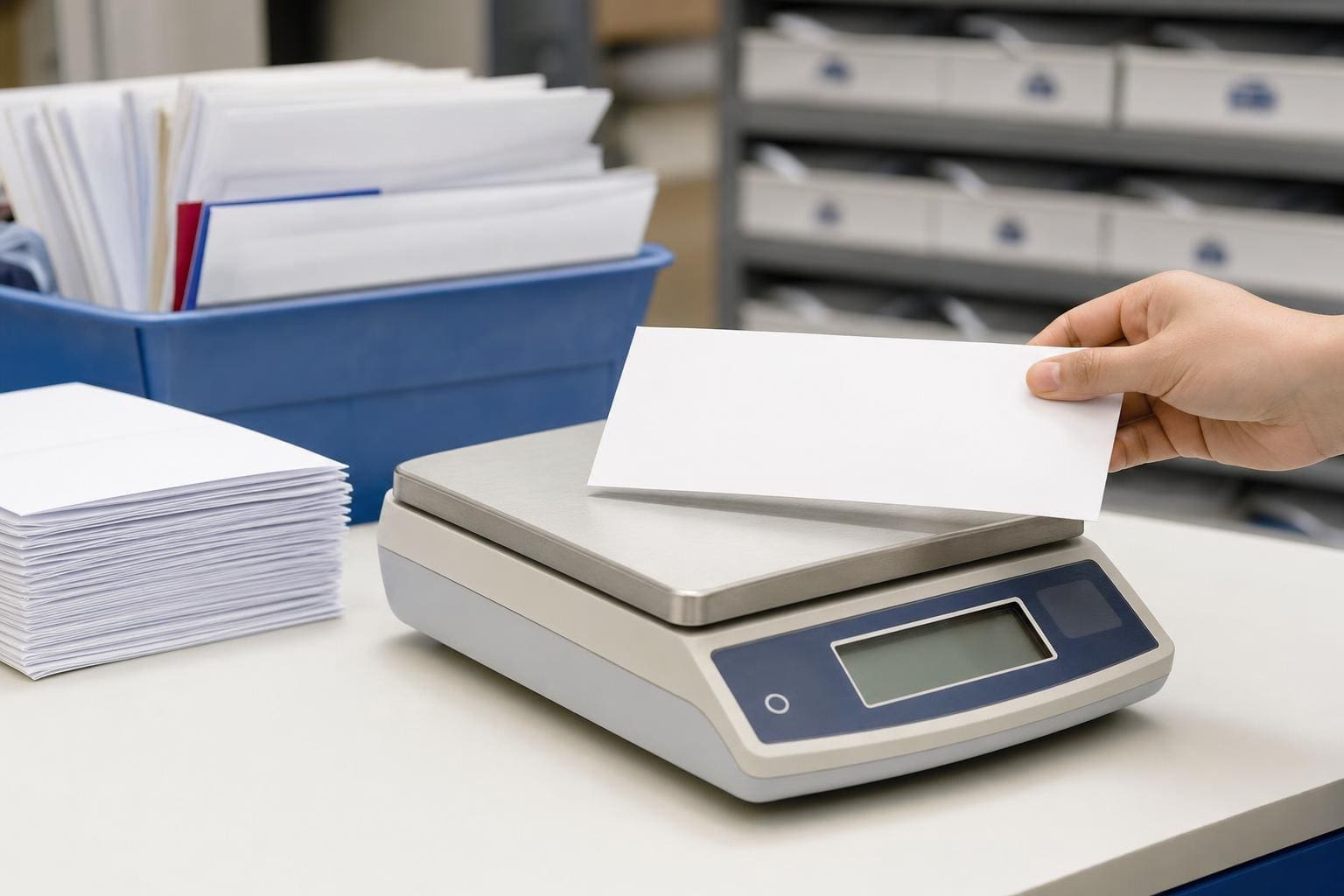
If you’re doing this in-house, don’t guess. Use a reliable postal or kitchen scale and measure a representative sample. Postal scales are inexpensive and calibrated for ounces. Weigh the finished, sealed piece exactly as it will be mailed — with ink, staples, and clear windows in place.
A good method when producing a batch: pick 5-10 pieces from the production run and weigh them. If any of them exceed 3.5 ounces, you either need to reduce content or plan for higher rates. Keep a log for audits if you claim bulk discounts.
### Pricing Consequences When You Exceed The Letter Weight Limit
Once you’re over the usps letter weight limit, pricing moves to the next category. For many mailers that means flat/large envelope rates. For others—particularly heavier or irregularly shaped pieces—it can mean package pricing. Rates are incremented by weight steps, so even a half-ounce can change your cost-per-piece.
For bulk senders, there’s another wrinkle: nonmachinable surcharges. If a piece is still a letter by weight but fails the machinability tests—too thick in spots, uneven, or rigid—the USPS can add a nonmachinable surcharge. That surcharge can be more painful than a weight-based rate increase.
### How Standard Mailers Can Stay Below The Limit
#### Reduce Inserts And Use Lighter Stock
Cut the number of inserts. Replace a 100-lb booklet with a 70-lb sheet or move detailed product data online and include a QR code. Little swaps add up. You can save fractions of an ounce across thousands of pieces.
#### Trim Size And Fold Carefully
A slightly smaller fold, or switching from a booklet to a single fold, helps. Also, avoid unnecessary coatings. Glossy coated paper weighs more. Think about where you can simply remove a page or replace one element with a URL.
#### Test For Machinability Early
Run a mock sheet through your folding and sealing equipment. If it feeds oddly or sticks, it’ll likely be nonmachinable. Fix the problem before you commit to print and postage. Automation-compatible adhesives and window placements are details that matter.
### Bulk Mailing Specifics
When you qualify for postage discounts as a commercial mailer, the rules get stricter. Automation letter rates require exact dimensions, barcode placement, and tight tolerances. Even if your piece is under the usps letter weight limit, failing automation specs will cost you. Mailers who rely on presort and bulk discounts should keep a copy of the USPS Domestic Mail Manual (DMM) close and run pieces through a validator before production.
### Weighing Common Mail Pieces — Quick Reference
– Single-sheet letter (no inserts) with standard envelope: usually well under the 3.5 oz threshold.
– Multi-page brochure + envelope: may approach or exceed 3.5 oz depending on paper weight.
– Thick booklet or small catalog: very likely to be a flat or parcel.
– Sample or product piece: almost always moves you out of the letter category.
If you’re unsure, weigh. The cost of a postal scale is tiny compared to paying surcharges on a large run.
### Mistakes I See All The Time
People assume one stamp covers everything. It doesn’t. They assume window envelopes are always okay. They’re not if they make the piece rigid or add weight. They fold and stuff late at night, then realize the folder crammed in an extra coupon, turning a letter into a flat. Also, bulk mailers sometimes assume that because they pay by weight in a manifest, individual piece limits don’t matter. They do.
If you get a postal statement that rejects a rate claim, don’t fight it blindly. Examine the sample piece, reweigh it, and check if the nonmachinable or thickness rules were breached. Sometimes you can dispute with clear evidence; sometimes you adjust the next run.
### Tools And Resources To Keep Handy
– A calibrated postal scale. Keeps you honest.
– A thickness gauge. Useful if you routinely produce near the 1/4-inch threshold.
– The USPS Domestic Mail Manual online. It’s not light reading, but it’s definitive.
– Software validators for barcodes and automation placement if you’re doing bulk runs.
If you’re working with a print shop, ask them to certify weights and provide sample weights in writing. Many shops will simply run a few pieces and note the ounce weight. That saves a lot of guesswork.
### When To Consider Reclassifying Your Piece
If trimming isn’t possible and rates balloon, think about reclassifying the piece intentionally. Sometimes moving to a flat or even a small parcel and optimizing for that class yields better ROI. For example: a heavier catalog may work better as a flat with a simplified layout, fewer inserts, and targeted distribution rather than trying to force it into a letter format.
### Small Tips That Save Money
– Use lightweight envelopes designed for high-volume mail. They shave measurable weight.
– Avoid unnecessary staples. They add weight and can interfere with sorting.
– Batch similar-weight pieces together. If one sample is over, you’ll catch others that are likely over too.
– Consider digital alternatives for heavy content. A QR code or a short URL reduces heft and keeps postage predictable.
### Where Confusion Usually Comes From
People mix up classes. The term “Standard Mail” (now often called Marketing Mail) is a mail class with its own rules. The phrase “usps weight limit” can mean different things depending on whether you mean letter, flat, package, or the maximum allowed for a particular service. When in doubt, specify the exact class and ask for the letter/flat/parcel limit — not just “what’s the weight limit.”
You can get audited if you claim certain discounts without meeting specs. Keep records: sample weights, production notes, and a copy of the piece you mailed. That’s the best defense if someone questions your postage claims.
### Final Practical Example
You’ve designed a 6-page self-mailer using 80-lb text paper with a window envelope. You suspect weight is tight. Weigh five finished pieces. If the average is 3.6 ounces, either drop a page, switch to lighter paper, or accept that you’ll pay flat rates. If you’re mailing 10,000 pieces, a small rate difference multiplies quickly. Make the decision on numbers, not guesses. It’s simplyfing the process to assume one approach will always save money — but testing will show you where the real savings are.
Keep the usps letter weight limit top of mind when planning mail runs. Little choices about paper, folds and inserts add up fast. You can be creative with content, but also practical about postage.