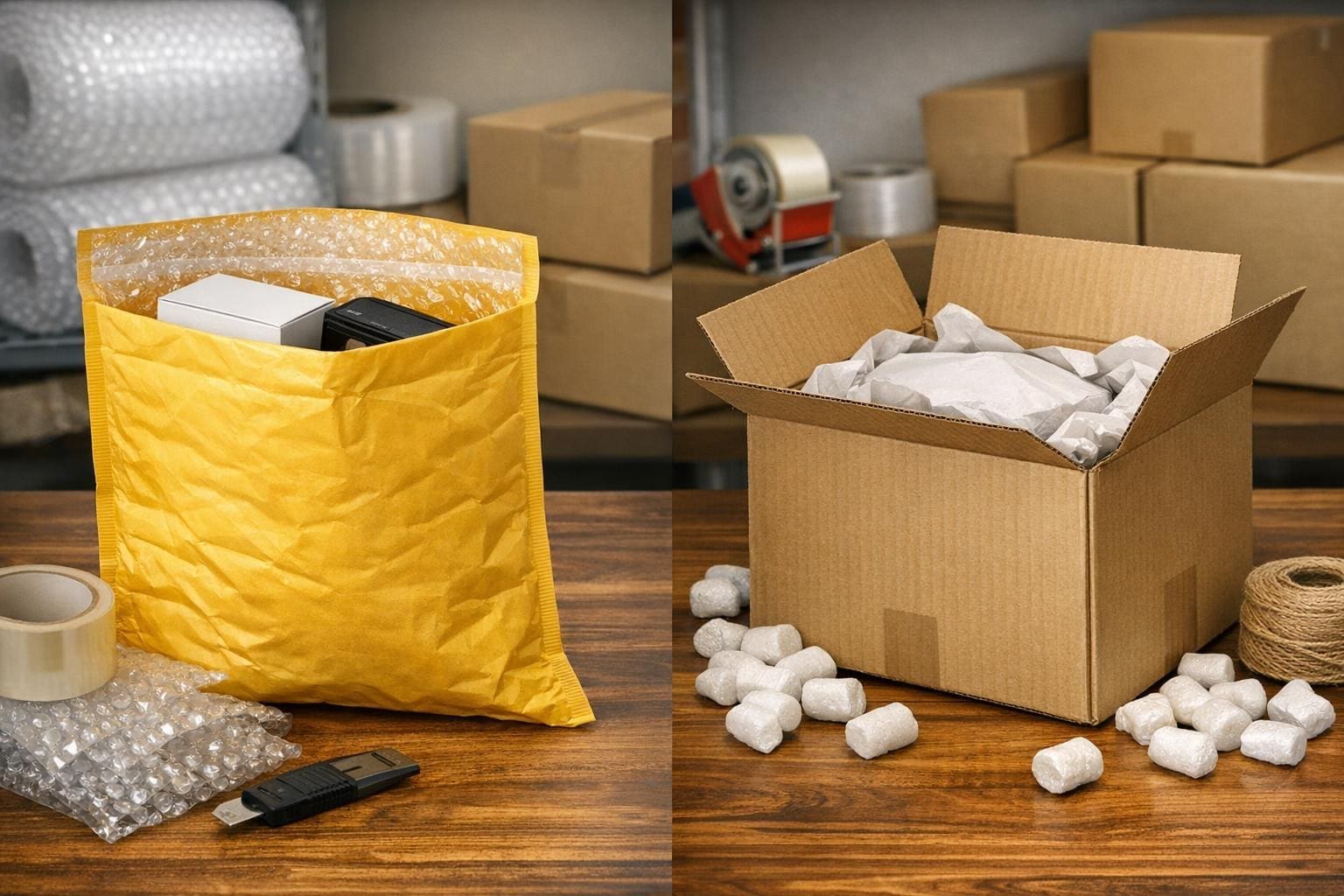
You don’t get a second chance to stop a dented product from ever reaching a customer. Pick the wrong package and you’ll pay for it with returns, refunds, and a bad review. Pick the right one and the whole process runs smoother, cheaper, and less stressful.
## Bubble Mailer Vs Box: How To Choose
When you boil it down, the bubble mailer vs box decision is a trade-off between weight/space and protection. Both options have clear advantages and clear limits. Use the wrong one and you’re either wasting money on postage or gambling with the item’s safety. Use the right one and shipping becomes routine.
### Weight And Dimensional Pricing
Shipping carriers charge for actual weight and sometimes dimensional weight. Boxes fill space; if a box is large but light, carriers may bill you for more than the physical weight. A padded poly bubble mailer often saves money for small, light, non-breakable items because it compresses and keeps the package compact. That’s where bubble mailer use really shines.
However, when an item needs a lot of filler to stop it from moving inside a box, the extra cubic inches can push you into a higher dimensional weight bracket. In those cases a snugly fitted box or a smaller parcel often costs less than stuffing a large box with cushioning. The math changes depending on carrier and destination, so run a few postage estimates before committing.
### Protection And Product Type
Not all products are created equal. Soft goods like tee shirts and fabric masks can survive a ride in a bubble mailer with minimal padding. Hard, brittle, or oddly shaped items usually need the stable, rigid protection a box provides.
A box will absorb crushing, point loads, and repeated stacking better. Corrugated walls resist punctures and distribute force. But don’t assume a box fixes everything: a fragile item in a box with nothing to stop internal movement is still vulnerable. That’s where good packing technique matters as much as the outer package.
#### Small, Flat Items Work Better In Mailers
Prints, small books, stickers, and jewelry in branded pouches often ship fine inside a bubble mailer. The mailer keeps things compact and reduces materials used. For art prints, slip a piece of chipboard in front and back to stop creases. For jewelry, use a tiny box inside the mailer if there’s any concern about snagging.
#### Fragile Or Multi-Item Orders Should Use Boxes
If you ship a set of items, or anything with a screen or glass, go with a box. Use corrugated inserts, kraft paper, or biodegradable foam peanuts to eliminate movement. Double-boxing is rare but useful for high-value electronics or fragile ceramics that might face rough handling.
### Cost And Speed Trade-Offs
The total cost isn’t just postage. You pay for the outer package, any inner packing, label printing, and return costs if a claim is made. Bubble mailers are cheap to buy and fast to pack. Boxes cost more to stock and take longer to assemble. But a damaged product shipped cheaply can be more expensive than a slightly pricier box that arrives intact.
For fast shipping, carriers handle mailers differently at sort hubs. Mailers move quickly because they collapse; boxes get stacked and scanned differently. If you sell high volumes and your goal is predictable delivery times, standardizing to a mailer or a box size reduces surprises.
## Packing Practicalities And Branding
Packaging is also a brand touchpoint. A clean box with tissue, a thank-you note, and a secure fit creates a better unboxing experience than a plain mailer for premium goods. But keep it honest: don’t wrap a fragile glass item in a flimsy pouch just because it looks good.
### Storage And Assembly
Space matters in a real way. Flat mailers occupy a fraction of the storage footprint of boxes. For small sellers with limited space, keeping a few sizes of mailers is easier than dozens of box sizes. Boxes take time to fold, tape, and label. That labor cost scales every day.
If you’re shipping seasonally, mailers let you expand capacity quickly without buying a bunch of box sizes. They stack flat, are lighter to carry, and speed up packing lines. On the other hand, if you’re shipping a consistent product mix, having a couple of right-sized boxes can reduce postage and protect items better.
### Sustainability And Materials
Paperboard boxes are widely recyclable; corrugated cardboard is collected by most municipal programs. Bubble mailers are trickier. Many padded poly mailers are mixed materials—plastic outer layer, air bubble lining—making them harder to recycle in curbside programs. Some brands offer paper padded mailers or recyclable poly mailers, but you should check local recycling guidelines.
Sustainability is part of customer perception. If you claim to be eco-friendly, shipping in a single-use padded poly bag may feel off-brand unless you’ve chosen recyclable or compostable options. For returns, reusable packaging ideas are growing, but they work best with boxes rather than single-use mailers.
## When To Use Each: Practical Rules
There’s no single rule that fits every seller, but a few practical thresholds help decide between a bubble mailer and a box.
– If the item weighs under one pound, is small, and won’t be crushed, a bubble mailer is usually cheaper and faster.
– If the item is fragile, oddly shaped, or part of a bundle, choose a box for predictable protection.
– If dimensional weight jumps your postage, find a smaller box or a mailer that keeps inches down.
Think of it like triage. Low-value, soft items go in mailers. High-value or fragile items go in boxes. Mid-range items need a case-by-case look at postage math and materials cost. Also consider returns: a broken product generates a higher return burden than saving a few cents on postage.
### Real-World Examples
Shipping sunglasses? A small corrugated tuck box inside a padded mailer works well. That combines the compactness of the mailer with the structure of a small box. A single paperback book usually fits fine in a bubble mailer with a bit of cardboard to prevent bending. Phone accessories like cases travel well in mailers too.
For a ceramic mug or a framed print, choose a box and pack it properly. Multiple items that fit together tightly in a box reduce the need for filler. For a set of three small glass bottles, a box with dividers solves the problem; a mailer would be a gamble.
When you sell high-ticket items like electronics, always default to a box and insure the package. The cost of a claim is not worth the few dollars saved on packaging. Keep the reciept and photos when you pack; carriers ask for evidence during claims.
## Quick Decision Flow
Ask three questions: How fragile is the item? How big is the item? What’s the postage math? If fragility is low and size is small, pick a mailer. If fragility is moderate to high, pick a box. If dimensional weight inflates postage, try a smaller package or a different carrier rate. That simple flow handles most day-to-day choices without overthinking.
### Mailer Vs Box: Customer Experience Considerations
Customer perception matters. Someone buying a premium candle expects a carefully packed box with branding, not a crumpled mailer. Conversely, a customer buying a basic phone cable wants speed and a fair price. The mailer vs box decision should match the product’s price point and the brand promise.
### Bubble Mailer Vs Box In High-Volume Operations
If your operation ships hundreds of packages daily, standardize. Choose a small set of box sizes and a couple of mailer types that cover the majority of SKUs. Measure your top-selling items and create packing templates. Automation saves time and reduces mistakes. Use weight sensors and pre-configured postage settings to avoid surprises. In high-volume contexts, the minor cost difference between mailers and boxes compounds quickly, so test both for a few weeks and compare damage and return rates.
Make the choice based on predictable logic, not habit. If damage rates spike after switching from boxes to mailers, switch back. If postage bills fall without a rise in returns, you’ve found a better option. Keep records, test packaging changes, and iterate.
There is no universal winner in the mailer vs box debate. The right pick depends on the product, the shipping lane, and the expectations you want to set. Choose deliberately and pack like you mean it.