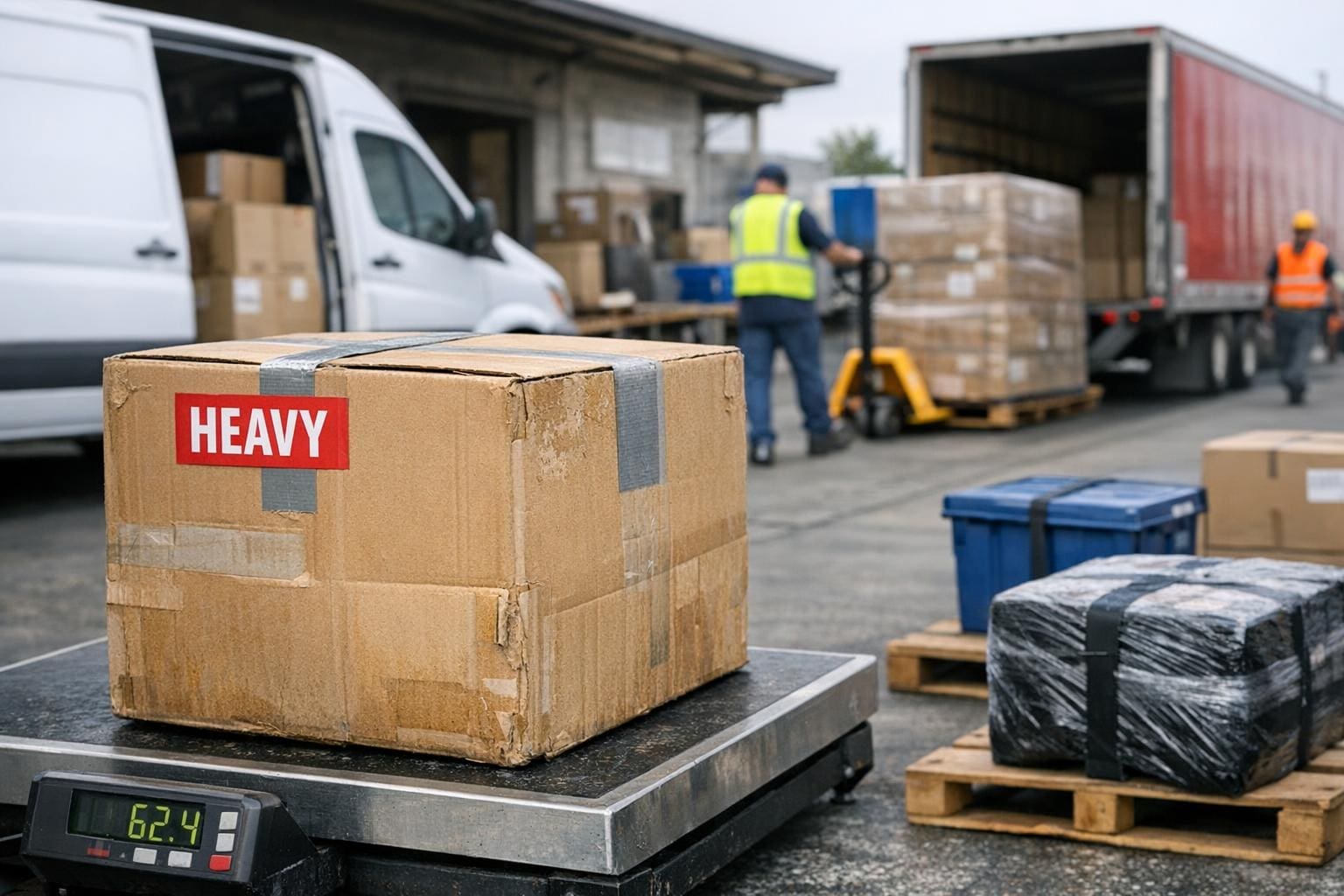
The freight bill just landed and your jaw dropped—those sky-high charges for that one bulky crate feel like a ransom demand. The good news? You don’t have to surrender your budget. The secret is choosing the right carriers, packing smarter, and exploiting lesser-known channels that slash costs without sacrificing safety. Read on if you want to transform sticker shock into savings and discover economical shipping options that actually make sense.
## Economical Shipping Options For Heavy Packages: 7 Shockingly Cheap Ways
Freight is not fate. Here are seven high-impact economical shipping options for heavy packages that can cut costs dramatically.
1) LTL (Less-Than-Truckload) Consolidation
– Why It Works: Your freight shares trailer space with other shippers, so you pay only for the portion you use.
– Best For: Medium-weight pallets and multi-piece loads that don’t need an entire truck.
– Note: Dimensional weight rules still apply. Accurate measurements and palletization are crucial to avoid surprise charges.
2) Freight Brokers And Online Marketplaces
– Why It Works: Brokers aggregate multiple carriers and negotiate bulk discounts. Marketplaces let you compare dozens of bids in minutes.
– Best For: Irregular routes, spot quotes, and one-off heavy shipments.
– Caution: Screen brokers for credentials and read guarantees about claims handling.
3) Regional Carriers And Shorthaul Specialists
– Why It Works: Regional carriers dominate local lanes and often undercut national players on price and delivery times.
– Best For: Routes within a specific region where density allows competitive pricing.
– Extra: Ask for regional LTL or guaranteed economy options.
4) Pallet Rate And Density Pricing Strategies
– Why It Works: Standardizing on pallets and maximizing density reduces per-unit handling and dimensional penalties.
– Best For: Repeated shipments with predictable dimensions.
– Tip: Use standardized pallet sizes to fit carrier rules and reduce manual handling fees.
5) Freight Forwarders And Ocean/LTL Intermodal Moves
– Why It Works: For cross-border or international heavy shipments, combining ocean plus inland trucking reduces air freight costs dramatically.
– Best For: International heavy package shipping where transit time is flexible.
6) Postal And Parcel Hybrids
– Why It Works: National postal services sometimes offer competitive large-parcel programs for heavy weight bands.
– Best For: Non-urgent domestic heavy package shipping that fits postal weight/dimension tiers.
7) Contracted Volume Discounts And Annual Agreements
– Why It Works: If you ship regularly, carriers will negotiate tariffs and surcharges under contract.
– Best For: Businesses with predictable monthly heavy shipments.
### What Drives Wild Price Swings In Heavy Shipments
Carriers aren’t just greedy—there are systematic reasons rates balloon:
– Dimensional Weight Rules: Large but lighter-than-expected packages are priced on volume, not mass.
– Origin/Destination Accessorials: Residential pickups, liftgate service, and limited access delivery add fees.
– Fuel Surcharges And Seasonal Demand: Rates spike with fuel price surges and holiday season capacity crunches.
Knowing these levers lets you target the cost drivers directly.
### How To Calculate The Real Cost Before You Book
To compare options, calculate a standardized landed rate:
– Step 1: Weigh and Measure Accurately (use calibrated scales and measure length×width×height).
– Step 2: Calculate Dimensional Weight: Carrier-specific formula—be sure to use the prospective carrier’s divisor.
– Step 3: Add Accessorial Estimates: Liftgate, residential, reconsignment, and handling fees.
– Step 4: Factor Transit Times And Insurance: Faster isn’t always worth the premium; insure appropriately for value.
When you compare apples to apples, the cheapest headline rate often isn’t the cheapest final bill.
## 2 DIY Remedies To Slash Costs On Heavy Shipments
These two remedies give practical, repeatable ways to lower your bills. Presented formally: materials lists and step-by-step application for each remedy follow.
### Remedy 1: Optimize Packaging And Palletization
#### Materials And Tools
– Standard-sized pallets (48″×40″ or regionally standard)
– Quality shrink wrap and pallet banding/strapping
– Edge protectors and corner boards
– Void-fill (recyclable foam or paper)
– Measuring tape and calibrated floor scale
– Heavy-duty cartons sized to product grouping
– Pallet jack or forklift access for staging
#### Step-By-Step Application
1. Group Products By Size And Weight: Consolidate items that fit together into uniform pallet loads to reduce irregular dimensions.
2. Choose Standard Pallet Size: Use the carrier’s standard pallet to minimize special handling and fit into standard trailer racking.
3. Stack For Density: Place heavier items on the bottom and pack tightly to reduce airspace; fill voids with recyclable fillers.
4. Protect Corners And Faces: Apply corner boards and edge protectors before strapping to prevent damage and reduce claims.
5. Secure With Strapping And Stretch Wrap: Use cross-strapping patterns; fully wrap top and bottom to lock the unit together.
6. Label Clearly And Include Handling Notes: Note “Do Not Double-Stack” or “Center Of Gravity” if needed to avoid rehandling fees.
7. Measure And Weigh Post-Palletization: Record final dimensions and actual weight—use these figures when requesting quotes.
This remedy reduces dimensional weight penalties, minimizes damage claims, and often qualifies shipments for pallet-rate discounts. The approach is formal, repeatable, and measurable.
### Remedy 2: Consolidate And Time Your Heavy Shipments
#### Materials And Tools
– Shipping manifest template and product SKU list
– Inventory report and demand forecast
– Access to freight marketplace or broker contacts
– Calendar for scheduling and cut-off dates
#### Step-By-Step Application
1. Audit Your Shipping Frequency: Identify shipments that can be delayed a few days without disrupting operations.
2. Consolidate Multiple Orders Into One Move: Combine single heavy shipments going to the same region into a single consolidated load.
3. Use Scheduled Weekly Loads: Set a recurring pickup cadence with a carrier or broker for predictable lanes to unlock lower rates.
4. Coordinate With Partners: Ask suppliers and customers if delivery windows are flexible to enable consolidation.
5. Solicit Multiple Quotes For The Same Consolidated Load: Provide the same standardized manifest to brokers and carriers for direct comparison.
6. Negotiate Volume Commitments: Offer predictable monthly volume in exchange for lower base rates and reduced accessorials.
Consolidation lowers per-unit costs, improves trailer utilization, and gives negotiating leverage—particularly for businesses with recurring heavy shipments.
### When To Use Each Remedy
– Use Packaging Optimization when dimensional weight or damage claims are eating your margins.
– Use Consolidation and Timing when you can accept slightly longer transit times for substantially lower per-shipment rates.
### Tools And Platforms That Let You Price-Shop Like A Pro
Shocking discovery: you no longer have to trust a single carrier’s quote. Use multi-carrier platforms and freight marketplaces to compare real-time offers. Look for tools that integrate:
– Dimensional weight calculators
– Instant LTL and FTL quoting
– Carrier scorecards and tracking integrations
These tools are essential for anyone trying to discover economical shipping options for heavy packages without manual phone calls and email chains.
### The Hidden Fees That Devour Savings
Most shippers forget accessorials and reweigh policies. Common traps:
– Reweigh And Re-measurement Claims: If your package differs from shipper-provided dimensions, you’ll be billed the higher measured rate.
– Address Correction And Residential Delivery Fees: Many warehouses are commercial; mislabeling costs money.
– Pallet/Packaging Reuse Fees: Some carriers charge for non-standard pallet types.
#### Pro Tips To Avoid These Traps
– Pre-measure using carrier divisors to pre-calculate dimensional weight.
– Use commercial pickup addresses where possible.
– Standardize pallet and packaging types to carrier-accepted specifications.
### Negotiation Tactics That Actually Work
Carriers respond to volume, predictability, and clarity. Present them:
– A documented shipping profile (weights, dims, lanes)
– Forecasted monthly volume and seasonal peaks
– A willingness to commit to quarterly reviews and performance metrics
These formalized data points give you leverage to secure contract rates and limit surcharge volatility.
### Real-World Case Study: Slash Costs By Combining Two Strategies
A mid-sized retailer reduced annual freight costs by 28% after:
– Standardizing pallet sizes and palletizing 90% of outbound loads.
– Switching 40% of lanes from national LTL to regional carriers.
– Setting up weekly consolidation pickups for three distribution corridors.
This demonstrates how packaging and carrier selection compound savings—precisely the advantage of pursuing economical shipping options for heavy packages.
### What To Ask Before You Book
– Will this carrier reweigh or re-measure at origin or destination?
– What accessorials are likely for my pickup and delivery locations?
– Are liftgate services included or extra?
– Is insurance or released value included, and what’s the rate?
Knowing the answers prevents post-shipment sticker shock and keeps your accounting predictable.
### Final Notes On Cost Versus Time Tradeoffs
Speed costs money. If your operation can tolerate slower transit, you can often choose slower economy lanes or intermodal moves that are a fraction of expedited truckload pricing. Balance customer expectations against the clear financial benefits of alternative economical shipping options for heavy packages.