## When Is Certified Mail For Legal Documents Necessary?
People assume the post office is simple: drop a letter, get a signature. But the question here is specific: is certified mail for legal documents required in court? Short answer: sometimes — it depends on the rules of the court, the type of document, and whether you need proof that the other side actually received the papers.
Some courts and statutes explicitly require a particular method of service. Others accept a range of techniques as long as you can prove delivery. For example, certain family law notices or administrative agency filings may demand a signed delivery confirmation. In other situations, a process server or sheriff must personally hand the paperwork to the recipient. You can’t rely on a one-size-fits-all rule.
### How Courts Treat Proof Of Service
Court rules are focused on one thing: did the party get notice? Proof of service shows the judge that the defendant or opposing party had the chance to respond. A signed card from the post office helps, but it’s only one kind of proof.
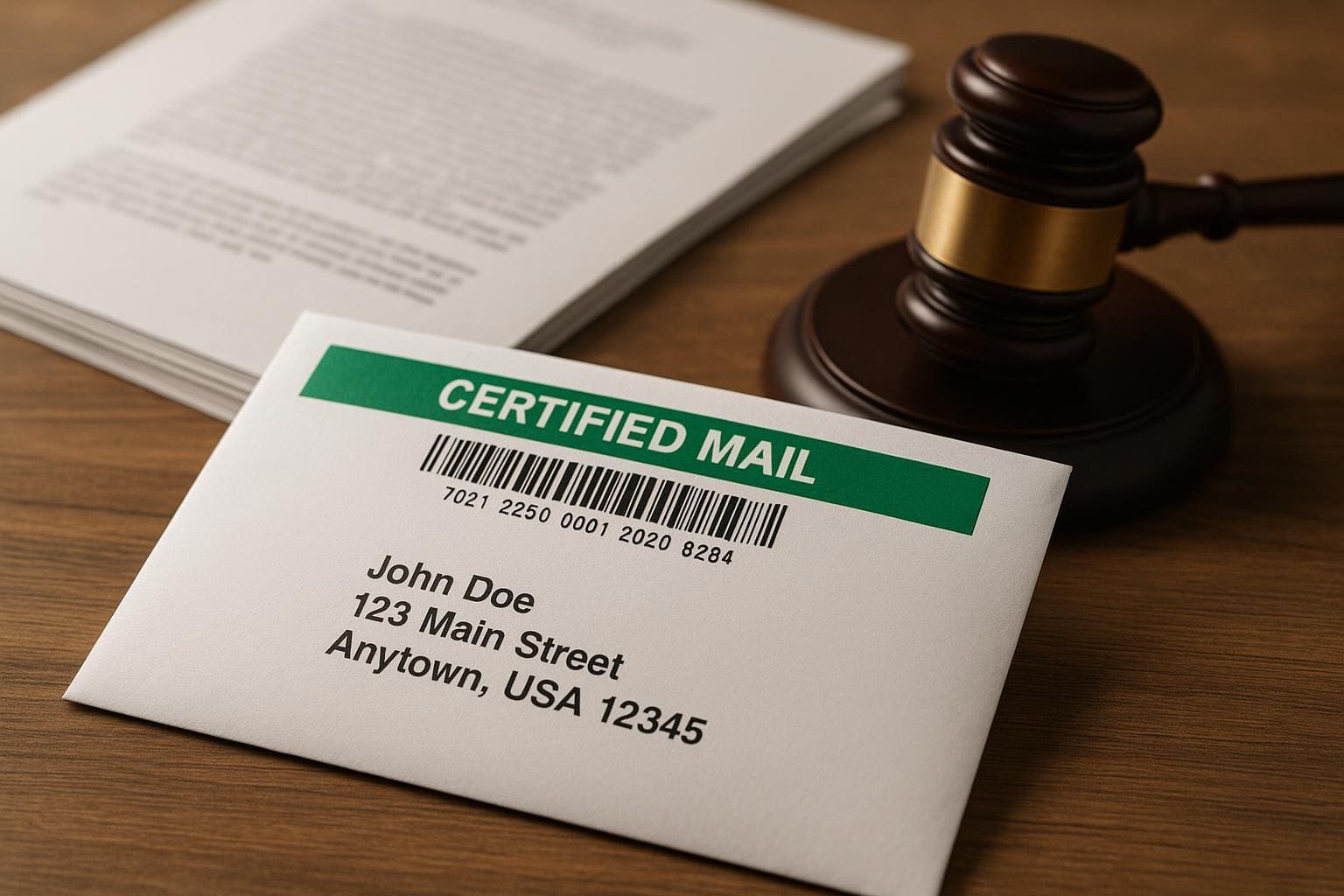
When you use certified mail for legal documents, you get a green-and-white or electronic record showing the item was mailed and, often, a signature showing who received it. That signature can be compelling. But some courts require a sworn affidavit or a formal proof of service that says exactly when and how the papers were delivered. In some jurisdictions, the affidavit must be notarized or filed on a specific form.
If a statute says “personal service” or “served in person,” certified mail alone won’t cut it. If the rules require “service by mail,” they may allow certified mail, regular mail, or even electronic service. Read your local rules carefully. A clerk at the courthouse can tell you which methods are acceptable, but don’t take oral advice as gospel — get it in writing or double-check the rulebook.
### What The Certified Mail Record Shows
Certified mail provides a dated mailing reciept and usually a tracking number. When delivery confirmation is requested, you receive a signed delivery record. Courts like concrete evidence. A signed delivery record ties a name to the event, which is stronger than a plain postage receipt.
But that evidence has limits. The signature might belong to a building manager, receptionist, or a person who never acknowledged the document’s legal importance. The court may allow it, or it might demand personal service. Also, tracking logs can sometimes be incomplete — packages show “delivered” but a signature image may be blurred or missing. If you rely on certified mail for legal documents, preserve every piece of paperwork: the mailing receipt, the tracking printout, and any postal return cards.
## Who Actually Requires Certified Mail For Legal Documents
Different players have different expectations. Administrative hearings, tax authorities, and some civil procedure statutes use mail as their primary service method. Conversely, criminal courts and many eviction proceedings insist on personal service.
A few examples:
– Tax notices and certain fines are often mailed certified because the agency needs a clear paper trail.
– Notices under landlord-tenant statutes sometimes specify mailed notice with proof of service.
– Small claims courts may accept certified mail as proof of service in some counties, but not all.
If you represent yourself, check the statute or the court’s civil rules before mailing. Attorneys usually know the local customs; if you don’t, ask the clerk for the rule citation and pull the relevant statute online.
### When Certified Mail Is The Safer Choice
If the rulebook isn’t crystal clear, choose the method that gives you the best evidence. Certified mail for legal documents is a strong, inexpensive way to show you tried to reach the other party. It costs more than regular postage, but it’s less costly than hiring a process server for every notice.
Think about the stakes. If a missed deadline could cost you a default judgment or a serious sanction, spend the money. Certified mail with a return receipted signature is cheap insurance compared with losing a case because the court says you did not properly serve the papers.
## Alternatives To Certified Mail
Certified mail is useful, but it’s not the only method. Here are commonly accepted alternatives:
– Personal service by a process server or law enforcement. This is the gold standard for many civil and family matters.
– First-class mail with an affidavit of mailing. Some courts accept a sworn statement that you mailed the documents to the correct address.
– Registered mail or restricted delivery. Registered mail adds a chain-of-custody layer. Restricted delivery forces the post office to give the item only to the specific addressee.
– Electronic service. Increasingly, courts permit email service — especially where the parties have agreed or the court has ordered it.
Each alternative has trade-offs. A process server can prove who they handed the papers to, which avoids disputes about whether a receptionist signed. Registered mail is slower and more expensive but creates a tighter trail. Electronic service is fast but only works where the parties consent or the rules allow it.
### Serving Someone Who Avoids Service
Some people try to dodge service. They skip town, avoid the porch, or refuse to sign the mail. If you suspect that, certified mail for legal documents may still help. It shows good-faith effort to notify. But courts also allow substituted service in many cases. That can mean leaving papers with someone of suitable age at the usual place of residence or posting the notice on the door and publishing it in a newspaper.
A judge will look at whether your method gave the person actual notice or was reasonably likely to do so. If you can document your attempts — dates, addresses, copies of returned mail — you increase your chance of success when you ask the court to accept substituted service.
## Practical Steps For Mailing Legal Documents
If you decide to use certified mail, do these things right.
### Prepare A Clean Paper Trail
Make copies of everything before you mail it. That includes the cover sheet, any attachments, and the envelope. Write the recipient’s full name and the address exactly as required by the court rules.
Purchase certified mail with return receipt requested. Keep the receipt stub that shows the tracking number. That stub is the primary proof you took the step to mail the item. If the return card comes back signed, staple that to your copy and file it with the court as part of your proof of service.
### Follow Filing And Timing Rules
Some documents have strict timing windows. Mail delays happen; don’t assume two-day delivery. If the rule requires service a certain number of days before a hearing, mail early enough to account for postal lag.
When you file papers with the court, attach the proof of service form required in your jurisdiction. Often that form asks for the date of mailing, the method, and who received it. Don’t improvise: use the court’s form if one exists. It avoids later arguments about compliance.
### Keep Records And Photographs
In addition to receipts, take a photo of the sealed envelope showing the postage and address. Keep calendar notes of when you bought and posted the certified mail. If the recipient claims they never received the papers, your documentation can rebut that claim.
## Cost, Speed, And Practical Limits
Cost matters. Certified mail with return receipt and delivery confirmation is not free. It’s a modest fee for most people, but it adds up in heavy litigation. Compare this with the cost for a process server or sheriff in your area.
Speed is another factor. Certified mail relies on the postal system, which can be slow. Registered or restricted delivery can add extra days. If time is tight, personal service is usually faster. Also consider reliability: certified mail delivery can be delayed without detailed notice from the post office.
### What If The Mail Is Returned As Unclaimed?
If the post office returns your certified mail as unclaimed, file that card or return envelope with the court and explain your attempts at service. Many judges will permit an alternate method based on that record. Sometimes a second mailing or substituted service will be ordered. The key is to document each step so a judge can see your effort.
## Common Mistakes And How To Avoid Them
Mistake: Relying on a stamped receipt alone. A stamped receipt shows you paid for postage; it does not prove delivery. Always pair it with tracking and a signed return card when possible.
Mistake: Mailing to an old address. Verify addresses before mailing. A forwarded address may not reach the intended recipient for legal notice purposes. If in doubt, do a quick public records search or ask the clerk how to verify.
Mistake: Not filing the proof of service on time. Filing the affidavit or return card late can be the same as not serving at all. Treat service steps as part of the litigation timeline.
Mistake: Assuming certified mail for legal documents is always enough. It isn’t. Read the statute or rule. If personal service is required, use personal service. If the court accepts mail, use certified mail and the proper forms.
### What Judges Look For
Judges want to avoid technical traps that deny a party the chance to be heard. If you can show a reasonable, documented effort to notify the other side, the judge will often allow some flexibility. If, however, you cut corners or fail to follow an explicit procedural requirement, the court may dismiss or delay your case.
Record-keeping is the single thing that separates a defensible mailing from a weak one. Keep every slip, form, and timestamped screenshot of tracking. Include the reciept stub in your filing packet. Those small steps make the difference.
## When To Consult An Attorney
If the stakes are high, get legal advice. Small mistakes in service can cost you a case. An attorney familiar with local practice knows when certified mail for legal documents will work, when you must use personal service, and when an affidavit is required.
An attorney can also handle tricky service situations: serving a corporation, a foreign defendant, or a party who is intentionally evading service. They’ll help you avoid wasting time and money on a service method the court will reject.
Keep in mind that courts vary. What works in one county might not pass muster in another. If you are handling a claim without counsel, a quick consult to confirm the proper service method can save a lot of trouble.