How To Fix USPS Tracking Not Updating With Clear Steps

how to fix usps tracking not updating

If a tracking page freezes and the delivery date slides further away, you can fix a lot of the problem yourself. Most of the time the issue isn’t a lost package; it’s a missing scan, a slow update, or a label that was created but never attached. Below are clear, practical steps to get information moving again — and what to do if those steps don’t help.

## How To Fix USPS Tracking Not Updating Quickly

Start here. If you search for how to fix usps tracking not updating, you’ll find a handful of common, repeatable actions that solve 80% of cases. Use them in order.

### Check The Tracking Number And Source

– Verify the number. Typing errors are surprisingly common. Copy the number from the seller’s email or the label and paste it into USPS tracking.
– Confirm you’re using the right carrier. Some sellers list multiple carriers; a “USPS” label might have actually been handed to UPS or a local courier.
– If the seller emailed a link, open that link rather than retyping the number.

### Wait A Short Window Before Worrying

The system often lags. If the label was created but the package hadn’t entered the mail stream, updates can take 8–24 hours. If the shipment is international, allow several days for the first inbound scan.

### Check For The “Label Created” Status

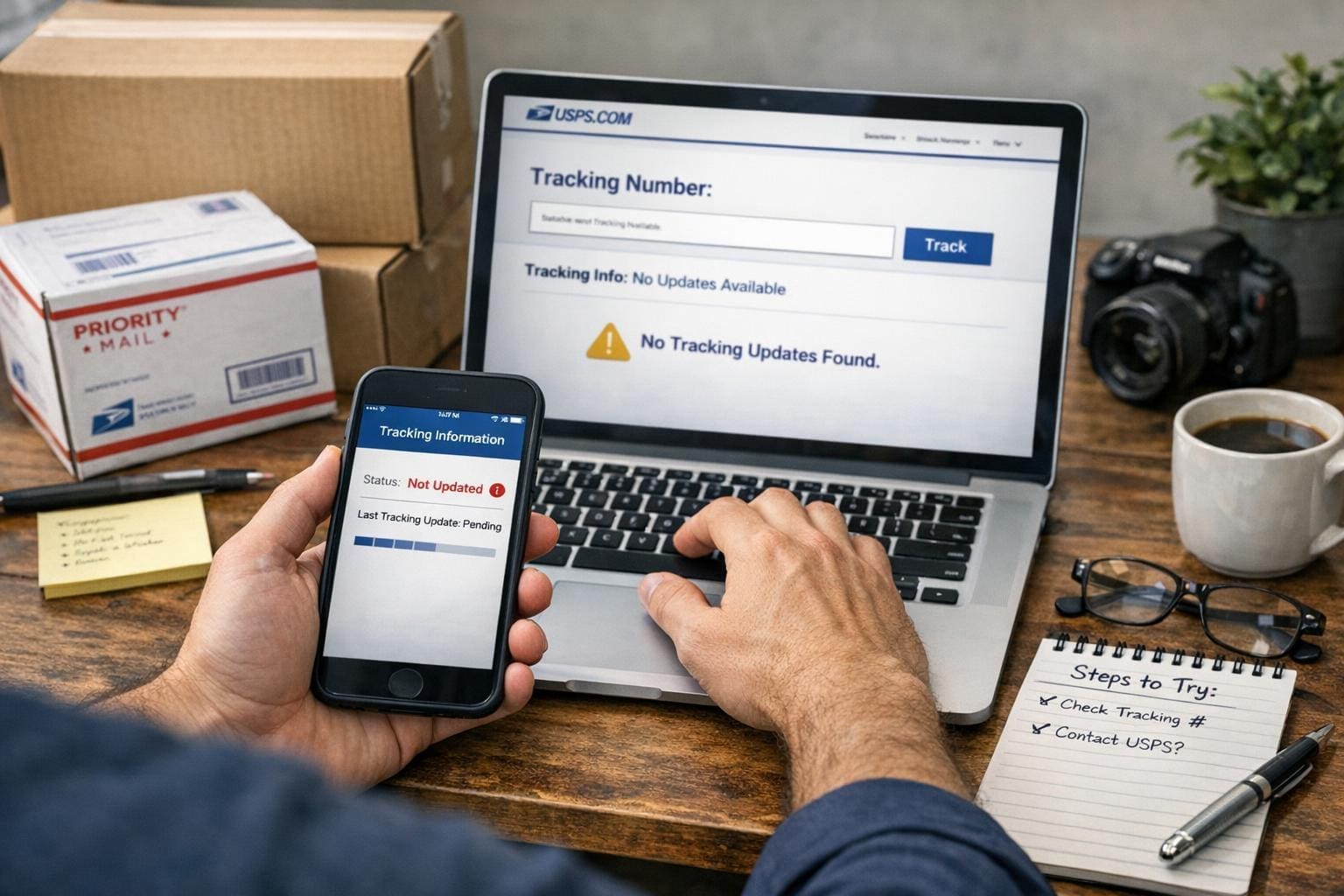
If the page reads “Label Created, USPS Awaiting Item,” the carrier hasn’t actually scanned the package yet. The fix here is simple: contact the seller and ask whether the item has physically been handed to the post office. Sellers can provide proof of drop-off or arrange a reshipment.

### Refresh With Another Device Or Network

Sometimes the tracker in your browser is caching an old page. Open the tracking number on your phone with mobile data, or use a different browser. This is basic, but it works more often than you’d expect.

### Use The Mobile App And Text Alerts

The USPS app sometimes pulls different data than the website. Turn on text or email notifications. If you’ve ever set up continuous alerts, they can show you when a new scan arrives before the site fully updates.

## Common Reasons Tracking Stops Updating

If the steps above don’t free things up, match your situation to one of these causes. Identifying the root makes the next step obvious.

### Label Created But Package Not Scanned

A seller prints a label and doesn’t actually drop the parcel off. That looks like delivery activity but won’t produce further scans. If you’re the buyer, ask the seller for a drop-off receipt or new tracking.

### Missed Scans At Sorting Facilities

Packages move physically but miss a scan due to operator overload or machine error. The item moves and then three scans later shows up at your local facility. That gap is frustrating but usually temporary.

### Human Error Or Incorrect Address

If the address is wrong, the package may be returned to sender or held for correction. Check the address on your order confirmation. If it’s wrong, contact the seller immediately.

### Delays Due To Weather Or Volume

Holidays and storms slow everything. Packages pile up and scanners aren’t the priority. The package still moves; updates come once staff catch up.

## How To Fix USPS Tracking Not Updating: Practical Steps For Each Cause

Below are targeted fixes for the specific scenarios above.

### If The Label Was Created But Not Dropped Off

1. Message the seller asking when the package was dropped off. Request a drop-off receipt or proof.
2. If the seller admits they haven’t shipped, ask for a full refund or immediate reshipment.
3. If the seller insists it was dropped, ask them to file a missing mail request with USPS; they can do that from their end.

### If Scans Were Missed In Transit

1. Give it 48 hours. Often the next facility will retroactively upload scans.
2. Check the estimated delivery date rather than the last scan time. If the date hasn’t passed, wait.
3. If the date passes and no update, file a missing mail search on the USPS site. Include photos and purchase records when applicable.

### If The Address Is Wrong

1. Contact the seller immediately. The faster you act, the more likely USPS can intercept or correct.
2. If the sender agrees, they can request an address correction through USPS. There’s a chance the package gets redirected without returning to sender.
3. Keep evidence of the correct address and the mistake. That helps claim disputes.

### If Weather Or Volume Is The Problem

1. Track the local facility’s status on social media or news. If your area had a storm, expect delays.
2. If the package is time-sensitive, call the seller to arrange a replacement or refund. Don’t wait for an indefinite scan update.

## Using USPS Tools And External Options

USPS provides tools designed for problems like this. Use them before escalating.

### File A Missing Mail Search

You can submit a Missing Mail Search online. Be specific: include expected delivery dates, item description, photos of packaging or receipts, and the tracking number. This alerts USPS to look through facilities in a more manual way.

### Request Delivery Instructions Or Intercept

If the package still shows activity and is eligible, you can request delivery instructions or file a Package Intercept. There’s a fee and strict eligibility rules, but it can reroute a parcel before it’s delivered to the wrong address.

### Use Third-Party Trackers

Services like 17track or AfterShip sometimes pick up different feed data. They’re not magic, but they might display a scan that USPS’s public page hasn’t shown yet.

## When To Contact USPS Directly

Contact USPS when 48–72 hours pass with no scans and the expected delivery date has passed. Or sooner if the item is high value.

### How To Contact For Best Results

– Call customer service and have your tracking number, order receipt, and sender/recipient details ready.
– If you prefer in-person, visit your local post office with the tracking number and a printed label or order confirmation. Ask the clerk to check the physical sort or to confirm whether the package is in the facility.
– Use the USPS online form to open a case. Use attachments. A photo of the label, the order, and any receipts helps.

### What To Expect From USPS

They will open an inquiry and often respond within a few business days. For some regional facilities, response times can stretch longer. If the item is insured and lost, follow their claim process; that requires proof of value and purchase.

## Seller And Buyer Responsibilities

These problems usually fall into two camps: seller-side or transit-side. Sellers are responsible for actually handing over the package and providing proof. Buyers should verify addresses and follow up quickly if scans stall.

### Sellers Should

– Confirm drop-off with a receipt.
– Reprint labels only when necessary.
– File missing mail requests if the package doesn’t show movement.

### Buyers Should

– Check the tracking link right away.
– Contact sellers immediately if status seems stuck.
– Keep records of communication and receipts for claims.

## Preventing Tracking Issues Going Forward

Fixing one frozen tracking number is satisfying, but prevention is better.

### Ask For Proof Of Drop-Off

If you’re buying something valuable, ask the seller to show a drop-off receipt or to use delivery confirmation. Sellers who ship frequently will have no problem with this.

### Use Carrier Pickup Or Hand-Delivery

When sellers schedule a USPS pickup or hand-deliver at a counter, there’s a scan at acceptance. That reduces “label created” problems.

### Choose Tracking With Insurance For High-Value Items

Insurance requires documentation if something is lost. It also forces a more thorough investigation when tracking gaps occur.

## Quick Troubleshooting Checklist

If you need a fast run-through, here’s what to do in order:

1. Verify tracking number and carrier.
2. Check for “Label Created” status.
3. Refresh on another device or app.
4. Wait up to 48 hours for missed scans.
5. Contact the seller to confirm drop-off or correct address.
6. File a Missing Mail Search with USPS if the date passes.
7. Call or visit your local post office if you need immediate help.

A single mis-scan can feel like a disaster, but most problems are solvable with a few calls and one or two forms. If you need help with the exact wording to send a seller or the USPS when filing a search, I can draft a message you can copy and paste. Just tell me what you’ve tried and what the current status says — I can work from there.
Bubble Mailer Vs Box Which Is The Superior Shipping Choice?

bubble mailer vs box

You don’t get a second chance to stop a dented product from ever reaching a customer. Pick the wrong package and you’ll pay for it with returns, refunds, and a bad review. Pick the right one and the whole process runs smoother, cheaper, and less stressful.

## Bubble Mailer Vs Box: How To Choose
When you boil it down, the bubble mailer vs box decision is a trade-off between weight/space and protection. Both options have clear advantages and clear limits. Use the wrong one and you’re either wasting money on postage or gambling with the item’s safety. Use the right one and shipping becomes routine.

### Weight And Dimensional Pricing
Shipping carriers charge for actual weight and sometimes dimensional weight. Boxes fill space; if a box is large but light, carriers may bill you for more than the physical weight. A padded poly bubble mailer often saves money for small, light, non-breakable items because it compresses and keeps the package compact. That’s where bubble mailer use really shines.

However, when an item needs a lot of filler to stop it from moving inside a box, the extra cubic inches can push you into a higher dimensional weight bracket. In those cases a snugly fitted box or a smaller parcel often costs less than stuffing a large box with cushioning. The math changes depending on carrier and destination, so run a few postage estimates before committing.

### Protection And Product Type
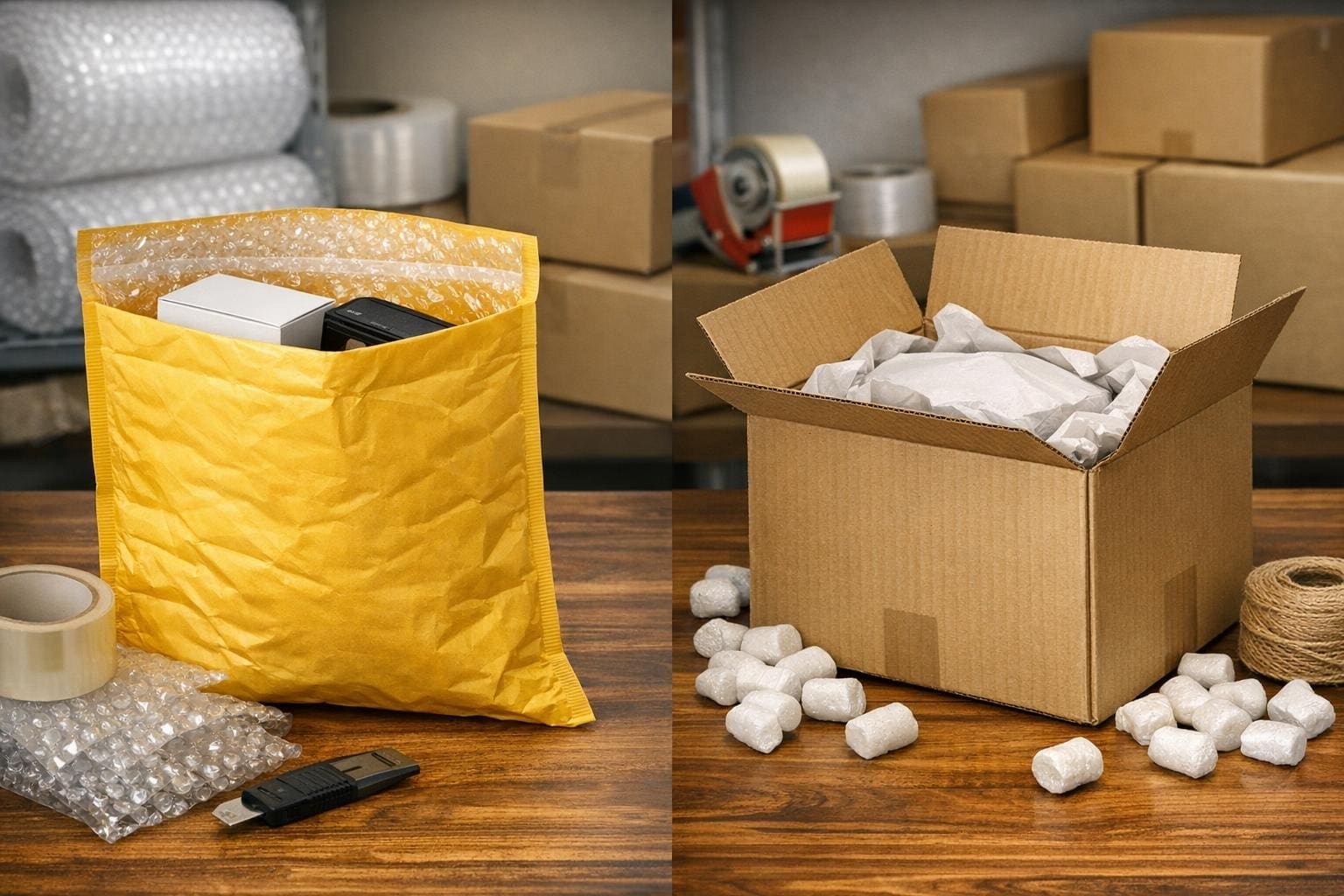
Not all products are created equal. Soft goods like tee shirts and fabric masks can survive a ride in a bubble mailer with minimal padding. Hard, brittle, or oddly shaped items usually need the stable, rigid protection a box provides.

A box will absorb crushing, point loads, and repeated stacking better. Corrugated walls resist punctures and distribute force. But don’t assume a box fixes everything: a fragile item in a box with nothing to stop internal movement is still vulnerable. That’s where good packing technique matters as much as the outer package.

#### Small, Flat Items Work Better In Mailers
Prints, small books, stickers, and jewelry in branded pouches often ship fine inside a bubble mailer. The mailer keeps things compact and reduces materials used. For art prints, slip a piece of chipboard in front and back to stop creases. For jewelry, use a tiny box inside the mailer if there’s any concern about snagging.

#### Fragile Or Multi-Item Orders Should Use Boxes
If you ship a set of items, or anything with a screen or glass, go with a box. Use corrugated inserts, kraft paper, or biodegradable foam peanuts to eliminate movement. Double-boxing is rare but useful for high-value electronics or fragile ceramics that might face rough handling.

### Cost And Speed Trade-Offs
The total cost isn’t just postage. You pay for the outer package, any inner packing, label printing, and return costs if a claim is made. Bubble mailers are cheap to buy and fast to pack. Boxes cost more to stock and take longer to assemble. But a damaged product shipped cheaply can be more expensive than a slightly pricier box that arrives intact.

For fast shipping, carriers handle mailers differently at sort hubs. Mailers move quickly because they collapse; boxes get stacked and scanned differently. If you sell high volumes and your goal is predictable delivery times, standardizing to a mailer or a box size reduces surprises.

## Packing Practicalities And Branding
Packaging is also a brand touchpoint. A clean box with tissue, a thank-you note, and a secure fit creates a better unboxing experience than a plain mailer for premium goods. But keep it honest: don’t wrap a fragile glass item in a flimsy pouch just because it looks good.

### Storage And Assembly
Space matters in a real way. Flat mailers occupy a fraction of the storage footprint of boxes. For small sellers with limited space, keeping a few sizes of mailers is easier than dozens of box sizes. Boxes take time to fold, tape, and label. That labor cost scales every day.

If you’re shipping seasonally, mailers let you expand capacity quickly without buying a bunch of box sizes. They stack flat, are lighter to carry, and speed up packing lines. On the other hand, if you’re shipping a consistent product mix, having a couple of right-sized boxes can reduce postage and protect items better.

### Sustainability And Materials
Paperboard boxes are widely recyclable; corrugated cardboard is collected by most municipal programs. Bubble mailers are trickier. Many padded poly mailers are mixed materials—plastic outer layer, air bubble lining—making them harder to recycle in curbside programs. Some brands offer paper padded mailers or recyclable poly mailers, but you should check local recycling guidelines.

Sustainability is part of customer perception. If you claim to be eco-friendly, shipping in a single-use padded poly bag may feel off-brand unless you’ve chosen recyclable or compostable options. For returns, reusable packaging ideas are growing, but they work best with boxes rather than single-use mailers.

## When To Use Each: Practical Rules
There’s no single rule that fits every seller, but a few practical thresholds help decide between a bubble mailer and a box.

– If the item weighs under one pound, is small, and won’t be crushed, a bubble mailer is usually cheaper and faster.
– If the item is fragile, oddly shaped, or part of a bundle, choose a box for predictable protection.
– If dimensional weight jumps your postage, find a smaller box or a mailer that keeps inches down.

Think of it like triage. Low-value, soft items go in mailers. High-value or fragile items go in boxes. Mid-range items need a case-by-case look at postage math and materials cost. Also consider returns: a broken product generates a higher return burden than saving a few cents on postage.

### Real-World Examples
Shipping sunglasses? A small corrugated tuck box inside a padded mailer works well. That combines the compactness of the mailer with the structure of a small box. A single paperback book usually fits fine in a bubble mailer with a bit of cardboard to prevent bending. Phone accessories like cases travel well in mailers too.

For a ceramic mug or a framed print, choose a box and pack it properly. Multiple items that fit together tightly in a box reduce the need for filler. For a set of three small glass bottles, a box with dividers solves the problem; a mailer would be a gamble.

When you sell high-ticket items like electronics, always default to a box and insure the package. The cost of a claim is not worth the few dollars saved on packaging. Keep the reciept and photos when you pack; carriers ask for evidence during claims.

## Quick Decision Flow
Ask three questions: How fragile is the item? How big is the item? What’s the postage math? If fragility is low and size is small, pick a mailer. If fragility is moderate to high, pick a box. If dimensional weight inflates postage, try a smaller package or a different carrier rate. That simple flow handles most day-to-day choices without overthinking.

### Mailer Vs Box: Customer Experience Considerations
Customer perception matters. Someone buying a premium candle expects a carefully packed box with branding, not a crumpled mailer. Conversely, a customer buying a basic phone cable wants speed and a fair price. The mailer vs box decision should match the product’s price point and the brand promise.

### Bubble Mailer Vs Box In High-Volume Operations
If your operation ships hundreds of packages daily, standardize. Choose a small set of box sizes and a couple of mailer types that cover the majority of SKUs. Measure your top-selling items and create packing templates. Automation saves time and reduces mistakes. Use weight sensors and pre-configured postage settings to avoid surprises. In high-volume contexts, the minor cost difference between mailers and boxes compounds quickly, so test both for a few weeks and compare damage and return rates.

Make the choice based on predictable logic, not habit. If damage rates spike after switching from boxes to mailers, switch back. If postage bills fall without a rise in returns, you’ve found a better option. Keep records, test packaging changes, and iterate.

There is no universal winner in the mailer vs box debate. The right pick depends on the product, the shipping lane, and the expectations you want to set. Choose deliberately and pack like you mean it.

Order Free USPS Shipping Supplies Online For Businesses

order free usps shipping supplies online

## How To Order Free USPS Shipping Supplies Online

If you run a small business and ship product regularly, you should be ordering free usps shipping supplies online. It’s not glamorous, but the right boxes and envelopes save time, protect goods, and keep costs predictable. USPS makes a lot of common items available at no cost—Priority Mail boxes, flat-rate envelopes, labels—and you can request them for delivery to your business address. That alone removes one more chore from your workflow.

### Which Items You Can Request

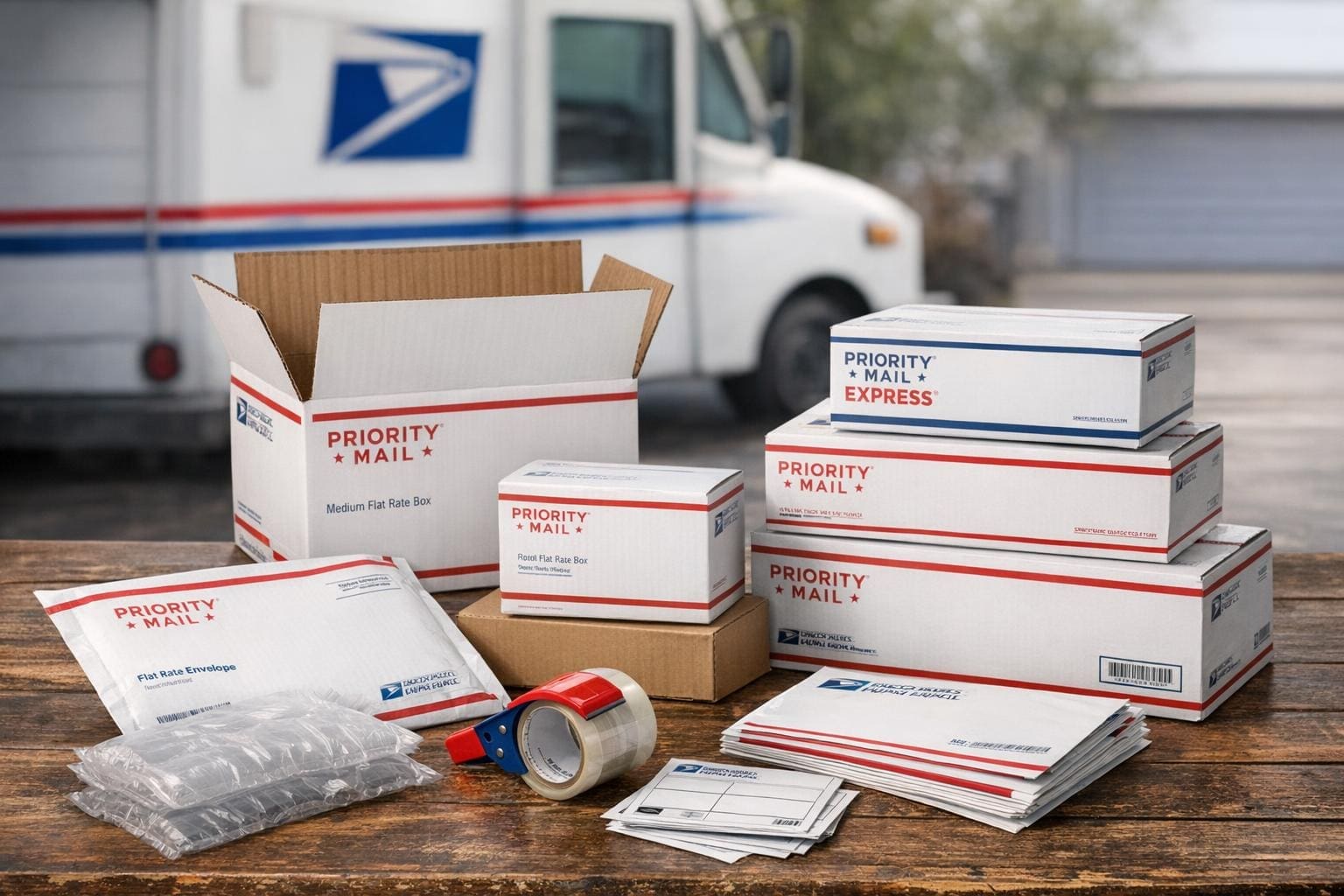
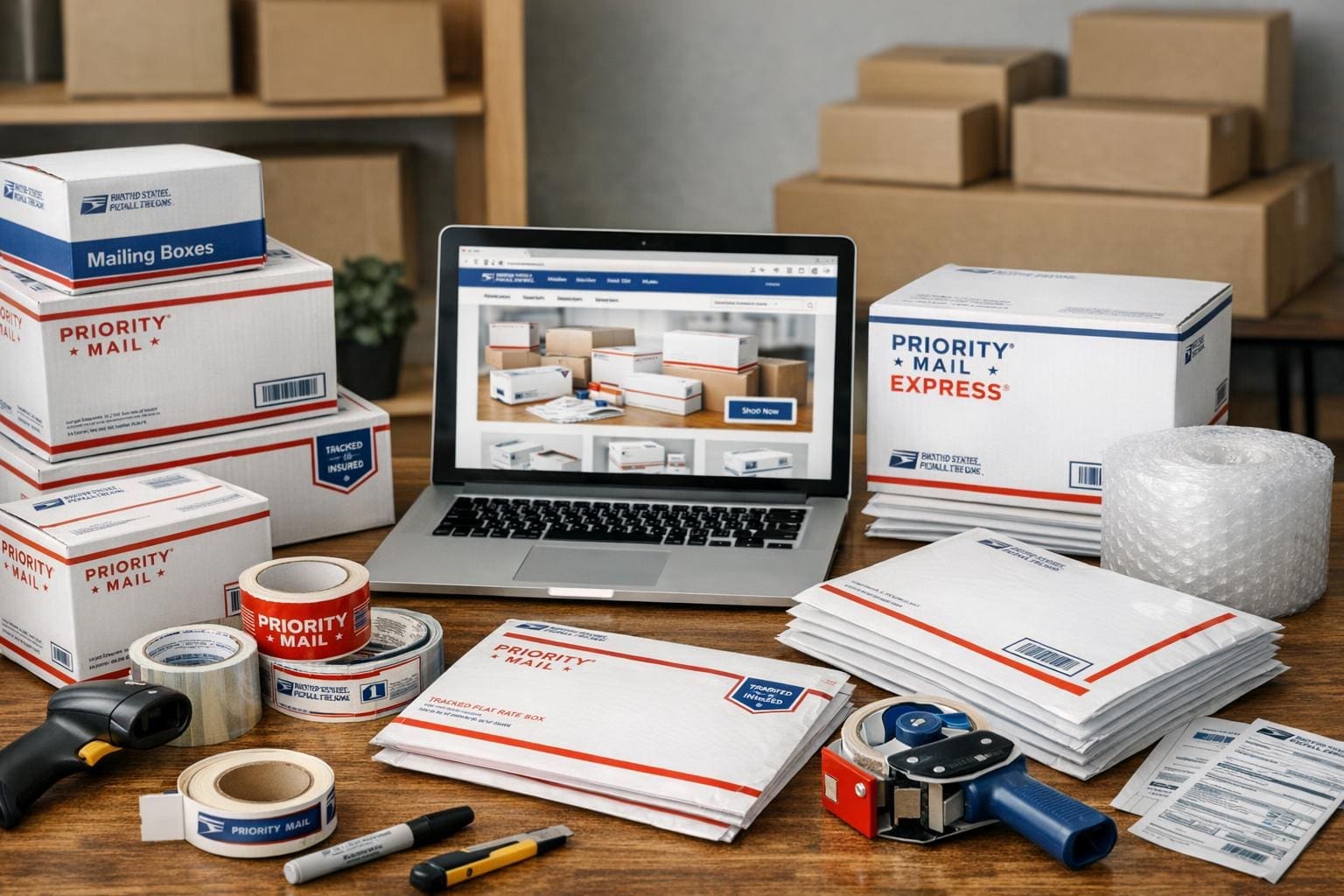
USPS offers a surprisingly long list of free items. The obvious ones are Priority Mail and Priority Mail Express boxes in various sizes, plus padded flat-rate envelopes. They also provide free padded and non-padded mailers, large parcel boxes, and small reclosable bags for small parts. For businesses that ship apparel or soft goods, poly mailers are a useful free option when available.

#### Specifics You Should Know

– Priority Mail boxes come in standard and flat-rate sizes. Use the flat-rate ones when weight would otherwise push shipping costs up.
– There are also free labels and prepaid postage supplies tied to Click-N-Ship and Business Customer Gateway services.
– Customs forms for international shipping can be printed from USPS and, in many cases, supplied physically for you to fill out.

### How To Order: Step By Step

First, set up an account on the USPS website if you don’t already have one. From the Business Customer Gateway or the main supplies page, you can place requests for shipment. The usual flow is straightforward: choose the items you need, add them to a cart, and provide a delivery address. Then wait for the supplies to show up at your door.

You can also schedule bulk deliveries if you place frequent, larger orders. That’s handy if you prefer to have a known supply rotation and avoid a last-minute scramble before peak selling days.

### Why Businesses Should Use The Free Options

There’s a practical side to using free usps supplies beyond cost savings. These boxes and envelopes are designed to meet USPS specifications—meaning they’ll fit automated sorting equipment and reduce the risk of manual handling delays. That matters when you’re trying to get orders out quickly. You’re also likely to avoid problems with box crush or tape that fails in transit because the USPS packaging is made for shipping, not retail display.

### Limits, Wait Times, And Availability

USPS doesn’t give unlimited supplies to every request. Limits depend on the item and on demand. During high seasons, some boxes run out sooner. Expect delivery of ordered supplies in about 3–7 business days in most areas. If you need something faster, you can sometimes pick up supplies at a local Post Office if they have inventory.

If you notice consistent shortages of a particular size, you can alter packaging choices—use slightly larger boxes with packing fill, or consider reusable packaging that you keep in stock. The key is to adapt rather than rely only on one size or style.

### Integrating Orders With Your Shipping Workflow

When you order free usps shipping supplies online, think about how they fit into your packing line. Keep commonly used sizes at arm’s reach, and store specialty items in a separate bin. Mark the inner dimensions and weight limits on storage shelving; that avoids mistakes when someone else packs orders.

For businesses using shipping software, many systems tie directly into USPS. That means once you buy labels through Click-N-Ship or a third-party provider, you can print postage and drop off packages. Some services even print pre-paid return labels you can include in outbound shipments.

### Small Business Hacks For Saving Time And Money

A few practical moves make a real difference. Pre-print commonly used labels or use a thermal label printer to speed up packing. Order a steady supply of the padded mailers and one or two sizes of boxes that cover most SKU sizes. For heavier items, learn the thresholds where parcel pricing jumps and pick packing strategies that minimize crossing that line.

If your business does a lot of returns, request free return envelopes and set up an easy returns process. It reduces friction for customers and can lower customer service costs. You can also schedule weekly pickups so you don’t waste time driving to the post office.

### Understanding Priority, Flat Rate, And Commercial Pricing

USPS’s free supplies often pair with Priority Mail and flat-rate options. Flat-rate boxes are handy when weight is high but dimensions are consistent. If you ship in high volumes, you may qualify for commercial pricing, which lowers postage compared to retail rates.

Order free usps shipping supplies online and then compare postage options in your shipping software. In many cases, buying supplies and shifting packaging choices reduces overall freight expense.

### International Shipping Considerations

When sending packages overseas, customs paperwork is key. USPS provides customs forms online and sometimes supplies physical forms with orders. Keep spare CN22 or PS Form 2976 packages handy if you do a lot of international fulfillment.

Be mindful of country-specific restrictions and required labeling. The wrong paperwork holds up shipments for days. If you ship internationally regularly, invest time in learning the typical hold-ups per destination.

### Branding Without Sacrificing Cost

Free usps supplies are plain by design, but you can brand without inflating costs. Use self-adhesive logo stickers, branded packing tape, or printed inserts inside packages. These small touches create a better unboxing experience without needing custom boxes.

If you want to add a gift-like presentation, tuck a thank-you card into the package. It’s inexpensive, and customers notice.

### What To Do If Items Don’t Arrive Or Are Damaged

If an order for free supplies doesn’t arrive, first check your order status on the USPS site. If it’s marked delivered and you didn’t recieve it, file a missing mail search. For damaged supplies, photos help when you report the issue. Keep records of what you ordered and any discrepancies—this speeds up resolution.

### Automation And Bulk Ordering For Larger Operations

Larger businesses can make ordering supplies part of a recurring process. Many fulfillment shops set automatic monthly orders for their most-used items. That keeps inventory flowing without manual reorders.

If you ship thousands of packages a month, talk to your USPS representative about supply programs. They can sometimes tailor delivery schedules to your needs and help ensure consistent availability.

### Common Packing Mistakes To Avoid

People often choose the wrong sized box—either too big or too small—and both choices cause problems. Oversized boxes mean higher shipping costs and risk of contents shifting; undersized boxes risk crushing. Don’t forget to measure girth correctly for cylindrical items.

Insufficient cushioning is another repeat offender. Even with a sturdier USPS box, items that can move need protection. Add bubble wrap, crumpled paper, or packing peanuts where necessary.

### Where To Find The Best Help And Documentation

USPS has clear online guides for business customers. The Business Customer Gateway has resources for commercial pricing, bulk pickups, and label printing. There are also community forums and shipping blogs with real-world tips—places where you’ll find the kind of tacit knowledge post office staff won’t always volunteer.

### When To Consider Third-Party Supplies

Sometimes you need special packaging that USPS doesn’t provide—branded boxes, rigid inserts, or unique sizes. In those cases, supplement free usps supplies with third-party packaging purchased in bulk. Balance the budget: use free USPS items where they work, and spend on custom pieces only where they add measurable value.

### Final Practical Notes On Ordering

When you order free usps shipping supplies online, use an address that will reliably accept deliveries—ideally the business address where staff can put orders away immediately. Track inventory monthly and set reorder triggers so you’re never down to the last box. And remember: small tweaks—like switching a popular SKU to a poly mailer—often drop costs more than negotiating shipping rates.

Keep these habits up and shipping becomes one less thing to think about. With steady supply planning and simple systems in place, you’ll feel the difference in both time saved and fewer packaging headaches.

Free Priority Mail Envelopes Explained To Cut Shipping Costs

free priority mail envelopes explained

You can save a surprising amount on shipping if you treat USPS’s free packaging as a tool, not an afterthought. Use the right envelope, crate your items correctly, and the savings add up. Here’s a practical walkthrough that shows how to use those free Priority Mail envelopes without getting tripped up by size limits, unnecessary insurance, or bad packaging choices.

## Free Priority Mail Envelopes Explained: How They Work
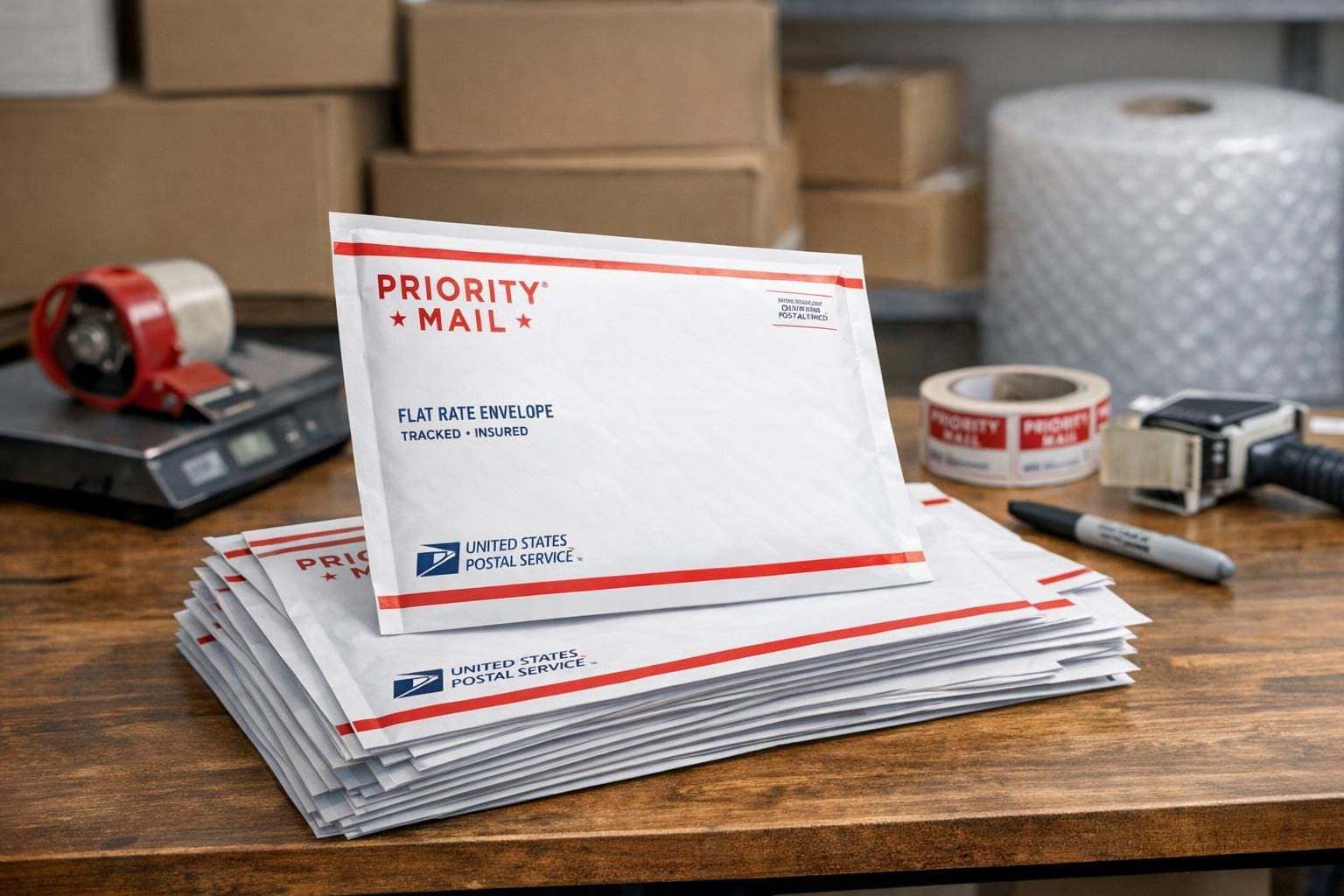
Free priority mail envelopes explained starts with a simple fact: USPS provides branded packaging at no charge for most Priority Mail shipments. That doesn’t mean every package is free to ship — postage is still paid — but the envelopes themselves are costless if you use the service. The advantage is twofold: you avoid paying for a third-party box or padded envelope, and you get packaging designed to meet USPS handling standards.

These envelopes come in different shapes and sizes: flat-rate envelopes, padded envelopes, and legal-size options. Flat-rate means the postage is fixed regardless of weight (up to the service limit). If your item is dense or heavy but fits the flat-rate envelope, you could come out ahead versus paying by weight. Conversely, if the item is light and bulky, the weight-based option might win. Free priority mail envelopes explained shows up again when comparing those scenarios: you need to match the envelope type to the item, not vice versa.

### Where To Get Them
USPS gives priority mail envelopes away at post offices, and you can order them online for delivery. If you run a small operation, stash a box of envelopes for regular use. The process is straightforward: request them in person or use the USPS online store. Orders usually ship for free, and you’ll recieve the supplies within a week or so.

#### Are There Limits Or Rules?
There aren’t strict purchase limits on how many free priority mail envelopes you can order for business use, but be practical. If you start ordering pallets of boxes for resale, USPS might question the intent. Also, envelopes must be used for USPS shipments only. Don’t reroute them to other carriers or use them for private deliveries — that can void the convenience.

## When Free Envelopes Cut Costs And When They Don’t
The short answer: use flat-rate free priority mail envelopes when weight would otherwise push postage above the flat-rate price. For example, shipping a 3-pound dense item in a flat-rate padded envelope often costs less than calculated weight-based postage. But if you ship a 12-ounce sweater that needs a cushioned bag, a lightweight poly mailer plus weight-based postage might beat a flat-rate envelope.

Free priority mail envelopes explained matters at the margins. If your typical package is under a pound and not dense, don’t force it into a flat-rate envelope just because it’s free. Also watch dimensions. Flat-rate is great for small heavy goods, not for awkward big-but-light items.

### Real-World Examples
Imagine sending hardcover books. A single book may fit comfortably in a flat-rate envelope and the fixed price could be cheaper than the weight-based rate. Now imagine sending a 2-inch-thick pair of boots; those may not fit, and trying to cram them can lead to damage or reclassification at the counter.

If you sell jewelry or electronics, padded flat-rate envelopes are often ideal — small, dense, and sensitive to bumps. On the other hand, art prints that must lie flat and be larger than standard envelopes often require custom packaging, and the free envelope won’t help.

#### Watch For Dimensional Pricing
USPS also calculates postage using dimensional weight in certain services. That means a large, light package can be charged as if it were heavier. Free priority mail envelopes explained includes recognizing when dimensional pricing might apply and choosing the envelope accordingly.

## How To Order And Stock Smartly
Order envelopes online for convenience, but keep a small inventory at your workspace so you’re not scrambling. Use the USPS website to request supplies; pick padded envelopes if you ship fragile small items, and flat-rate legal envelopes for documents and thin goods. The free supplies are a small time-saver, but the real value is consistency — standardized packaging makes measuring, labeling, and dropping off quicker.

### Organization Tips For Small Businesses
Label your stash by size and keep a few backups. Store paperwork like return labels and a small roll of packing tape nearby. Train whoever packs shipments to choose the right envelope type and to avoid overstuffing. Overstuffing ruins the envelope’s protective design and can lead to damaged goods or rejected packages at the post office.

#### Don’t Skimp On Protective Measures
Even with padded free priority mail envelopes, fragile items sometimes need more cushioning. Use inexpensive bubble wrap or corner protectors inside the envelope. The USPS pads help, but they’re not meant to replace proper internal packing for fragile electronics or glass.

## Common Mistakes That Lose You Money
One mistake is confusing “free envelopes” with “free shipping.” The USPS supplies packaging for free, but postage still applies. Sellers who advertise “free shipping” but absorb postage without adjusting their pricing are the ones eating the cost. Another mistake: choosing flat-rate envelopes for large, light items out of habit. That’s a fast way to pay more.

Free priority mail envelopes explained also warns against assuming the envelopes are unlimited in size. If your item bulges the seams, you’ll lose the benefits and likely get charged for a different category.

### Mislabeling And Insurance Pitfalls
Never cover preprinted USPS branding or barcodes on the envelope. And if you apply postage by printing labels at home, make sure the barcode is unobstructed. If you rely on included Priority Mail insurance, know the limits. The basic coverage may not be enough for high-value items and you might want to buy additional insurance or require a signature on delivery.

#### What About Returns?
Many sellers include return labels in their shipments. Offering a USPS-branded return envelope can reduce friction for buyers. But if returns are frequent and heavy, the cost of those free envelopes plus return postage can add up. Instead, consider requiring the buyer to pay return postage or offering store credit.

## How To Combine Free Supplies With Online Shipping Tools
Use online postage tools to compare flat-rate vs. weight-based pricing before buying stamps. Tools integrated into marketplaces will usually calculate the cheapest option, but you should double-check for unusual sizes. Free priority mail envelopes explained becomes actionable here: knowing your typical package weight and size lets you preselect envelope types in your shipping profiles.

### Printing Labels And Drop-Offs
Printing labels at home often includes discounted postage compared to buying at the post office. After printing, drop packages at a post office, leave them in a USPS collection box if size permits, or schedule a carrier pickup. Carrier pickup is especially handy for shops that ship multiple items daily.

#### Avoiding Last-Minute Surprises
Weigh and measure your packaged item after boxing it to get accurate postage. The customer will appreciate predictable shipping charges, and you’ll avoid additional collected postage at the counter. If you ship internationally, remember different rules apply and free priority mail envelopes are generally for domestic Priority Mail services, unless specific international equivalents are offered.

## What The Small Print Often Overlooks
Free priority mail envelopes explained should include a look at branding. The USPS requires the packaging to remain its property. Don’t alter logos or remove tracking barcodes unless you are the one applying a new postage label. Also, free supplies are intended for actual mailing; bulk harvesting for third-party sales or non-mail uses is discouraged.

### Sustainability And Recycling
If you care about waste, free priority mail envelopes can be reused for returns or repackaging, and many are recyclable depending on material. Padded envelopes with plastic lining aren’t always recyclable curbside; separate those for special drop-off programs when possible.

#### Hacks To Stretch Value
Double up for extra protection: place a fragile item inside a free padded envelope, then into a small box. For very dense items that benefit from flat-rate pricing, pack them snugly to avoid shifting. And always compare the postage for the same item across envelope types—sometimes a little math saves a lot.

Free priority mail envelopes explained is not just jargon — it’s a practical decision framework. Use the free supplies wisely, protect items properly, and price your shipping so you aren’t surprised. You’ll cut costs without cutting corners, and your customers get a consistent, dependable experience.

One last practical note: keep records of your postage purchases and returns. It helps when things go sideways and you need to file a claim. Also, don’t forget to check USPS policy updates — their programs shift occasionally, and staying informed keeps you from overpaying or ordering the wrong supplies. And yes, remember to recieive packages yourself before assuming every free envelope option suits your needs.

Are USPS Shipping Boxes Free How To Access Free Supplies

are usps shipping boxes free

Short answer: yes — but with conditions. You can get free boxes from the Postal Service, but they’re meant for specific services and there are practical limits to how and when you can grab them.

## Are USPS Shipping Boxes Free And How To Get Them
When people ask are usps shipping boxes free they usually mean two things: can I get cardboard and envelopes for no charge, and can I use them for any shipment? The Postal Service hands out packaging at no cost for qualifying services — mainly Priority Mail and Priority Mail Express (that includes flat-rate boxes and padded envelopes). You don’t pay extra for the box itself, but you still pay postage for whatever service you use. That detail is where a lot of confusion starts.

### Which Types Of Boxes Are Free
USPS offers a handful of standard free shipping options tied to its services. Priority Mail boxes and envelopes, flat-rate boxes and envelopes, padded flat-rate envelopes, and many Priority Mail International boxes are part of that lineup. If you’re using Priority Mail or Priority Mail Express, you can use those free USPS-supplied containers. People also call these free shipping boxes, and that terminology is accurate in practice — the packaging is provided at no extra charge by the carrier for customers using those services.

Not everything is free, though. If you want a special container for First-Class Package Service or a custom-sized box, you either use your own box or buy one. And while you can sometimes get other small items at the counter (labels, tape samples), expect to pay for nonstandard supplies.

### How To Order Free Shipping Boxes Online
If you prefer to plan ahead, go to the USPS website and use the “Order Free Supplies” page. You pick the types and quantities you need and they ship them to your address. Delivery usually takes a few business days. Many small sellers and solopreneurs do this monthly so they always have a stack of small flat-rate boxes on hand.

A few practical tips:
– You’ll need to be specific about sizes. If you’ll ship books, choose the media mail or small flat-rate options when available.
– Orders can be limited if you’re placing very large volume requests. For typical household or small-business needs, that’s not an issue.
– You can also print labels with Click-N-Ship and schedule pickup — then the carrier brings postage-paid boxes right alongside your shipments.

### Showing Up At The Post Office Works Too
If you don’t want to wait for a delivery, visit a local post office. Clerks usually keep a supply of the common boxes and envelopes behind the counter or in a supply closet. Ask for the free Priority Mail boxes or say you need a padded flat-rate envelope. If you’re polite and not asking for a pallet of boxes, you’ll walk away with what you need.

A realistic approach: don’t expect every size to be available at every branch. Small stations might only stock the most commonly used pieces. If a particular item matters, check online first, or call ahead to see if your branch has it in stock.

#### How Pickup Can Deliver Supplies
If you’re already using carrier pickup for shipments, you can often request free supplies when scheduling. Carriers or local postal personnel can leave a small bundle of boxes on the next pickup round, which is handy if you keep running low.

## Practical Limits And Rules To Know
People who ask are usps shipping boxes free sometimes expect unlimited access. That’s not how it usually works. The boxes are free because they’re intended for mail that will be sent via the Postal Service. Using them for another carrier violates USPS policy. Also, taking huge quantities for resale, or hoarding boxes you never use, is frowned upon.

If you run a business and need large quantities, USPS has business solutions and commercial supply channels where availability and limits are clearer. For casual or small-scale use, the system is generous enough.

### Tips For Small Businesses That Rely On Free Boxes
I know a few Etsy sellers who count free boxes as part of their cost-cutting. Their workflow looks like this: order a steady supply of small flat-rate boxes online, print labels at home via Click-N-Ship to get commercial rates, schedule a carrier pickup, and reuse padding from incoming shipments. It’s not glamorous, but it cuts monthly packaging costs meaningfully.

A few operational points they follow:
– Keep an inventory sheet so you’re not over-ordering.
– Label box sizes clearly for staff to avoid opening the wrong package size.
– Reuse packing peanuts or paper when possible — just make sure they’re clean.

#### Packaging And Weight Considerations
Free boxes aren’t magic. They all have size and weight limits. A small flat-rate box might be a bargain if your item weighs 3–4 pounds, but a heavy item will cost the same or more than other options. If your shipment is light but awkwardly shaped, free shipping boxes from USPS can be ideal. If it’s heavy, calculate whether a custom box and zoned pricing might be cheaper.

Make sure fragile items recieve adequate cushioning, and always use enough tape. Flat-rate boxes can fail fast if poorly sealed.

## When Free Boxes Aren’t The Right Move
There are times when free USPS boxes are a poor fit. If you’re shipping internationally with complicated customs needs, you might prefer your own boxes to ensure your paperwork fits and labels attach cleanly. Likewise, oversized items that don’t match flat-rate dimensions will force you into variable-rate postage. A quick rule: use USPS free boxes when their dimensions match your product and the service’s flat rate or included packaging makes the total price predictable.

### Alternatives If You Can’t Get Or Use USPS Supplies
If you can’t get free boxes, consider these options:
– Buy plain corrugated boxes in bulk from office suppliers — cheaper per piece once you reach decent quantities.
– Reuse boxes from deliveries you receive. Flatten and store the best ones; they’re free and sturdy.
– Use eco-friendly mailers or padded envelopes bought in bulk, which can be lighter and cheaper at scale.

## Common Misunderstandings People Have
One misconception is that “free” means “no cost for shipping.” That’s not true. USPS provides the box, but you still pay postage. Another confusion comes from size names: people think “flat rate” equals “best price.” Flat rate is predictable, not always the cheapest.

Another point: the phrase are usps shipping boxes free is often typed into search when someone needs immediate boxes. That’s fine — use the search to find your nearest supply source, then decide whether online ordering or a quick walk to the post office is faster.

#### Safety And Labeling Best Practices
Whatever box you use, label placement is important. Keep labels on a flat surface, avoid seams and corners, and cover or remove old labels if reusing boxes. For valuable or fragile goods, consider signature confirmation or insurance — the box is free, but replacement value is not.

## Final Practical Steps To Get Free USPS Boxes Today
Head to USPS.com and hit the “Order Free Supplies” link or stop by your local branch. If you’re short-term strapped, ask a clerk for small flat-rate or padded envelopes and accept whatever they have. If this will be a recurring need, set up a simple inventory system and align your shipping service (Priority Mail, usually) with the boxes you ordered.

Remember: when you’re wondering are usps shipping boxes free, the short, useful answer is yes — for certain services and if you follow the rules. The rest is about matching sizes, services, and timing so the free supplies actually save you money and hassle.