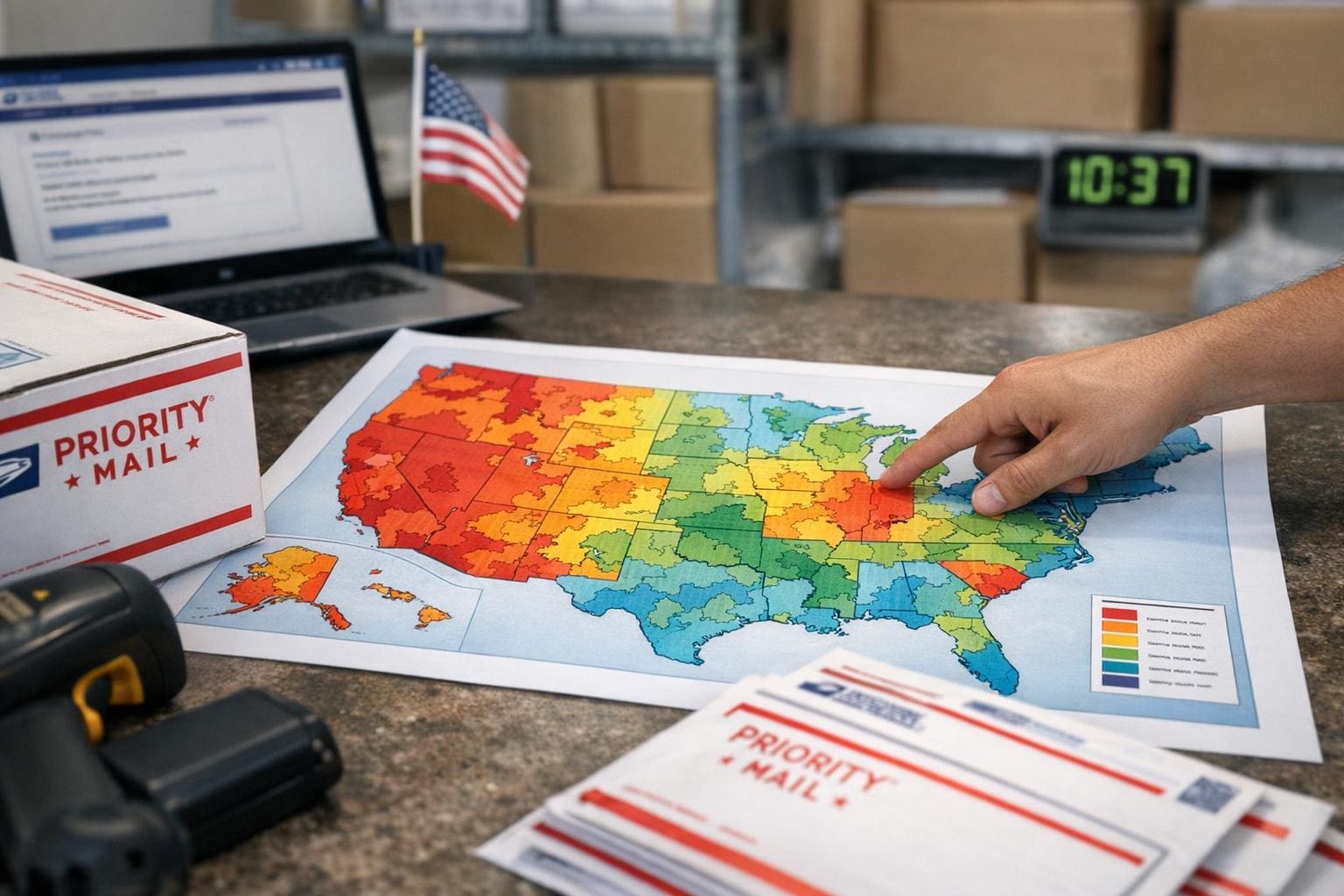
A map can be more than colors on a grid; it’s a storyteller of movement, pace, and possibility. When packages seem to drift in a postal fog, a good map becomes a compass. In this article you’ll roam through interactive maps, decode transit color bands, and learn a formal remedy to shave days off shipments by leveraging the map like a logistics-savvy navigator.
## Explore Priority Mail Delivery Time Map For Fast Shipping
The priority mail delivery time map is the postal industry’s visual shorthand for speed. Whether you’re sending a birthday box across state lines or running a small e-commerce shop, the priority mail delivery time map explains where time is gained and where it can be lost. It layers geography, facility hubs, and service guarantees to display expected transit windows that help set realistic customer expectations and shape smarter routing decisions.
### What The Delivery Time Map Communicates
At a glance, the delivery time map translates complex routing into simple transit bands. It highlights:
– Typical ground transit days between origin and destination.
– Major processing centers that act as chokepoints.
– Regions where same-day or next-day service is likely versus areas that commonly require additional days.
This visual tool is not a promise but a predictive model based on historical performance and scheduled service paths. Understanding the delivery time map reduces guesswork and improves planning, especially for businesses that live and breathe timelines.
### How To Read The Priority Mail Delivery Time Map
Learning to interpret the priority mail delivery time map helps you make actionable choices. Start with these formal reading steps:
1. Identify Your Origin And Destination: Enter postal codes or click on the map to locate both points.
2. Note The Transit Band: Maps typically show 1–3+ day bands for Priority Mail. The color or label indicates expected days in transit.
3. Observe Intermediate Hubs: If the route passes through major processing centers, factor in handling time and peak-period slowdowns.
4. Check Service Notifications: Special advisories, like weather events or holidays, are often annotated and can alter the expected window.
5. Translate To ETA: Combine the transit band with the pickup date to estimate the priority mail eta for each package.
A careful read of the map and its annotations gives you a working ETA rather than a blind assumption.
#### Color Coding And Transit Bands
Most maps use progressive colors to denote day ranges—lighter shades for 1-day, mid-tones for 2–3 days, and darker shades for longer transit. Because these bands are statistical aggregates, local variations can apply. Always cross-check the map’s legend and any overlay tools that allow you to simulate departure dates to refine your priority mail eta.
#### Regional Nuances And Exceptions
Rural areas, islands, and locations serviced by air transport can have exceptions not obvious from continental map views. The priority mail delivery time map will often show an average transit window for these regions, but specific schedules and carrier partners may change the actual outcome.
### Priority Mail ETA: Factors That Shape It
Priority mail eta is influenced by a blend of operational and external variables. Some of the primary considerations include:
– Dispatch Cutoff Times: Late drop-offs may not enter the earliest processing cycle.
– Facility Load: High-volume post offices or distribution centers can introduce delays.
– Carrier Partnerships: Last-mile carriers and contract partners in remote regions can affect an ETA.
– External Disruptions: Weather, strikes, or regulatory disruptions may shift the timeframe.
The priority mail delivery time map incorporates many of these factors into an averaged projection, but prudent shippers treat the map as a planning tool, not an immutable timetable.
### Using The Delivery Time Map For Business Advantage
Creative fulfillment strategies draw directly from map insights. Examples include:
– Staggering shipments from different origins to smooth workload across hubs.
– Storing inventory in multiple regional fulfillment centers aligned with map transit advantages.
– Setting customer expectations by showing a map-derived ETA during checkout.
The delivery time map becomes a conversion and loyalty tool when communicated transparently—customers appreciate realistic timelines far more than optimistic promises that are later missed.
## Remedy 1: Optimize Shipments Using The Map
When delays threaten customer satisfaction, apply this formal remedy to optimize shipping cadence and improve priority mail eta. Materials and steps below are precise and actionable.
Materials / Required Items:
– Computer or smartphone with internet access
– Access to the official priority mail delivery time map or carrier portal
– List of origin and destination ZIP/Postal codes
– Shipping labels and packaging materials (boxes, tape, cushioning)
– Carrier account access or postage printing capability
– Calendar and pickup/drop-off schedule information
Creation And Application Steps:
1. Gather Shipping Data: Create a list of outgoing packages with their origin/destination postal codes and desired delivery date windows.
2. Consult The Map: Open the priority mail delivery time map and input each origin-destination pair to retrieve the transit band and any annotations affecting service.
3. Calculate Working ETA: For each package, translate the transit band into calendar days. Add handling buffer (typically 1 business day) to account for drop-off timing and local processing.
4. Choose Pickup Or Drop-Off Points Strategically: If the map indicates a facility near the origin with faster outbound routing, select that drop-off location rather than the closest branch. This can reduce the priority mail eta by re-routing through a faster hub.
5. Prioritize Labeling And Cutoff Compliance: Print postage and labels in advance and confirm daily dispatch cutoffs. Ensuring packages enter the earliest processing cycle helps meet the map-projected ETA.
6. Use Regional Inventory When Possible: If recurrent destinations fall into slower transit bands, consider prepositioning stock in closer fulfillment nodes to compress transit windows shown on the delivery time map.
7. Communicate ETA To Recipients: Provide the calculated priority mail eta to recipients and include a brief note about potential variances. Transparency reduces customer inquiries and raises trust.
8. Monitor And Adjust: Track actual delivery times against map projections for a rolling 30–60 day sample. Use discrepancies to adjust buffers and refine future ETA calculations.
This methodical approach treats the map as a predictive instrument and combines it with operational discipline to improve outcomes.
### Advanced Tactics To Shrink Transit Time
For those seeking marginal gains beyond the remedy above, consider:
– Consolidated Drop-Offs: Schedule pickups at high-throughput facilities during non-peak hours to minimize queue delays.
– Service Escalation: When the map shows marginal transit bands that threaten deadlines, upgrade to a guaranteed service or use overnight alternatives.
– Data Logging: Maintain a spreadsheet of actual transit times by ZIP pair to identify persistent variances from the map and to decide on permanent routing changes.
Each tactical change should be validated against cost considerations and customer expectations.
### Frequently Asked Questions About The Priority Mail Delivery Time Map
Q: How accurate is the delivery time map?
A: The delivery time map provides statistically-derived transit ranges. Accuracy is high for common routes but can vary due to seasonal loads and external disruptions. Use the map as a planning baseline and add a buffer when necessary.
Q: Can the priority mail eta change after shipment?
A: Yes. Events such as rerouting, weather delays, and processing exceptions can change the ETA. Tracking updates and carrier notifications will reflect any changes in real time.
Q: Should small businesses rely solely on the map for promises to customers?
A: No. Small businesses should use the map to form conservative ETAs and include operational buffers. Combining the map with real-world tracking and historical delivery data yields the best customer experience.
#### When To Re-check The Map
Always consult the map before major shipping waves—holiday seasons, product launches, or when dispatching to less common ZIP codes. Updated overlays and advisories appear regularly and can materially affect the priority mail eta.
### Practical Communication Tips Using Map Insights
Share map-based ETAs in customer-facing communications. Phrases like “Based on transit projections from the delivery time map, expected arrival is…” set a professional tone and prepare recipients for variability. Visual snippets or links to the relevant map region can also reassure recipients that the timeframe is data-driven.
A thoughtful blend of creative presentation and formal logistics planning transforms the priority mail delivery time map from a decorative image into a tactical asset you consult before every major shipment.