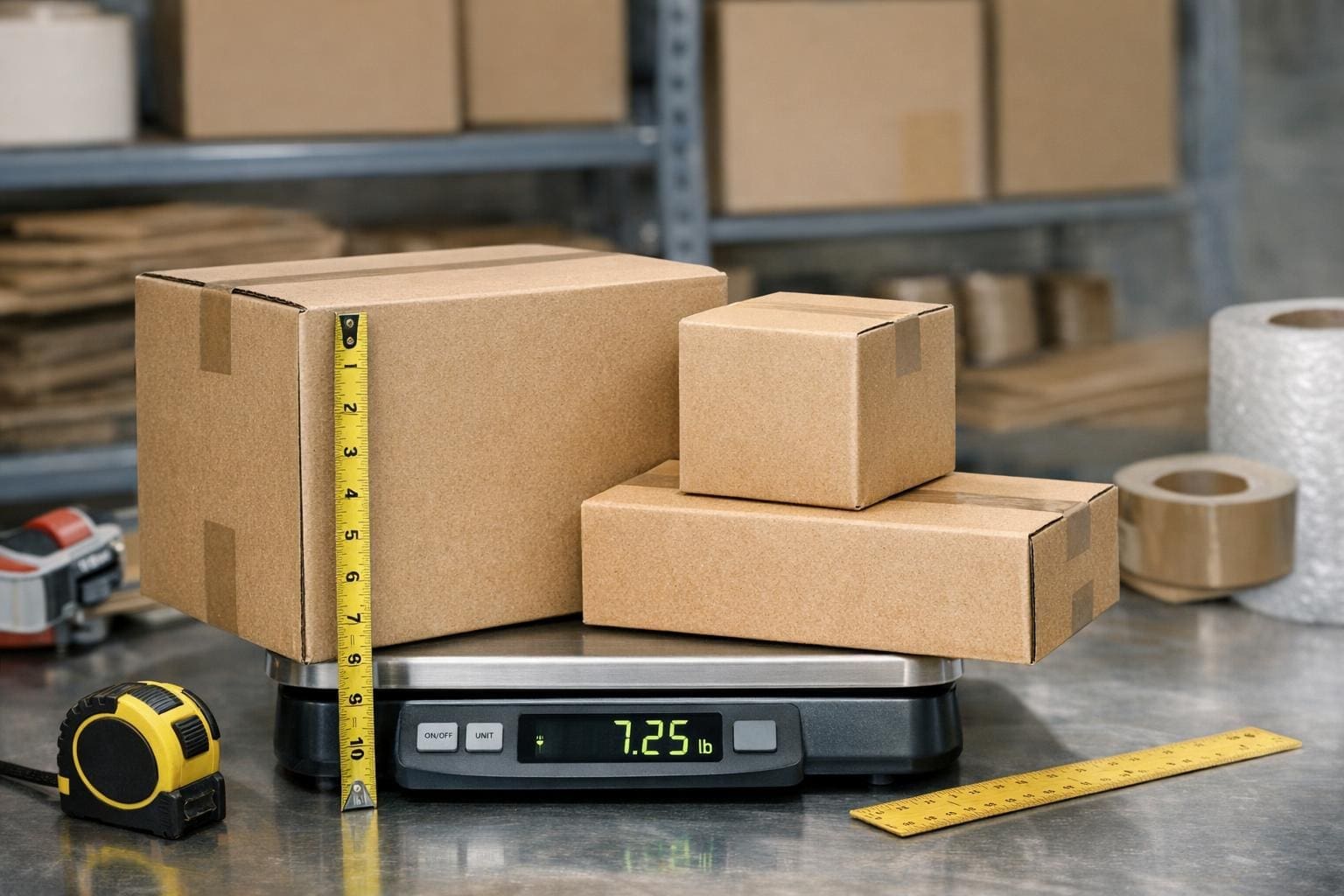
Imagine your box as a small cloud drifting across the postal sky. Two parcels that look the same on a scale can trigger wildly different invoices simply because one is puffier, taller, or oddly shaped. In shipping, space and mass share the spotlight, and a few smart moves can keep your costs grounded.
## How Package Dimensions Affect Shipping Weight: What To Know
When carriers talk about weight, they mean more than the number you read on the bathroom scale. This quick guide explains how package dimensions affect shipping weight in real-world terms and why carriers switch between actual weight and a calculated billed weight. Understanding that switch helps you design packaging that protects your product without padding your bill.
### The Two Weights That Decide Your Bill
Carriers compare actual weight (what you see on the scale) with a billed weight that comes from dimensional formulas. That billed figure is often referred to as dim weight or volumetric weight depending on the carrier and region. The higher of the two becomes the billable weight, so a light but bulky box can cost more than a dense, compact package.
### How Dimensional Calculations Work
Dimensional calculations convert cubic space into a theoretical weight. Carriers measure length × width × height, then divide by a DIM factor (also called a divisor) to get the dimensional number. Common DIM factors vary: domestic couriers often use 139 or 166 for inches-to-pounds; international shippers may use 5000 or 6000 for centimeters-to-kilograms. Because carriers must manage space on trucks and planes, they lean on dim weight logic to charge fairly for bulky items.
#### Dim Weight Versus Volumetric Weight
Terminology can look different across carriers, but the math and intent are consistent. Some carriers label the calculation dim weight; others use volumetric weight. Either way, multiply the three dimensions, divide by the carrier’s divisor, and follow the carrier’s rounding rules. Then compare that number to your actual scale reading. The larger becomes the billable weight.
### Real Examples To Make It Click
A 10×10×10-inch box weighing 8 pounds with a DIM divisor of 139: 10×10×10 = 1000 cubic inches. 1000 ÷ 139 ≈ 7.19 pounds, so billed weight = max(8, 7.19) = 8 pounds. Change shape: a 24×12×8-inch box still at 8 pounds becomes 24×12×8 = 2304 cubic inches. 2304 ÷ 139 ≈ 16.58 pounds; billed weight jumps to 17 pounds after carrier rounding. This demonstrates how package dimensions affect shipping weight even when actual mass stays constant.
### Common DIM Factors And Why They Differ
Carriers set DIM factors to manage available cargo volume relative to routing and pricing structures. Low divisors make dimensional weight more likely to exceed actual scale weight, which pushes bills higher on lighter but voluminous shipments. High divisors suppress dimensional impacts. E-commerce platforms may apply proprietary multipliers, so always confirm the divisor before you add a new packaging format.
#### Measurement Methods And Packaging Considerations
Measure from the longest points, include protective layers that can’t be removed in transit, and round per carrier rules. Excess void space or oddly shaped padding can nudge your package into dim weight territory. Right-sizing is not just about aesthetics: it materially influences your final freight cost.
## How Package Dimensions Affect Shipping Weight In Practice
Sellers who optimize packaging can lower their effective shipping spend substantially. By choosing boxes that fit the product, swapping bulky fills for compact alternatives, and consolidating orders, you reduce the likelihood that the dimensional calculation (often described as dim weight or volumetric weight) will outplace the actual weight. For high-volume shippers, even small millimeter trims across many shipments compound into meaningful savings.
### Creative Packing Strategies
Think like a sculptor—shape matters. Use air pillows only where they stop movement, replace oversized cartons with snug mailers when appropriate, and bundle multiple items into a single properly sized box rather than several half-empty ones. Consider custom inserts that secure product in a smaller footprint. Those creative shifts keep materials functional and bills predictable.
#### When Weight Still Wins
Dense goods like metal components, liquid products, and bulk food are dominated by actual weight. In these cases, dimensional optimizations have limited effect. Always balance protection and space efficiency: underpacking risks damage and returns, which can cost more than a slightly higher shipping fee.
## Calculating Dimensional Weight And Volumetric Weight
Formally, measure length, width, and height in the units required by your carrier. Multiply the three measurements, divide by the carrier’s DIM factor, and apply the carrier’s rounding rules. Compare that figure to your actual scale weight. Whichever number is greater becomes the billable weight. Use carrier-provided calculators or certified scales to avoid disputes. When you know the divisor your carrier uses—whether for dim weight or volumetric weight—you can model scenarios and pick packaging that minimizes the billed weight for the product mix you ship.
### A Practical Remedy To Reduce Billable Weight
Required Materials:
– Accurate tape measure or laser distance tool
– Calibrated shipping scale
– A set of box templates or a cable tie box sizer
– Selection of box sizes and right-sized mailers
– Compact void-fill options (air pillows, foam inserts, tissue)
– Marker and inventory log or simple spreadsheet/app
Procedure:
1. Measure the product in its final packed state: include any fixed protective layers and the box thickness. Record length × width × height, following the carrier’s measurement rules (e.g., round up to whole inches).
2. Compute dimensional weight using your carrier’s DIM factor: (L × W × H) ÷ DIM factor. Round per carrier rules.
3. Weigh the package on a calibrated scale. Compare the scale reading to the computed dimensional weight.
4. If dimensional weight is higher, trial alternate packaging: move to a smaller box, compress or replace bulky fill with low-profile protection, or combine multiple items into a single optimized carton.
5. Repack and remeasure. Document the new L × W × H and scale weight. Repeat steps 2–4 until the billed weight is minimized without compromising product safety.
6. Maintain a small catalog of best-fit box sizes for each SKU or SKU group and update your shipping settings in your e-commerce platform to reflect the optimized dimensions and weights.
This formal, repeatable method directly addresses how package dimensions affect shipping weight by converting packing decisions into measurable outcomes that reduce the billed dim weight or volumetric weight where possible.
### Tools And Apps That Help
Modern shipping tools scan dimensions with smartphone cameras, integrate carrier DIM rules, and suggest box sizes. Many third-party platforms let you set conditional packaging rules—if a parcel fits in Box A use Box A; otherwise use Box B—and automatically pull the correct billed weight at checkout. Automation reduces human error in measuring and ensures your checkout estimates reflect the same computations carriers apply.
### Common Pitfalls And How To Avoid Them
– Using oversize boxes “just in case”: Right-sizing instead of guessing saves repeated cost.
– Forgetting to include permanent packaging layers: If the carrier can’t remove a layer, it counts toward your dimensions.
– Not tracking divisor changes: Carriers can adjust DIM factors; set a reminder to verify periodically.
– Relying on rough scale estimates: Always use a calibrated shipping scale for billing disputes.
Keep records of your optimized boxes, DIM factor assumptions, and a history of carrier invoices so you can spot when dimensions, rather than weight, are driving cost increases. The art of minimizing bills blends practical measurement, the right materials, and a disciplined process that shows exactly how package dimensions affect shipping weight.