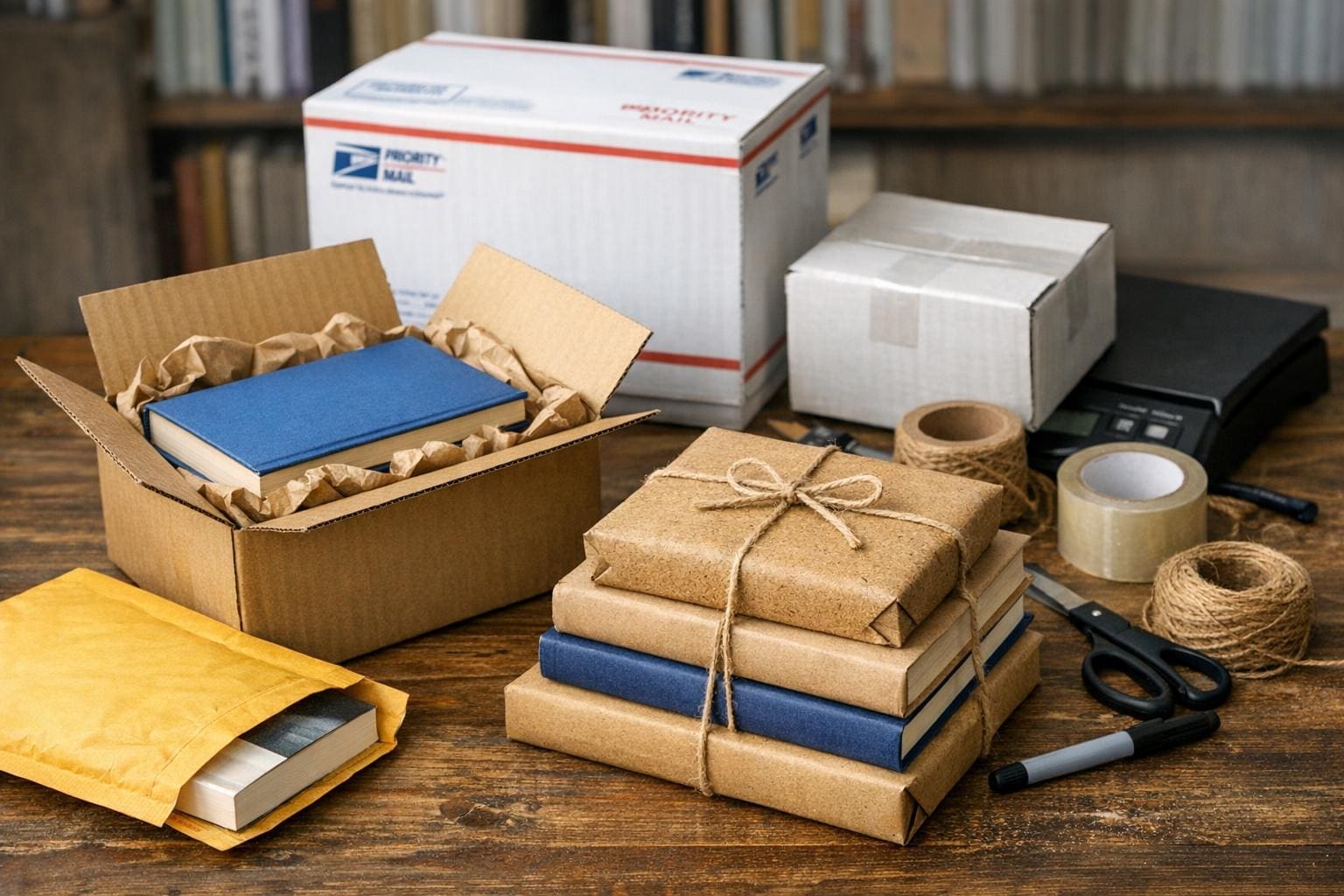
## Why Smart Shippers Choose The Cheapest Way To Ship Books
Whether you’re decluttering a shelf, running a micro bookshop from a garage, or sending a thoughtful gift, finding the cheapest way to ship books saves time and money. The creative part is thinking beyond the obvious: how you pack, what carrier you pick, and when you ship can shave dollars off every order. Below are practical tactics and a DIY remedy to protect books without blowing your budget.
### Compare Carrier Options And Services
Start by surveying the landscape. USPS, UPS, FedEx, and regional carriers each have sweet spots. For single paperback or small hardcover shipments within the same country, USPS tends to dominate on price. When volume is low, USPS Media Mail is almost always the cheapest way to ship books for domestic shipments. Media Mail enforces content rules, so use it only for qualifying printed material.
### Weighing, Measuring, And Avoiding Surprise Fees
Accurate book shipping begins before you choose a box. A home scale and a tape measure are your best friends. Know the weight and dimensions to avoid size-based or overweight surcharges. Round up to the next ounce or inch for postage calculations, and check for additional fees like residential delivery, signature requirements, or special handling. These add-ons can turn an economical shipment into an expensive one.
#### Media Mail: The Budget Champion
Media Mail is slow and purpose-built for printed matter. It’s inexpensive because it doesn’t include expedited processing or certain ancillary services. Keep it compliant: include only eligible items (books, printed music, recorded media) and avoid mixing in non-media items. Properly declared Media Mail can undercut other options by a wide margin; many sellers consider it the backbone of cheap book shipping strategies.
### Use Flat Rate And Regional Options When Appropriate
Flat rate boxes and envelopes are useful when weight is high but item size is modest. Flat rate is rarely the cheapest for a single paperback, but if you’re sending several books together, it often beats weight-based rates. Regional carriers and regional rate boxes sometimes offer a lower price-over-distance than national carriers, so test a few shipment types for your typical orders. Flat rate options can also be simpler for pricing and customer communication.
### Save With Online Postage And Discounted Labels
Buying postage online usually gives you commercial rates not available at the counter. Print labels at home to save time and money: discounted postage, fewer trips to the post office, and batch processing all reduce per-package cost. Buying postage online, printing labels at home, and batching shipments is often the cheapest way to ship books because of commercial discounts. Many marketplaces and shipping platforms integrate discounts directly into the sale workflow.
### Protective Packaging Without Breaking The Bank
Books don’t need luxury packing to arrive intact; they need smart packing. Use snug, low-void packaging to avoid shifting that causes spine damage. If you want the absolute cheapest way to ship books, packing snugly with recycled materials reduces both weight and the need for oversized boxes. Avoid heavy fillers like dense bubble wrap if they add weight; instead, use crumpled paper, clean corrugated cuts, or eco-friendly pouches for light cushioning.
## DIY Reinforced Book Mailer: A Practical Remedy For Damage Control
When shipping valuable or fragile books, a modest up-front investment in a reinforced mailer reduces returns and unhappy customers. This remedy is written in a formal, stepwise manner so you can reproduce it reliably.
### Materials Required
– Sturdy corrugated mailer box or rigid Mailer Board (one per book)
– Acid-free tissue or thin cardboard to separate covers (optional for delicate books)
– Heavy-duty packing tape (2-inch wide)
– Corner protectors (cardboard or foam)
– Scissors or a box cutter
– Ruler and permanent marker
– Recycled kraft paper or puffy mailer for void fill
### Step-By-Step Assembly And Application
1. Inspect The Book: Ensure the spine is intact and covers lie flat. If the book is collectible, wear cotton gloves to avoid oils on the cover.
2. Wrap The Book: Place acid-free tissue between the cover and the first page for very old books; otherwise wrap the exterior in a single sheet of kraft paper to prevent scuffs.
3. Add Corner Protection: Position cardboard corner protectors on all four corners. This reduces impact stress during transit.
4. Insert Into Rigid Mailer: Slide the wrapped book into a snug corrugated mailer or between two pieces of mailer board sealed on three sides to form a sleeve.
5. Seal And Reinforce: Close the mailer and apply heavy-duty packing tape across all seams. Reinforce the long edges with an additional strip of tape for increased rigidity.
6. Fill Voids If Shipping Multiple Items: Use recycled paper to remove any movement if additional items are included. Movement is the chief cause of damage claims.
7. Label Clearly: Write or affix the printed label to the flattest surface. Avoid placing labels over seams or tape that can later peel.
8. Weigh And Measure For Postage: Measure the final package dimensions and weight for accurate postage. Record these for your records and customer notifications.
Following these steps protects the spine and makes the cheapest way to ship books more reliable by reducing damaged-return incidents and associated costs.
### When To Use This Mailer
Use this reinforced mailer for first editions, signed copies, or when a buyer pays for tracked shipping. For mass-market paperbacks or high-volume low-cost items, a standard padded envelope may suffice; reserve the reinforced mailer for items where the replacement cost and customer satisfaction justify the extra time and materials. This remedy is ideal for careful book shipping.
### Tips For Sellers And Libraries
– Combine Orders: Ship multiple books together to amortize the base cost across items.
– Batch Processing: Print labels and drop off in bulk to save time and access discounts.
– Offer Multiple Service Levels: Let buyers choose economy (cheapest) or expedited (faster) options.
– Prepare Clear Policies: Communicate handling times and insurance options on listings to set expectations and reduce disputes.
Offer combined shipping, use couponed carriers, and allow pickup to enable cheap book shipping for recurring customers.
### More Advanced Cost-Saving Strategies
Negotiate discounted rates if your monthly parcel numbers grow; for high volume, partnering with a fulfillment center can be the cheapest way to ship books at scale. Use analytics to identify your best-selling sizes and weights so you can standardize packaging and reduce variability. Alternatively, bundling shipments, using slower services, and consolidating orders are simple behaviors that lock in the cheapest way to ship books over time.
### International Considerations And Insurance
If you ship outside your country, customs forms, duties, and international rates change the math. International small parcel services and economy options can be affordable, but always disclose expected delivery windows and potential customs fees. For irreplaceable items, purchasing additional insurance is a cost-benefit decision—compare the price of coverage against potential loss value.
### Final Practical Exercises To Start Saving Today
– Weigh and measure five recent shipments and run them through three carrier calculators to compare real costs.
– Test a reinforced mailer versus a padded envelope on similar items and track return/damage rates.
– Set up an online postage account and print labels for five sample orders to experience the time and cost savings firsthand.
Adopt these tips, run small experiments, and scale what works. The right mix of packaging, carrier choice, and operational habits will make cheaper, safer deliveries a dependable part of your shipping routine.