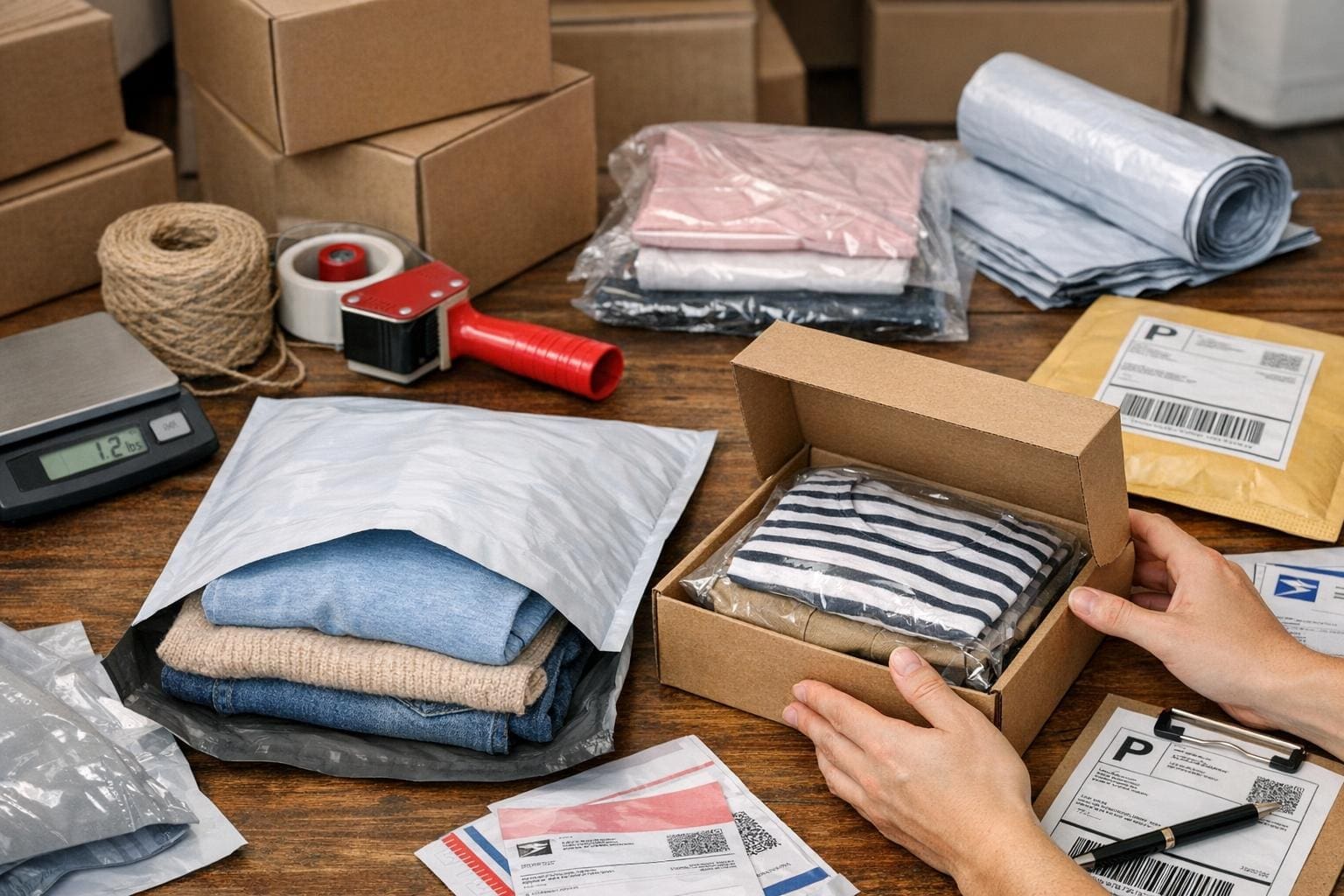
Shipping apparel effectively requires careful selection of service, packaging, and timing to minimize expense without compromising garment condition. The procedures and strategies described below explain how to evaluate carriers, calculate costs, and implement low-cost packaging and shipping remedies that reliably reduce the final freight price for both occasional sellers and small businesses.
## Cheapest Way To Ship Clothes: Methods, Tips, And Savings
Selecting the cheapest way to ship clothes depends on three controllable variables: parcel weight and dimensions, declared value and insurance, and choice of carrier or service level. For most shipments, carriers invoice by actual weight or dimensional weight—whichever is greater—so reducing package size and weight can reduce the clothes shipping rate significantly. Accurate comparison of the carriers’ zone-based pricing structures yields a clear view of which option will produce the lowest clothes shipping charges for each parcel type.
### Compare Carrier Pricing And Services
Most major carriers publish online rate calculators and offer discounted account rates for frequent shippers. Always obtain estimates from at least three providers—national postal service, regional carriers, and courier networks—because the cheapest way to ship clothes varies by parcel size and destination. For domestic shipments, the postal service often offers the most economical ground option for light apparel; for heavier or bulk shipments, regional freight or small-parcel consolidators can provide better clothes shipping rates.
#### Consider Cubic Pricing And Dimensional Weight
Dimensional weight calculation often increases the effective weight for bulky, lightweight apparel (for example, a box filled with sweaters). Compressing items or selecting flatter packaging can lower dimensional weight, thereby reducing the clothes shipping rate. When using carrier calculators, enter accurate dimensions and weight to avoid surprise fees.
### Optimize Packaging For Minimum Cost
Reducing package volume and weight is the most direct method to lower cost. Lightweight poly mailers, compression bags, and carefully folding garments can reduce both actual weight and dimensional weight. Be mindful of carrier packaging rules: some services require rigid packaging for certain items, and fragile or high-value garments may warrant protective packaging and insurance, which will affect the cheapest way to ship clothes calculation.
#### Use Carrier-Provided Packaging When Appropriate
Some carriers provide free boxes and envelopes for specific services. If the provided dimensions suit the shipment and do not inflate dimensional weight, using carrier-supplied packaging can be an inexpensive option that simplifies label printing and drop-off.
### Leverage Discounts, Presets, And Third-Party Platforms
Third-party shipping aggregators and marketplaces frequently offer discounted clothes shipping rates due to volume contracts. Small businesses or individuals can often save by printing labels through these platforms and selecting ground or economy service levels. Additionally, negotiate or inquire about commercial base rates if shipping regularly; small per-parcel savings compound quickly.
### Remedy 1: Vacuum-Compression Packing For Bulk Savings
Required Materials:
– Commercial vacuum storage bags sized to garment dimensions
– Hand-held vacuum or central vacuum with appropriate adapter
– Sturdy poly mailers or corrugated boxes
– Packing tape and a marker
Preparation And Application Steps:
1. Fold garments uniformly to minimize trapped air; place items inside a vacuum bag without overfilling.
2. Seal the bag according to manufacturer instructions, ensuring the zipper is fully closed.
3. Attach the vacuum hose to the valve and extract air until the bag is visibly compacted; close the valve.
4. Place the compressed bag into an appropriately sized poly mailer or small box, selecting the smallest packaging that accommodates the compressed contents while meeting carrier rules.
5. Apply packing tape and label the parcel; measure and weigh the final package accurately to obtain an exact clothes shipping rate before finalizing payment.
This method is formal and methodical: vacuum-compression reduces dimensional weight and actual weight incrementally, making it one of the most reliable ways to lower fees for bulky textiles such as sweaters, coats, or linens when the garment tolerates compression.
### Remedy 2: Roll And Layer Packing For Individual Garments
Required Materials:
– Lightweight tissue paper or thin plastic wrap
– Bubble wrap only if protection is required
– Lightweight poly mailers (express or standard)
– Flexible scale and tape measure
Preparation And Application Steps:
1. Lay the garment flat and smooth out wrinkles; place a sheet of tissue paper to preserve finish if needed.
2. Roll the garment tightly from one end to the other to produce a cylindrical bundle that occupies less volume than folding.
3. Wrap the roll in tissue or thin plastic to maintain shape; avoid bulky protective materials unless necessary.
4. Insert the roll into a poly mailer sized to the roll’s dimensions, choosing a mailer that minimizes excess empty space.
5. Record the parcel’s weight and dimensions and compare available services to select the most economical clothes shipping rate for the resulting size class.
This packing remedy is particularly effective for shirts, thin trousers, and lightweight dresses and is presented with precise steps to ensure consistency and reproducible savings.
### Utilize Regional And Hybrid Services For Cost Efficiency
Regional carriers and hybrid services (where a private carrier picks up and the national postal service completes last-mile delivery) frequently provide unusual savings for specified routes. For cross-town and intrastate deliveries, regional carriers may offer the lowest clothes shipping rate. Hybrid options often present the cheapest way to ship clothes for e-commerce sellers because they combine low pickup costs with affordable final delivery.
#### Assess Delivery Speed Versus Cost
Cheapest does not always mean fastest. When time permits, choose economy or ground services and select slower transit times. Adjusting expectations for delivery speed remains the simplest way to obtain the most favorable clothes shipping rate across carriers.
### Accurate Labeling And Documentation To Avoid Fees
Incorrect labeling, under-declared weight, or missing documentation can lead to surcharges and returns that negate initial savings. Use a calibrated scale, verify addresses with a standardized format, and select the correct customs categories for international clothes shipping. Where applicable, include a clear packing list. These administrative steps are essential to maintaining the projected clothes shipping rate and ensuring the chosen cheapest way to ship clothes remains the actual final cost.
### Timing, Bulk Consolidation, And Seasonal Considerations
Shipping rates fluctuate with demand. Plan shipments during off-peak periods if possible, and consolidate multiple items into single shipments when weight-based pricing yields net savings. Seasonal spikes—holiday periods and end-of-season clearances—often increase base rates; scheduling shipments outside these windows will frequently identify the cheapest way to ship clothes.
#### Consider Insurance And Liability When Valuing Savings
When pursuing the cheapest way to ship clothes, do not omit cost components tied to insurance and liability. Low-cost services may limit indemnity for lost or damaged goods. For high-value clothing, consider purchasing additional coverage or using a higher-tier service whose base clothes shipping rate is higher but which reduces financial exposure.
### Packaging Materials And Tools Checklist
Required Materials:
– Lightweight poly mailers in several sizes
– Vacuum storage bags and adapter
– Packing tape, label printer or clear labels
– Flexible postal scale and tape measure
– Protective tissue or thin plastic for delicate fabrics
Step-By-Step Use:
1. Select packaging sized to the compressed or rolled garment.
2. Use vacuum or rolling techniques to reduce volume.
3. Weigh and measure accurately; account for dimensional weight.
4. Compare carrier rates using updated calculators.
5. Choose the service and print the label through a discount platform if available.
Adherence to these steps formalizes the operational process and helps ensure consistent attainment of the cheapest way to ship clothes for repeated shipments.
### Practical Example: Calculating A Low-Cost Shipment
To illustrate, compress three sweaters using vacuum bags into a single poly mailer and weigh the final package. If dimensional calculations place the shipment in a lower weight tier, the clothes shipping rate can drop substantially compared with shipping the same garments in an inadequately sized box. Document the dimensions and cost per parcel, then iterate with alternate packaging strategies to find the optimal balance between protection and minimal clothes shipping expense.
Follow these recommendations and systematic remedies to identify and implement the cheapest way to ship clothes for a variety of garment types and shipping scenarios.