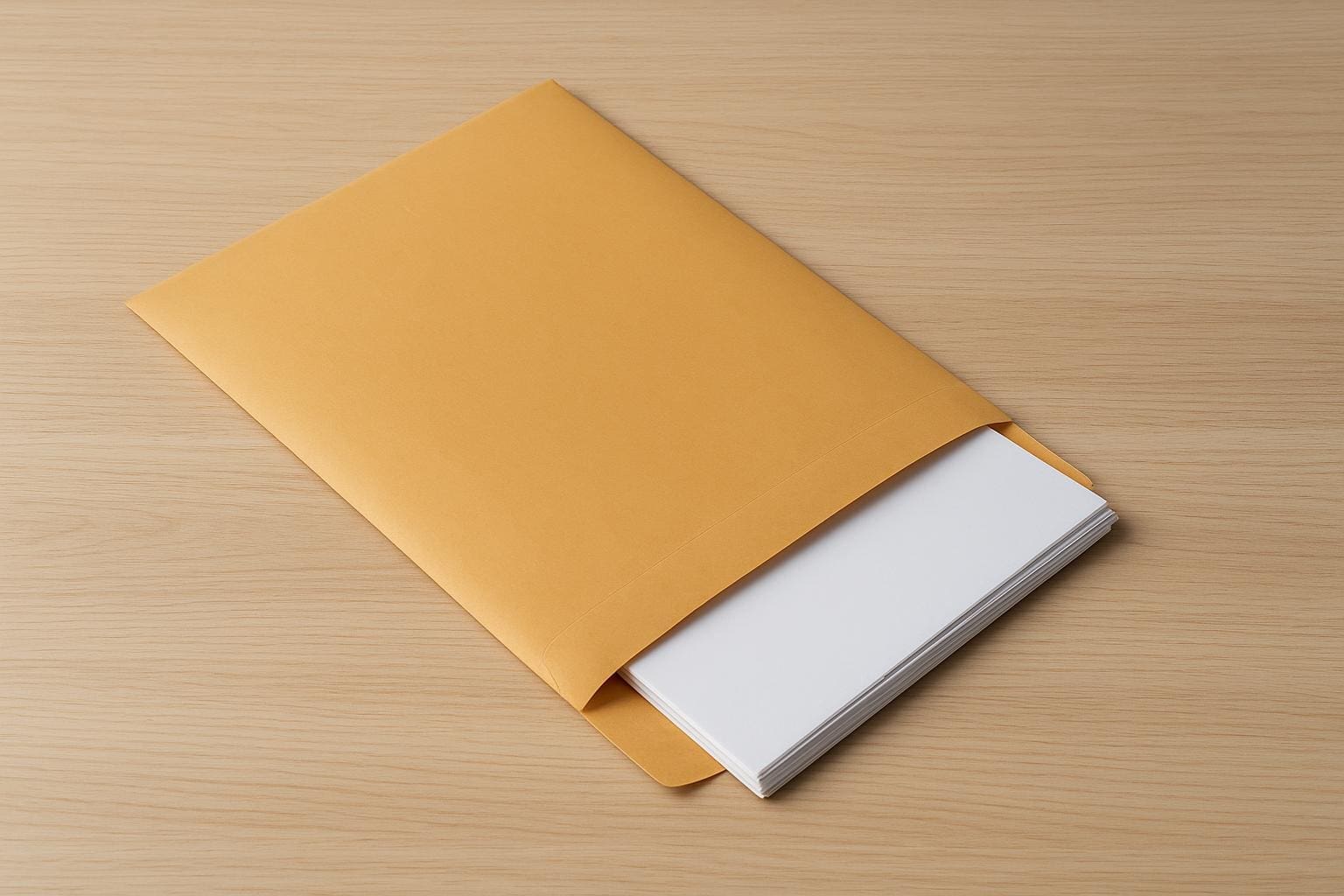
If you need papers to arrive exactly as they left your desk, packaging matters more than you think. Envelopes fold, machines twist, and packages get slid around. You can cut most of that risk down with simple materials and a methodical approach that keeps documents flat and readable when they reach the other side.
## Mail Documents Flat To Prevent Bending Without Damage
Mail documents flat to prevent bending by removing slack, adding stiffeners, and choosing a mail class that treats the item as a parcel rather than a flexible envelope. Start by deciding whether the recipient must receive the pages pristine, or merely legible. A stack of invoices? Less risk. A signed contract, original certificate, or fine art print? Treat it like something fragile.
Make the item a sandwich. Put the documents in a protective sleeve, then between two pieces of rigid board. Tape around the edges so the boards can’t shift. Slip that assembly into a rigid mailer or a small box. That simple sandwich is the one thing that will stop a postal worker’s hand or a sorting machine from folding your paper.
### Choose The Right Envelope Or Mailer
Paper envelopes are designed for sheets, but they are not designed to stop bending. A regular number 10 business envelope will protect content from casual scuffs, but not from creases. To really prevent bending mail, pick one of these options:
– Rigid mailers: These are flat, thickboard sleeves sold for photos and documents. They give good protection with little bulk.
– Cardboard-backed envelopes: Thin document sleeves with stiff paperboard built in. Cheap and widely available.
– Small corrugated boxes: Best when you’re sending several pages or thicker items. They resist crushing.
– Flat rate rigid envelopes from carriers: Some services offer sturdy mailers that are treated like parcels.
Whatever you choose, the key is rigidity. Poly mailers and padded envelopes protect from moisture and shock, but they don’t stop creasing unless you add a board stiffener inside.
#### Match Mail Size To Document Size
Cut the stiffeners slightly larger than the document but small enough to fit comfortably in the mailer. For standard 8.5 x 11 pages, cut boards to about 9 x 12. That leaves space for a sleeve and tape without exposing the document to the edges. If you’re mailing legal-size or A4, use matching boards. Oversized backing that extends beyond the envelope increases the chance of catching or tearing in transit.
### Make A Stiffener Sandwich That Won’t Shift
A good sandwich is composed of layers, each with a purpose. Layering achieves two things: it keeps the document flat and prevents local pressure points that cause small creases.
1. Sleeve the document. Use a clear plastic sleeve (polyethylene or polypropylene) for water resistance. For photographs or archival certificates, choose acid-free glassine or archival sleeves.
2. Place the sleeved document on one rigid board.
3. Top with a second board. Align corners precisely.
4. Seal edges with tape so the boards can’t slide.
Use cloth-backed paper tape or wide packing tape for the edges. Run tape all the way around the perimeter, but avoid sticking tape directly to the document. If you do get tape near paper, make sure it only touches the board or the outside of the sleeve.
Keep tape application smooth. Wrinkled tape can create pressure points that show up as creases. If the boards are very thin, reinforce them with an extra layer to prevent flex.
#### Materials That Protect Photos And Certificates
Photos, certificates, and art prints need more than a rigid board. They also need a surface that won’t scratch and an inner layer that prevents movement.
– Use glassine paper between photo and board to avoid sticking or abrasion.
– For anything high-value, add a foam-core sheet as the outer layer and thin acid-free board next to the print.
– Avoid PVC sleeves for long-term storage. They can off-gas and discolor delicate inks.
Remember that lamination changes a document. It might look permanent, but it can complicate notarization or authentication. Don’t laminate legal originals unless you’re sure you want that alteration.
### Choose Carrier Service Based On Handling, Not Just Speed
Next, decide how you want the parcel handled. Carriers differ in how they sort and move items. The fastest service is not always the safest for flat items.
– USPS Priority Mail treats a rigid mailer like a parcel. It often moves quickly and with less folding risk than standard letters.
– FedEx and UPS small-package services keep items moving through parcel aisles and subject them to less bending. They are usually safer for rigid mailers.
– If you use an oversized envelope that meets the postal service’s “flat” category, it may be handled differently by automated machinery. Consider shipping as a parcel if you want to avoid machines.
Add tracking and request a signature for high-value or legal documents. Tracking won’t keep a document flat, but it does give you data if a problem occurs.
### Labeling And “Do Not Bend” Isn’t A Guarantee
Sticking a “Do Not Bend” sticker or writing it on the envelope helps. It tells people how to handle the item. But it is not a guarantee. Machines and human error still exist. Use the sticker as a last line of communication, not your only protective measure.
Place the shipping label flat on the largest rigid surface. Don’t place labels so they obscure important information or are partly on an edge. If authorities need to attach a customs form, provide a separate envelope for those forms and tape it to the outside so the document inside remains untouched.
### Steps To Mail Documents Flat To Prevent Bending (A Practical Sequence)
Follow this practical sequence to mail documents flat to prevent bending reliably:
1. Inspect and prepare the document. Remove staples or paper clips that could cause bumps. Place any loose pages in sequence and sleeve them.
2. Pick appropriate backing boards sized slightly larger than the document.
3. Sandwich the sleeved document between the boards; align carefully.
4. Tape the bundle around the edges to lock boards together.
5. Insert the sandwich into a rigid mailer or small box with minimal extra space.
6. Seal the mailer; label and affix postage on the rigid face.
This process costs a few dollars more than a simple envelope, but it eliminates most bending during transit. For critical items, it’s worth it.
### Addressing Common Document Types
Different kinds of documents need slightly different care.
– Contracts and signed agreements: Use single-thickness cardboards and clear sleeves. Add a copy inside labeled “Copy” so the original stays intact if questioned.
– Certificates and diplomas: Use archival glassine and foam-core outer layers. Consider a small box instead of an envelope for maximum protection.
– Photographs and prints: Glassine next to the print, stiff boards outside, then a waterproof outer sleeve.
– Checks and invoices: These are less sensitive but still deserve a card-backed mailer to prevent creases that could affect scanning.
If you’re sending multiple documents, stack them in order and include a table of contents sheet on top. That sheet can be a buffer too.
#### Avoid Common Mistakes That Cause Bends
People often make simple mistakes that defeat the sandwich idea. Don’t make these errors.
– Leaving slack inside the mailer. If the bundle rattles, it can rotate and end up folded by chance.
– Using a single thin board. Thin boards flex easily and don’t stop heavy folds.
– Taping in a way that allows one corner to detach. A loose corner can get bent by a sorting machine.
– Putting heavy labels or postage directly over the document area. The adhesive and pressure can leave marks.
Fix these and you’ll reduce the odds of bending dramatically.
### International Shipping And Customs Considerations
When sending documents abroad, expect additional handling. Customs clerks may open packages for inspection. To prevent bending mail in international transit, take these steps:
– Use a small box rather than an envelope in many cases. Boxes survive more handling.
– Place customs paperwork in a pouch on the outside. Do not staple it to the document.
– Consider insured or tracked services. If a customs office opens the package, tracking reduces dispute friction.
Be mindful of any rules about sending original legal documents to certain countries. Some governments prefer scanned copies for initial review. When unsure, contact the receiving agency before shipping.
### When To Use Tubes Instead Of Flat Mail
Not every document belongs flat. Posters, architectural plans, and large maps are often safer rolled. If the recipient plans to unroll and frame, mailing in a rigid tube is better. But if flattening is required at arrival, use a tube only when the recipient has the ability to store it under weight until it lies flat. Otherwise follow the sandwich approach.
### Tracking, Insurance, And Proof Of Condition
For valuable or irreplaceable documents, take a few extra steps:
– Photograph the document before packing. Include a ruler or date in the photo to prove condition and date.
– Use tracking and insurance. If something happens, you’ll have recourse.
– Choose delivery services that offer proof of delivery and signed receipts. If your document is time-sensitive, require a signature.
If a recipient claims damage, your photos and a record of packing method strengthen a claim.
### Small Tricks That Help A Lot
A few small habits prevent a lot of headaches.
– Use two boards instead of one. It costs little and reduces the chance of bending.
– Wrap the sandwich in a thin sheet of bubble wrap just at the edges. That cushions knocks while keeping the center flat.
– If using a padded envelope, first insert the sandwiched boards in a thin plastic sleeve to keep moisture away from the edges.
– For multiple similar shipments, create a simple jig to trim boards to size in bulk. It saves time and makes each package consistent.
One final note: people often over-trust labels. My reciept of several “Do Not Bend” envelopes came creased because the internal protection wasn’t there. Labels are communication, not protection.
### When Cost Competes With Protection
If budget is the main constraint, choose your battles. For low-value documents, a sturdy cardboard-backed envelope and careful taping is usually sufficient. For anything irreplaceable, prioritize protection over postage savings. It’s better to spend a few extra dollars than to lose or ruin a one-of-a-kind original.
There’s no single perfect method for every situation. But if you consistently use sleeves, matched boards, a locked edge tape job, and a rigid outer mailer or box, you’ll achieve the aim: mail documents flat to prevent bending and keep the recipient from having to smooth out someone else’s mistake.