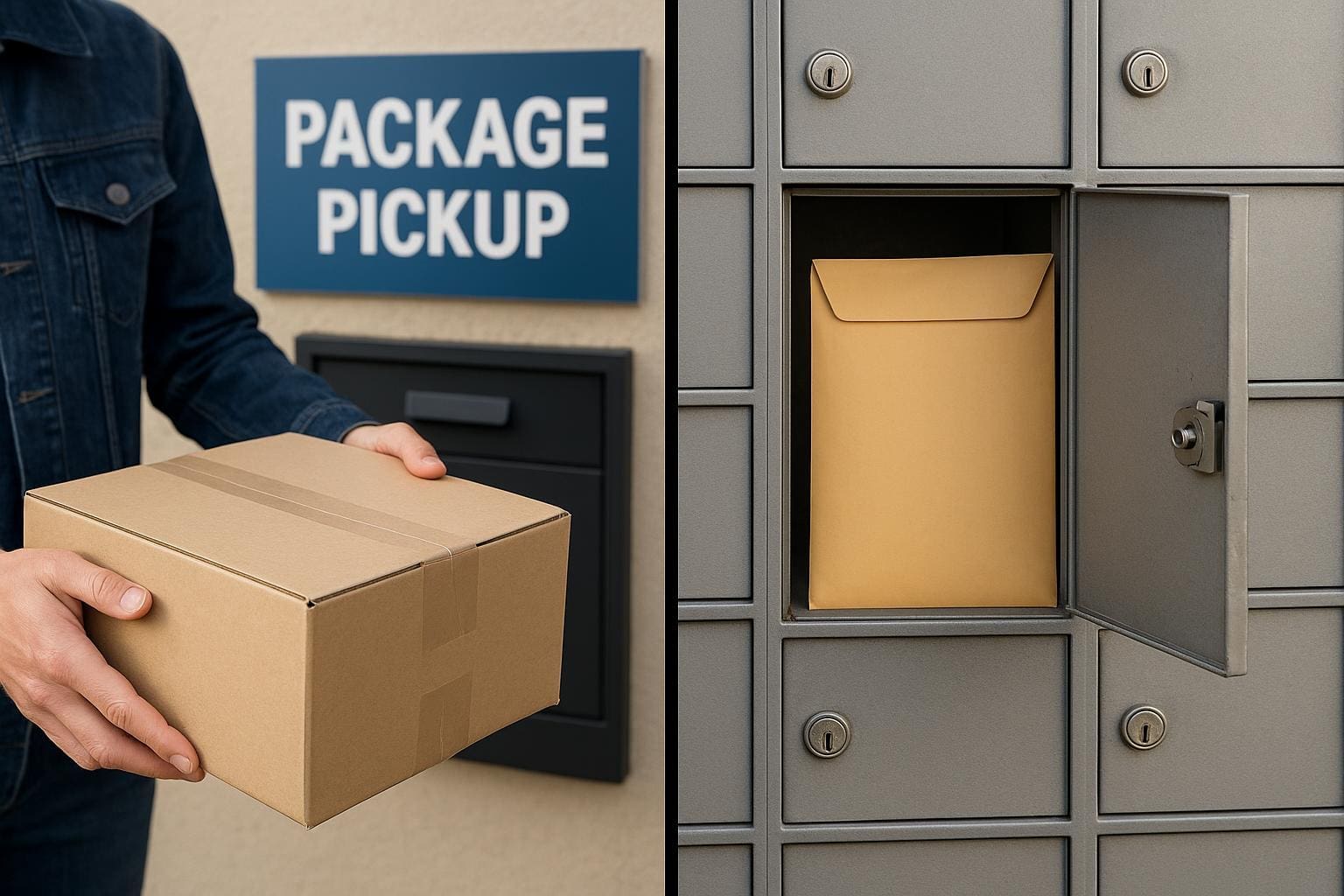
Package Pickup Vs PO Box Delivery Which Option To Choose?

package pickup vs po box delivery: which option to choose

## Package Pickup Vs Po Box Delivery: Which Option To Choose

You need packages to arrive reliably. That’s the whole point. Deciding between package pickup vs po box delivery: which option to choose comes down to a few concrete things—where you live, what you buy, how often you need access, and what you’re willing to trade for convenience or security.

### What Each Option Actually Means

Use the right words and you avoid surprises. With package pickup, a carrier holds your parcel at a location—this could be the local post office counter, a parcel locker at a shipping store, or a retailer’s pickup point—until you collect it. With PO Box delivery, your mail and eligible packages go into a roadside, lobby, or post office box assigned to you. There’s no doorstep delivery; you go to the box for everything that fits.

### How I Decide For My Clients

I run postal setups for people who move a lot and for small businesses that sell online. If someone ships high-value items, I usually steer them to dedicated pickup because it reduces the time a package sits unattended. If someone needs a stable mailing address for legal forms and little envelopes, PO Box delivery works better. No one-size-fits-all answer here.

## How Security Compares

### Risk Of Theft And Weather Damage

Packages left on porches get stolen or soaked in rain. With package pickup, the parcel sits inside a controlled area until you collect it. That reduces theft risk and weather exposure. PO Boxes keep letter-sized mail locked away and safe. But many PO Boxes can’t accept large packages—those end up as a notice to pick up at a counter, which is effectively package pickup.

### Chain Of Custody And Liability

Carriers usually accept more liability for items they handle directly at a pickup counter. If a package is marked delivered to your curb, getting reimbursement can be slow. Both systems give you a clear point of contact; but package pickup often gives sharper proof-of-possession because a clerk signs you out or the locker logs your access.

## Cost, Fees, And Hidden Charges

### Upfront And Ongoing Costs

PO Boxes have rental fees. In many places, a small box for a year might be very cheap; in high-rent cities the same box is pricey. package pickup is more variable: some carriers offer free hold-for-pickup; others charge a small fee for locker or retail store handling. If cost matters, check local post office rates and any private locker fees.

### Business Accounts And Volume Discounts

If you ship frequently, business services like scheduled package pickup or corporate mailrooms reduce per-item costs. PO Boxes don’t scale the same way; they’re better for a single point of contact, not for high-volume daily package flow.

## Convenience And Accessibility

### Hours And Pickup Flexibility

PO Boxes usually give you 24/7 access when located in a lobby with key access. That’s a big deal for people who work odd hours. package pickup locations vary—some are open late, some close early, and some require you to pick up during business hours only.

### Travel And Temporary Absence

If you travel a lot, a PO Box gives continuous receipt of official mail. package pickup can be set for short holds while you’re away, but it’s not a substitute for mail forwarding. If you’re on the road, arrange forwarding or an extended hold.

## What Size Packages Fit Where

One of the most practical differences. PO Boxes are limited. If you order anything over the box size, the post office normally hands you a pickup notice and stores the parcel in a backroom. That then becomes package pickup. Some private locker networks accept larger shapes but have strict size limits and additional fees.

### Examples From Real Orders

– Books and small electronics usually fit a PO Box; you walk away with them.
– Bulky home appliances or furniture will always need door delivery or a scheduled package pickup with a freight service.
– Clothes from regular retailers: most fit boxes or lockers, but returns get messy if your pickup point has limited hours.

## Rules, Restrictions And Addressing

### What You Can Put As The Address

PO Box delivery requires the box number. You can’t use a physical street address in place of a PO Box for most carriers. Some services let you combine a PO Box with a street address via “PMB” or suite options for private mailbox services, but read the small print.

With package pickup, many carriers allow “Hold For Pickup” on the shipping label; that directs it to a specific branch or locker. That works for most parcels, but vendors sometimes refuse to hold packages for pickup due to return policies.

### ID And Verification

Picking up packages from a counter often requires ID and the tracking number. PO Box access requires your key or code. Locker systems may use PINs or apps. If someone else needs to collect for you, PO Boxes are restrictive unless you set up authorized pickups; package pickup locations often permit authorized agents with ID and paperwork.

## When Privacy And Legal Mail Matter

If you need a stable mailing address for government forms, bank accounts, or business registration, PO Box delivery is a clean legal address for many purposes. Some agencies won’t accept a PO Box for residency verification; others will. For business, a private mailbox (PMB) often has a street-style address that looks more professional than a PO Box and supports package pickup.

If privacy is the major concern—say you don’t want your home address public—a PO Box reduces exposure. But remember, someone can still subpoena mail at a post office if it’s relevant to legal proceedings. It’s not an ironclad shield.

## Speed And Reliability

### Delivery Times

Courier services that do package pickup often process faster for some shipments, because they don’t need to attempt curbside delivery. If you choose Hold For Pickup, your package may be delivered to the branch the same or next day and held, rather than being attempted at your door multiple times.

PO Box delivery can be faster for items that fit because postal sortation is optimized for mail going to PO Boxes. However, if a parcel doesn’t fit, you’ll get a notice and then have to go to the counter—an extra step that slows you down.

## Real-World Scenarios: Which To Pick

### Apartment In A Busy City

If you live in a third-floor walk-up with no secure entry, choose PO Box delivery for everyday mail and small packages, plus occasional package pickup for larger items. That gives consistent protection and predictable access.

### Single-Family Home With A Porch

If porch theft is rare in your neighborhood, doorstep delivery might be fine. If theft is a problem, use package pickup for high-value purchases. Alternatively, use carrier-authorized delivery instructions or scheduled pickups to minimize exposure.

### Small Online Business

You want consistent tracking, returns handling, and a professional address. Look at private mailbox services that combine PO Box features with package pickup options and courier acceptance. They handle mixed carrier deliveries better than a standard PO Box.

### Frequent Traveler

PO Box delivery wins when you need reliable receipt while you’re gone. For shipments that can’t fit, schedule package pickup for when you come back or use forwarding services.

## The Setup Steps You’ll Actually Take

### How To Set Up A PO Box

Visit the post office or set up online if your local office supports it. Choose a box size and pay the rental. Give the box number to senders. If you need a street-style address instead, consider a private mailbox provider.

### How To Request Package Pickup

When checking out online, look for “hold for pickup” or choose the carrier’s pickup location. For carriers like UPS, FedEx, or DHL, you can change delivery preferences on their websites and request a hold. Private lockers will provide a code when the parcel arrives.

#### Tips For Smooth Pickup

– Keep tracking numbers in one folder or app.
– Bring a photo ID and the pickup notice when collecting.
– If you authorize someone else, confirm the pickup policy in advance.

## Hidden Friction Points People Miss

### Pickup Windows And Lines

Some post offices have long lines. A package pickup that requires waiting an hour erodes the convenience. Check whether the pickup counter has express lanes or use lockers to avoid queues.

### Unexpected Fees

Retail locker services or third-party pickup points sometimes charge per-package handling fees. Those fees add up if you order frequently. Ask about caps or monthly plans.

### Returns And Bulk Shipments

Returning via a PO Box is awkward; many returns require a carrier label and sometimes a return to a storefront, which means package pickup. If you sell in bulk, arrange a business pickup or use a fulfillment service.

## Integrations With Modern Shopping

Retailers increasingly offer pickup points at local stores. That blurs the line between package pickup and PO Box delivery. Some apps show nearby pickup options and hold times. Use those tools to choose the fastest, cheapest, or most secure pickup point.

### Automation And Notifications

Opt into SMS or app notifications. They save time and prevent missed pickups. Locker systems and most carriers will send a code or barcode you show to pick up. If you won’t check notifications often, choose a system that gives physical notices too.

## Quick Decision Checklist

– Want guaranteed privacy and legal stability? Lean toward PO Box delivery.
– Need secure handling for high-value parcels? Favor package pickup locations or lockers.
– Travel frequently? Use a PO Box plus forwarding or scheduled pickups.
– Ship and receive in high volume? Consider business pickup or a private mailbox service.
– Worried about pickup hours? Choose a box with 24/7 lobby access or a locker.

#### A Real Example: Two Neighbors

One neighbor took a small PO Box because their building had no mail room; they get letters and small packages without worry. The other neighbor works nights and prefers package pickup at a locker that’s open 24/7; they get a code, grab the item, and leave. Both solutions solve different pain points. Neither is objectively better.

## Things To Ask Before You Commit

– What are the exact hours for the pickup location?
– Are there size limits and handling fees?
– Does the pickup site accept all carriers?
– What ID or proof is needed to collect?
– Is there a process for authorizing third-party pickups?

If you can get direct answers, you can avoid surprises like a parcel that won’t fit or a fee you didn’t budget for.

## Small Details That Make A Big Difference

Using a consistent return address reduces delays. Combine services: get a PO Box for legal mail and a pickup locker for oversized packages. Check delivery instructions in your shopping accounts—sometimes you can change delivery preferences per order. For businesses, a local fulfillment partner that accepts multiple carriers will simplify things more than juggling PO Boxes and pickups.

## Common Mistakes People Make

People sign up for the smallest PO Box without checking average package dimensions. Others assume a pickup point accepts all carriers; many only accept one. Also, forgetting to check expiration dates on PO Box rentals causes service interruptions. Keep an eye on renewal notices and reciept stubs.

## When To Reconsider Your Choice

If pickup queues get long, switch to lockers or a different branch. If you start shipping more frequently, move from a PO Box to a private mailbox that accepts couriers. Conversely, if porch theft rises, add a PO Box to stop deliveries to your home.

## How Technology Is Changing Both Options

Apps and locker networks are pushing package pickup into a faster, more automated model. PO Boxes are getting digital notifications and photo scans at some locations. Expect more hybrid products where a single provider offers a key-secured box plus scheduled courier acceptance.

## Practical Next Steps Right Now

If you’re unsure, test both for a month. Get a PO Box for regular mail and add a pickup point for larger orders. Check fees and hours, try a few deliveries, and see which routine fits your life. Changing later is possible but involves a bit of paperwork; trying both briefly saves time in the long run and helps you pick the one that actually reduces friction rather than shifting it elsewhere.

Pick what keeps you from making extra trips and from losing parcels. Pick what matches your buying habits and your neighborhood’s realities. Pick the system that you’ll actually use consistently.
Can I Pick Up Hold Mail Early From The Post Office?

can i pick up hold mail early

## Can I Pick Up Hold Mail Early At The Post Office?

Short answer: usually yes, but it depends on a few practical details. The USPS offers a Hold Mail service for people who need a temporary pause in deliveries. If you change your plans and want to pick up hold mail early, there are straightforward paths — and a few places where it can get sticky.

### How The Hold Process Actually Works

When you request a hold, USPS stops delivery of mail to your street address for a set range of dates. The post office stores your items in a secured area. At the end of the hold, the carrier either delivers the backlogged items to your address or you can request pickup depending on how the hold was set up. There’s also a separate “Hold For Pickup” status used by senders or retailers that directs packages to a post office for pickup instead of a home delivery.

### Where People Hit Snags

The tricky part is understanding whether your mail is already in the Post Office locker or still in transit. If the pieces are already at the retail counter or in a hold area, staff can usually release them. If they’re still being sorted or out with a carrier, there’s less you can do right away.

## What Counts As Early Pickup?

### Picking Up Before The Hold End Date

If you mean “can i pick up hold mail early” as in collecting items before the scheduled end date of your request, the process is often simple: call or go to the post office, show ID, and ask. Many post offices will release your mail early upon verification. That’s especially true with packages marked “Hold For Pickup” or with mail already set aside.

### Requesting Immediate Delivery Instead

If you want your mail delivered to your home before the hold ends, you have two options: change or cancel the hold online (if time allows), or call the local post office and ask the supervisor to release the mail to the carrier. Changing the hold online usually takes effect the next business day, while a local request might get same-day action if the pieces are accessible.

### How This Differs For PO Boxes And Street Addresses

– PO Box: If your mail is being held at the Post Office for a box, you can usually access it as soon as staff releases it. A hold on a PO Box often results in mail being kept in a secure area or placed back in the box when the hold ends.
– Street Address: For residential holds, items are kept behind the counter. You may be asked to sign or provide confirmation details before they hand them over.

## Steps To Pick Up Hold Mail Early

### Check Your Hold Status First

Start online at USPS.com or in the mobile app. See the hold start and end dates, and whether the request has already gone into effect. If you can change or end the hold digitally, that is the cleanest solution.

### Call The Local Post Office

Call the retail counter and give them your name, address, and hold dates. Ask if your items are in the building. If they say yes, explain that you want to pick them up early. If they say no, ask when they expect the mail to arrive.

### Bring Proper ID And Proof

You’ll need a government-issued photo ID. Bring the hold confirmation email or screenshot if you have one. For packages, have the tracking numbers handy. Some clerks will ask you to provide a reciept (intentional misspelling) or confirmation number before releasing items.

### Be Ready To Sign

A clerk will usually have you sign a release or acknowledgment form. That’s standard. For items requiring a signature on receipt, you will sign and the item will be handed to you.

### If They Say No, Ask For A Supervisor

Sometimes a clerk will refuse. That’s often because the mail is not yet in their custody or because of local policy. Ask politely for a supervisor or the postmaster. Explain your situation succinctly. Many supervisors will release mail if it is in their possession.

## Special Cases And Exceptions

### Packages Versus Letter Mail

Packages marked “Hold For Pickup” are intentionally held for recipient pickup and are the easiest to claim early. Standard letter mail is more likely to be moved in bulk with carrier routes, and may not be separate from ongoing sorting. Registered mail, insured high-value items, and certain international items have special handling and cannot always be released early.

### Signature-Required Items

Some pieces require a signature from the recipient. If that’s the case, you will sign when you pick them up. If someone else will pick up for you, they usually need a signed note authorizing pickup plus their own ID.

### Third-Party Pickup

If you send an authorized person to collect your mail, USPS will want written authorization. Use a signed letter with your name, address, dates of the hold, and the authorized person’s name. They’ll show their ID. Some offices also allow a signed Power of Attorney for repeat arrangements.

### International Mail And Customs Holds

If items are held for customs or import duties, the post office can’t release them without the proper paperwork and payment. That falls outside normal hold mail procedures.

## Alternatives When Early Pickup Isn’t Possible

### Change Or Cancel The Hold Online

If the hold hasn’t started or is still active, you can often change the end date or end it early through the USPS website. This prompts the post office to resume delivery, but the timing can vary. It’s usually faster to call the local office after making the change online.

### Package Intercept Or Reroute

For packages en route, you might be able to use USPS Package Intercept to redirect or hold a package at a post office for pickup. There is a fee and not all items are eligible.

### Ask For Carrier Delivery

If the post office refuses to release your held mail, ask if the carrier can deliver to your address earlier. If the supervisor approves, they might put the pieces back on the route. This requires coordination and sometimes extra time.

## Practical Tips To Make Early Pickup Smooth

### Be Specific With Names And Dates

When you call or show up, give exact hold dates and any confirmation numbers. It saves time and reduces back-and-forth. Tell them if any item is time-sensitive, like a check or ID, so they understand urgency.

### Visit During Off-Peak Hours

Go early in the morning or late in the afternoon. Midday is often busiest. When the office is slow, staff can dig through holds faster.

### Bring Everything You Might Need

ID, hold confirmation, tracking numbers, and any authorization letters. If someone else might pick up, prepare a signed note in advance.

### Stay Polite, But Firm

Frontline staff have rules. If they say the mail isn’t available, ask for the supervisor. Explain clearly why you need the mail early. Most problems are administrative and get sorted with a calm escalation.

## How Long Does Post Office Hold Mail Stay?

You can schedule a hold for 3 to 30 days via the online system. If you need longer, you must make other arrangements like having a friend collect mail or getting a PO Box. The hold timeline matters because if you plan to pick up early, the items might not arrive at the local office until late in the hold period.

### What If You Missed The Hold End Date?

If the hold expired while you were gone, most post offices will deliver the backlogged mail to your address on the first delivery after the end of the hold. You can also call to ask that they hold it for pickup instead if that’s more convenient.

## How To Avoid Problems Before You Leave

### Put A Trusted Person On File

Give an authorized pickup name to the post office or set up someone to collect for you. Make sure your authorization is in writing and dated.

### Use PO Box Or “Hold For Pickup” When Possible

If you frequently need mail held, a PO Box or arranging shipments with “Hold For Pickup” can give you more control. That reduces the need to retrieve items from the counter unexpectedly.

### Track Important Items

If a bill or ID is in the mail, use tracking whenever possible so you know precisely where an item is in the system. That also helps when you call the post office.

## Common Misconceptions

### Myth: There’s A Fee To Pick Up Hold Mail Early

False. USPS doesn’t charge a fee simply to release your held mail. Fees may apply for Package Intercept or other special services, but not for collecting mail held at the post office.

### Myth: The Carrier Keeps Everything In The Truck

Not necessarily. During a hold, most mail goes to the local office and is kept secure. Some items may still be on sorting machines or carrier routes until the end of the hold period.

### Myth: Hold Mail Is Only For Vacations

People use it for many things: long trips, temporary relocations, repairs at home, or even security when they have sensitive deliveries. It’s a flexible tool, and knowing how to get access early expands its usefulness.

## Frequently Asked Questions About Early Pickup

### Can I Pick Up Hold Mail Early Without Changing The Hold Online?

Yes. If the mail is physically at the post office, staff will often release it when you present ID and confirmation. Changing the hold online is optional but can help coordinate delivery if you want carrier service resumed.

### How Long Will The Post Office Keep A Held Package For Pickup?

For packages held for pickup by the sender, the post office typically holds them for a limited period, often around 15 to 30 days, depending on policies and the type of item. Check the tracking notice for exact limits.

### I Need A Specific Package Right Now. What Should I Do?

Call the post office, give the tracking number, and ask whether it’s already at the facility. If it is, arrange to pick it up and bring ID. If it’s not, ask when it will arrive and if they can consider an early release once it does.

### What If My Authorized Pickup Person Runs Into Problems?

Make sure the authorization letter includes your contact number. If the person is turned away, call the post office yourself. Sometimes a quick phone confirmation solves the problem.

## When The Post Office Won’t Release Your Mail

### Reasons They Might Refuse

– The mail hasn’t reached the post office yet.
– The piece is under customs or legal hold.
– The item requires special processing.
– You or your authorized person failed to show proper identification or authorization.

### Your Options After A Refusal

You can request that the hold be cancelled so the carrier delivers, ask for a supervisor review, or schedule pickup for the next day once the item arrives.

## How To Change A Hold So You Don’t Need An Early Pickup

If you have some lead time, change the hold end date online to a sooner date. After you change it, call the local post office so they know to release the mail or return it to the carrier. That’s often the smoothest way to resume service.

### Using The USPS Mobile App

You can start, change, or cancel a hold through the app. Use the same confirmation screenshot when you go to pick up early. The app also helps you track incoming packages so you can coordinate better.

## Examples From Real-Life Situations

– A neighbor scheduled a 14-day hold and discovered a refundable check was mailed on day 5. They called the local post office, confirmed the check was in the hold area, and picked it up that afternoon with an ID and the confirmation email.
– A small business put a hold on their storefront address. Mid-hold, a vendor mailed urgent tax documents. The business manager showed up with authorization and collected the documents at the counter without issue.
– Someone tried to have a friend pick up their held mail without a signed authorization. The clerk refused. They had to rush home to sign a letter, then return the next day.

These examples show why early pickup usually works if you prepare the right info and coordinate with the local office.

## How To Phrase Your Request When You Call

Keep it short and factual. For example: “Hi, this is Jane Doe at 123 Main Street. I have a hold from April 5–12, confirmation number 12345. I need to pick up mail early because I’m returning today. Are the items at the office?” This gets the right info across and makes it easier for the clerk to check.

## When You Should Escalate Immediately

If a critical document like a passport, check, or legal paperwork is trapped in the hold, escalate quickly. Call the postmaster or the retail supervisor, explain urgency, and provide the tracking or confirmation number. Many post offices accommodate urgent requests when the reason is clear.

## Final Practical Notes

When you ask “can i pick up hold mail early,” think like the clerk: where are the pieces, what proof do you have, and how can they verify your identity quickly? Bring ID, confirmation, and be specific about why you need the mail. Most of the time, you’ll walk out with what you need. If not, you’ll at least know where the hold stands and what to do next.

Po Box Vs Street Address For Business A Strategic Choice

po box vs street address for business

## Po Box Vs Street Address For Business: Weighing The Trade-Offs

Choosing between a PO Box and a street address is dull on paper, but it shapes everything from customer trust to whether your packages ever arrive. The decision isn’t about “which is better” in the abstract. It’s about which solves the real problems your business faces right now and which lets you scale without surprise headaches. Here’s how to think about it.

### How The Two Options Work In Practice

A PO Box sits at the post office. You rent a numbered box and pick up mail during business hours. Simple. It’s private and cheap. It’s also limited: packages from couriers like UPS or FedEx sometimes won’t be delivered, and many banks and government agencies won’t accept a PO Box for registration or verification.

A street address is any physical location that can receive deliveries—an office, storefront, warehouse, or mailbox at a commercial mail receiving agency (CMRA). It’s what customers expect for deliveries and legal filings. It also serves as proof of presence in a locality for permits, licensing, and bank verification.

### Who Should Pick A PO Box

A PO Box shines for tiny operations where cost and security beat accessibility. Consider these cases:

– A sole proprietor who runs an online craft shop from home and wants to avoid publishing a home adress on the website.
– A seasonal vendor who needs a cheap, reliable place to receive invoices and letters.
– A hobbyist selling low-volume items where couriers aren’t a major factor.

PO Boxes are low-profile and fairly inexpensive. They remove the risk of customers or suppliers showing up unannounced at your home. If you mainly receive letters and small envelopes, a PO Box does the job.

### When A Street Address Is Necessary

If customers expect deliveries, if you need to accept courier packages, or if you must register with banks and regulators, get a street address. Situations that push you toward a street address:

– You sell physical goods that require FedEx, UPS, DHL, or same-day delivery.
– You rent a co-working space or storefront and need a public-facing location.
– You’re applying for an employer identification number (EIN), certain licenses, or opening a business bank account that requires a physical address.

A street address signals legitimacy. Clients, suppliers, and partners often treat a business at a physical address more seriously than one that lists only a PO Box.

### The Reality Of Compliance And Banking

Banks and state authorities tend to prefer street addresses. When you’re setting up an LLC, registering for state taxes, or opening a merchant account, a physical address can be mandatory. Banks use street addresses for identity verification and fraud prevention. If you try to open an account with a PO Box as your primary address, expect extra hoops or outright rejection.

This isn’t bureaucracy for its own sake. Financial institutions need ways to tie a business to a geolocation for risk assessment. A street address provides that. If you can’t list your home, consider virtual office services that provide a real street address you can use for banking and registrations.

### Customer Perception And Brand Signals

Look at websites. Which one are you more likely to trust: a company that lists a PO Box as its only contact or one that lists a street address and hours? People read addresses as data about legitimacy.

That said, some businesses intentionally hide a home address behind a PO Box because privacy is more important than appearing brick-and-mortar. The trade-off is clear: privacy versus perceived credibility.

### Shipping And Package Delivery Nuances

PO Boxes are fine for letters and small USPS parcels. But couriers often require a street address. Many e-commerce platforms default to showing shipping options that depend on the delivery address; if your business address is a PO Box, customers may be prevented from selecting ground shipping with certain carriers. That creates friction at checkout.

If your business depends on returns, replacements, or receiving supplier shipments, a street address usually wins.

#### Handling Large Volumes And Mixed Mail

If you foresee a mix of letters, catalogs, and frequent courier deliveries, using a street address—or a commercial mail receiving agency that accepts courier parcels for you—is less of a headache. You pay more, but your operations run smoother.

### PO Box Alternatives That Fit Between Cheap And Professional

Not everyone needs a full office, but many need more capability than a PO Box. Here are practical po box alternatives to consider: virtual mailboxes, UPS mailbox services, rented office mail services, and coworking addresses.

A virtual mailbox scans incoming mail and shows it to you online. You can request opening, scanning, shredding, or forwarding. This is great for remote founders who travel. UPS and other CMRAs give you a real street address and accept courier deliveries. Coworking spaces often let you list their address for mail and provide meeting rooms by the hour.

Each of these po box alternatives costs more than a basic PO Box, but they solve specific problems—package acceptance, professional presentation, and remote access to mail contents.

### Cost Comparison: Dollars And Time

A PO Box is cheap. You can rent one for under $100 per year in many locations. A virtual mailbox or CMRA is more expensive—typically several hundred dollars a year for reliable services. Renting a physical office or storefront is far costlier.

Don’t forget hidden costs. Time matters. If you’re spending hours driving to the post office to pick up mail, that’s an expense. If missed courier deliveries force you to reschedule or lose inventory, that’s an expense too. Sometimes paying extra for a service that accepts all delivery types is cheaper in practice.

### Legal Address Versus Mailing Address: A Distinction That Matters

Your mailing address is where you receive correspondence. Your legal or registered address is what government entities use for official contact and where legal notices can be served. In many jurisdictions, a PO Box cannot serve as the registered address for a corporation. You might need to list a physical location even if you use a PO Box for day-to-day mail.

The term business mailing address often shows up in forms. That’s the address you expect to receive mail at. It can be a PO Box, but if the form specifically asks for a “principal place of business” or “registered office,” they typically want a street address.

### Privacy And Safety Considerations

Publishing a street address exposes you to more direct contact. If you work from home, that might be undesirable. For service providers who meet clients at neutral locations, a PO Box or one of the po box alternatives keeps their home private.

But also consider records and subpoenas. A PO Box doesn’t shield you from legal process; it just changes the way documents are served. Law enforcement, process servers, and official notices will still find their way to you through other channels.

### Case Studies: Which Choice Fits Which Business

– Local Coffee Shop: Needs deliveries of coffee beans and equipment. Must pass health inspections. A street address is necessary.
– Freelance Graphic Designer Working From Home: Wants privacy and minimal mail volume. A PO Box or virtual mailbox makes sense.
– E-Commerce Retailer Shipping Boxes Nationwide: Needs couriers and returns handling. A street address or CMRA that accepts courier parcels is essential.
– Startup With Remote Team And Investor Visibility: Wants a professional address for pitch decks and incorporation documents. A virtual office providing a street address or coworking mail service can bridge the gap.

### Practical Steps To Decide Today

Figure out what you actually receive now and what you expect to receive in six months. If shipments are rare and mostly letters, a PO Box is fine. If you’re scaling inventory or expect to sign contracts and need bank accounts, prioritize a street address.

Call your bank and the state office. Ask whether a PO Box will be accepted for your specific filings. Check popular carriers you’ll use and confirm whether they deliver to PO Boxes in your region.

### How To Combine Both: Hybrid Approaches That Work

You don’t have to be all-in on one choice. Many small businesses use a hybrid approach: list a street address for registrations and customer-facing pages, and use a PO Box for certain invoices and personal mail. Virtual mailbox services can reroute or scan selected items so you control what arrives physically.

Using a CMRA to get a street address while keeping a PO Box for sensitive correspondence merges security with functionality. That’s often the pragmatic middle ground.

#### Practical Example Of A Hybrid Setup

A photographer lists a virtual office street address for client bookings and bank account registration. They also maintain a PO Box for personal correspondence and vendor invoices. Large deliveries from suppliers go to a rented studio when needed.

### Common Misconceptions That Trip People Up

People often assume PO Boxes protect them from all solicitation. They don’t. Junk mail, marketing flyers, and inquiries can still be associated with a business through other public listings. Conversely, having a street address doesn’t automatically mean better search rankings or instant credibility. Reputation is built by reviews, responsiveness, and consistent branding.

Another myth: PO Boxes are inherently anonymous. They’re not; the post office keeps records, and in many legal contexts you must disclose your real identity.

### Implementing A Change Without Disruption

If you switch from a PO Box to a street address, notify vendors, banks, and customers. Update your website, invoices, and registrations. If you’re changing registered addresses, follow your state’s procedures to amend filings. Use mail forwarding for a transition period so nothing gets lost.

If you adopt one of the po box alternatives, test the service with a few trial shipments before committing. Send a high-value package and a regular invoice to make sure they treat both reliably.

### The Role Of E-Commerce Platforms And Marketplaces

Marketplaces like Amazon and Etsy sometimes treat addresses differently. Amazon sellers, for example, often need to verify locations for tax and performance reasons. Some platforms block checkout options if a PO Box is entered. When you set up shipping profiles, test the checkout flow as a customer to see if your listed address causes unexpected results.

Keep in mind that returns are frequently the pain point. If you sell on multiple channels, ensure your returns process works with the address you provide.

### Final Practical Advice For Most Small Businesses

For a one-person operation with low mail volume, start with a PO Box or a virtual mailbox. It’s inexpensive and keeps your home private. If you sell physical goods, accept regular courier deliveries, or need to register with banks or state agencies, invest in a street address—either by renting space, using a CMRA, or subscribing to a virtual office.

Remember to think beyond price. Time, customer experience, compliance, and risk of missed deliveries are often more expensive than the rental fee. And if you need a middle path, explore po box alternatives until you find a setup that fits your workflow and budget.

### How To Choose A Provider Without Getting Burned

When evaluating virtual mailboxes or CMRA providers, look for: clear pricing, sample scans, secure storage, and a local street address rather than a PO Box. Read reviews about package handling. Ask about insurance for lost packages. Check if they allow you to add authorized users so employees can pick up mail without complications.

If you need bank or legal acceptance, confirm the provider’s reputation with those institutions. Some virtual address services are specifically designed to meet verification requirements; others aren’t.

### Changing Addresses Later: What To Watch Out For

Changing your adress, whether it’s to a street address or a virtual office, means updating tax registrations, bank accounts, vendor records, and web listings. Missing one of these can cause billing errors, lost mail, or compliance flags. Use a checklist and allow overlap with mail forwarding for at least 60 days.

Keep a log of who you notified, including dates. That small habit saves hours during audits, renewals, and vendor disputes.

### Quick Workflow Checklist To Decide

– List current mail volume and types (letters, small parcels, large couriers).
– Identify required registrations and whether they accept a PO Box.
– Tally direct costs and estimate time cost for pickups and missed deliveries.
– Trial a po box alternative if you need package handling but don’t want a full office.
– Confirm bank and marketplace requirements before deciding.

Pick the option that maps to your operational realities, not just your budget. The right choice shifts paperwork, customer experience, and cash flow in tangible ways. If you’re unsure, start with a lean solution that can scale: a virtual mailbox or CMRA often buys time without locking you into a full office lease. And remember, a tiny investment now can prevent a big problem later.

How To Hold Mail At The Post Office For Your Upcoming Trip

how to hold mail at the post office

If you’re leaving town, don’t assume your mail will be fine. A quick stop at the post office or a few clicks online will keep bills, packages, and junk from piling up in your box while you’re gone.

## How To Hold Mail At The Post Office Before You Travel
Knowing how to hold mail at the post office is simpler than people expect. You can do it online, at the counter, or by talking to your local carrier. The basic idea is the same: pause delivery for a set window so someone else doesn’t spot a bulging mailbox and your mail doesn’t get damaged by weather.

### What The Post Office Does (And Doesn’t Do)
The service holds your mail at the branch and either delivers it all at once when you return or keeps it for pickup. It’s not a secure vault—think of it as a short-term pause. If you need longer-term solutions, like forwarding for months, you’ll want a different service. A post office hold usually covers 3 to 30 days. Requesting a hold mail can be done up to 30 days in advance, so plan ahead but don’t overcomplicate it.

### What You Need To Bring Or Have Ready
If you go in person, bring ID and your address. The clerk will confirm your name and dates. If you do it online, have your account info and the dates you want the hold to start and end. Don’t forget the pickup photo ID if you’ll retrieve items in person after your return. Keep a copy of the confirmation or reciept—trust me, it saves time if there’s any mix-up.

### Step-By-Step: In Person Versus Online
The in-person route is straightforward: tell the clerk you want to place a hold mail request, give your address, and specify the start and end dates. They’ll print a confirmation. If something seems off—wrong address format, carrier routes changed—the clerk can fix it right there.

Online: go to the USPS website, sign in or create an account, and follow the prompts to schedule a hold. You’ll get an email confirmation and can cancel or change dates online. The advantage of online is speed; the disadvantage is you don’t get a human double-checking weird address quirks.

### How Long You Can Pause Delivery
For most requests, you can pause delivery up to 30 days. If you need longer, consider mail forwarding or get a trusted neighbor to collect for you. A post office hold beyond 30 days may not be available, so check your branch policies if your trip stretches into weeks.

### Timing And The Practical Stuff
The post office hold starts on the date you request. That means if your trip begins the morning of the 10th and you set the hold for the 10th, a carrier might have already delivered earlier that day. If timing matters, schedule the hold a day ahead. Double-check holidays; services move slower around them.

### When Packages Arrive
Hold mail covers letter mail and most small items. For larger packages, carriers or the branch will usually hold them for pickup as well, but tracking notifications can help. If you get a delivery notice while away, the courier might try again or leave it at the branch. Consider signing up for text or email alerts so you know what’s waiting.

### Common Problems And Quick Fixes
If mail keeps coming, talk to your postmaster. Most issues are clerical: wrong start date, address formatting, or a missed request. Keep your confirmation number handy. If you scheduled online and it didn’t register, a quick counter visit usually solves it.

#### When Someone Else Will Pick Up
If a friend or neighbor will pick up your held mail, they’ll need ID and sometimes an authorization note. Some branches let you add an authorized pickup person to your hold. Call ahead and confirm the local branch policy so there aren’t surprises.

#### What About Package Theft Concerns
A hold mail minimizes a visible sign that you’re away. For extra caution, ask a neighbor to collect packages from your porch and drop them in your house. The post office isn’t a storage locker for long-term valuables, so don’t rely on it for expensive items you’ll be gone for weeks.

### Small Tips That Save Time
– Schedule the hold a day early if you’re flying out early in the morning.
– Put a temporary vacation notice on your door for neighbors so they don’t assume you’re home.
– Keep the confirmation email or take a photo of the paper confirmation in your phone.
– If you need to extend a hold, do it before it ends; some branches require notice.

When you call or walk in, be specific about dates and pickups. That clarity prevents a lot of headaches. If you’re still unsure, ask the clerk: they deal with these requests every day and can explain how the post office hold will work on your street.

USPS Hold Mail Duration How Long Your Mail Stays On Hold

usps hold mail duration

## USPS Hold Mail Duration: What To Expect

If you want the short answer: the USPS hold mail duration is limited. You can typically pause delivery for days to weeks, not months. That matters if you worry about packages piling up at your door while you’re gone.

Most residential customers use the USPS Hold Mail service when they’re out of town for a vacation or a short trip. The post office stores your incoming mail at your local facility instead of putting it in the box. When the hold ends, your mail is released for delivery or you can pick it up at the counter.

### How Long Can You Keep Mail On Hold

The basic rule people run into is that the USPS hold mail duration runs from a few days up to 30 days. That’s the built-in limit for the standard service. If you need to be away longer than that, the post office expects you to file a change of address, rent a PO Box, or arrange for someone to pick up your mail in person. Trying to chain back-to-back holds isn’t reliable; different branches enforce things differently.

If your question is “how long will the post office hold packages and letters?” the practical answer is the same: short-term only. There are exceptions and quirks — envelopes and small packages are straightforward, but oversized packages or items requiring a signature might be handled differently. Ask your local postmaster if you have delicate, high-value, or unusual deliveries.

### What Counts As A Valid Hold Period

You can request a hold for a minimum of a few days and a maximum of 30 days. Online requests typically ask for a start and end date. Choose dates carefully. If you pick a start date in the very near future, the post office needs time to process the request, so it’s smart to submit at least 24–48 hours before you leave.

Remember that the advertised hold mail duration is just the official window. In practice, operational issues — staffing, local rules, or package volume — can change how things play out. Don’t assume everything will run perfectly if you’re leaving a critical bill or important legal mail unattended.

## How To Place Or Cancel A Hold

### Requesting A Hold Online Or In Person

Placing a hold is simple. You can do it on USPS.com, at the local post office, or by calling your carrier. The online form asks for your name, address, start and end dates, and sometimes a delivery preference. The service itself is free.

If you prefer to deal with a person, go inside your local post office. That’s useful when you have special circumstances — say, a package that needs to be held behind the counter rather than left in a lobby locker. In-person staff can confirm whether your requested hold mail duration looks workable.

### Cancelling Or Changing A Hold

Changing or cancelling a hold is usually straightforward. Log in to your USPS account and edit the request, or call the post office directly. If you need a sudden extension beyond 30 days, you won’t get it through the usual online form. Your best bet is to talk to the postmaster; sometimes exceptions are made, but they’re not guaranteed.

Watch for the confirmation reciept email when you submit a request. It’s the proof the post office has your dates on file. Keep that until you see the mail resume.

## What Happens To Packages And Large Items

### Packages Require Special Attention

Packages don’t always behave like letters. Many carriers will hold packages the same way they hold mail, but some merchant shipments or signature-required parcels might be processed differently. If a package is oversized or requires signature, the post office usually holds it behind the counter for pickup. If you specify a hold, staff will try to collect those items with the rest of your mail.

If you regularly receive packages from multiple carriers, consider a PO Box or a secure parcel locker service. The USPS hold mail duration won’t protect you from deliveries by private carriers like UPS or FedEx.

### Packages Dropped Off Before Your Hold Starts

A common snag: a package arrives right before your requested hold start date. If the carrier has already attempted delivery and left a notice, that package may end up at the counter for pickup rather than being tucked in with the held mail. Check tracking for anything time-sensitive and coordinate with the local post office if necessary.

## Timing On Release: When You Get Your Held Mail

Most post offices release held mail for delivery on the first delivery day after your hold ends. That means all the envelopes, flats, and eligible packages will often arrive in one load. Expect a single bulk delivery or to pick everything up at the counter.

If you requested the hold to end on a Monday, don’t necessarily assume you’ll get the bundle that same afternoon. Sometimes it’s scheduled for the next regular delivery run. If timing matters — a bill due date or legal notice — plan around a buffer day or two.

### Splitting A Large Pile Of Mail

If your held mail is big, the carrier may spread deliveries across a couple of days. That’s not a refusal to deliver; it’s just logistics. If you prefer to pick things up at the post office to avoid multiple trips, tell the clerk when you place the hold.

## Security, Theft, And Practical Tips

### Why Use Hold Mail Instead Of Forwarding

A lot of people think forwarding will solve long absences. It will, but forwarding reroutes mail permanently or for an extended period, and not all mail can be forwarded (some periodicals or packages won’t forward reliably). Hold mail keeps everything at the post office and reduces the chance of theft from a visibly full mailbox.

If you expect only a few pieces of crucial mail, arrange for a trusted neighbor to collect them and bring them to you. Otherwise use the official hold — it’s one of the easiest ways to protect your deliveries.

### Use Informed Delivery Carefully

USPS Informed Delivery can give you previews of expected mail while it’s on hold. But it’s not perfect. Sometimes images won’t show every piece while items are being held. Don’t rely entirely on it for proof that something arrived.

Lock down your mailbox before you leave. If you have a lockable box or can lock the front entry, do it. If not, hold mail is the least risky option.

## Common Problems People Run Into

### Hold Requests Not Processed On Time

Sometimes your request doesn’t get entered or gets delayed in the local system. That’s why the reciept confirmation matters. If you don’t get it, follow up. If staff are busy, ask for written confirmation in person.

### Neighbor Picks Up Mail Without Authorization

If you want someone else to pick up your held mail, give the post office written authorization with the person’s full name and a photo ID requirement. Otherwise staff might refuse to release it. Some locations are strict — they won’t release a bundle without seeing the exact ID that matches your authorization.

### Returned Or Undeliverable Items

If something is undeliverable while you’re gone — wrong address, damage, or refusal — the USPS follows typical undeliverable procedures. That can mean the item gets returned to sender or held for pickup. If you’re expecting something critical, track it and reach out early.

## Alternatives If You Need Longer Holds

### Change Of Address Or PO Box

If you need mail held for longer than the standard hold mail duration, a permanent or temporary change of address may be the right move. A PO Box is another option — it gives you long-term control over mail pickup and often works better for frequent travelers.

### Authorize A Mail Forwarding Service

There are private mail services that will receive and scan your mail, forward items selectively, and store packages. These services come with fees, but they provide more control than the standard hold. Use them if you’re a digital nomad or gone for months.

### Work With The Local Postmaster

If you have unusual needs — a long-term medical leave, military deployment, or trusted neighbor arrangement — talk to the postmaster. They can sometimes make exceptions or advise on the best local workaround.

### Quick Checklist Before You Leave
– Submit your hold mail request early and get confirmation.
– Note which carriers deliver to your address besides USPS.
– Tell the post office if someone else has permission to pick up.
– Track high-value packages separately.
– Consider a PO Box for long or frequent absences.

### Frequently Asked Questions About Hold Mail Duration

#### Can I Hold Mail For Less Than 3 Days?
Policies vary by branch, but most holds should be for at least a couple of days. The system is meant for short-term absences, not same-day toggles.

#### Will Bills Still Be Delivered On Time?
Bills go into the same held pile. If a due date lands while your mail is held, treat that as your responsibility. Consider paying bills online or setting autopay.

#### Are There Fees For Hold Mail?
No. The USPS hold mail service is free for eligible addresses. Paid alternatives (like private mail services) will charge you.

Keep in mind: the USPS hold mail duration gives you a practical window to secure your deliveries, but it’s not a long-term solution. Plan according to what you actually receive, not just the calendar.